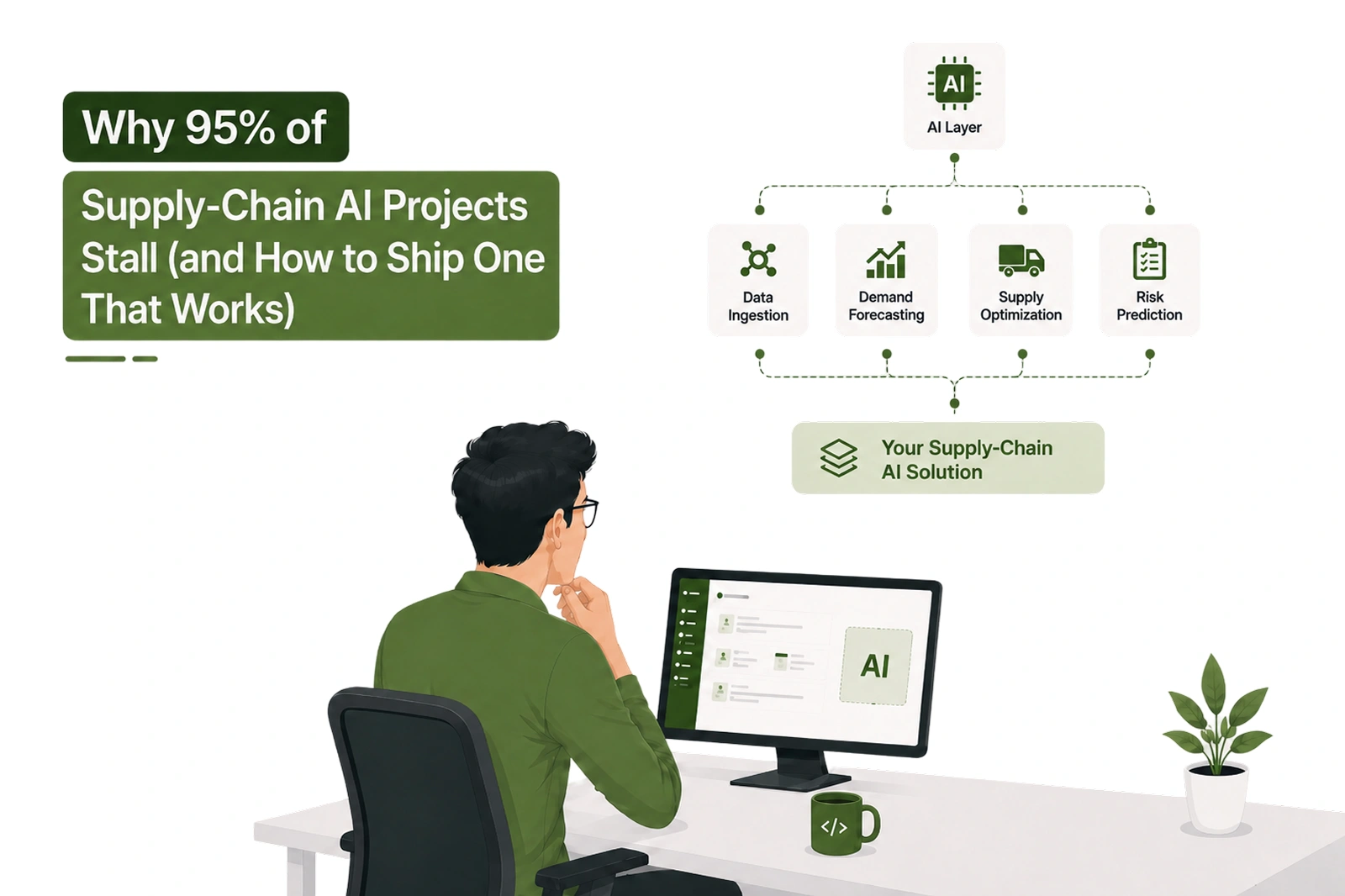
Nearly every logistics and manufacturing leader I talk to in 2026 wants the same machine: one AI that forecasts demand, allocates stock, reroutes trucks, and flags trouble before it lands. It is a great pitch, and it is exactly why most of these projects stall. When a company brings us in for AI consulting on their supply chain, the pilot that already failed almost always tried to do everything at once, on data that was never built for it. The fix is less ambitious and far more effective. Build narrow.
This is a buyer's guide to that shift. I will walk through why the all-in-one "god agent" stalls, which supply-chain jobs AI genuinely does better than the tools you already run, which jobs a plain deterministic solver still beats it at, and how the teams that actually ship draw a clear line for when a human stays in the loop. If you are shopping for AI demand forecasting and route optimization software, this is the difference between a demo that dazzles in the room and a system that survives contact with your real orders.
of enterprises now use AI for demand forecasting
of enterprise GenAI pilots show no measurable P&L impact (MIT)
of supply-chain leaders trust AI for unsupervised critical decisions
Why supply-chain AI pilots stall
The short answer: most pilots stall because they are scoped too broadly and sit on data that was never designed for a model. MIT's 2025 research put a number on the wider problem, roughly 95 percent of enterprise GenAI pilots show no measurable impact on the P&L. In supply chain the failure has a signature. A team scopes one system to forecast demand, rebalance inventory, negotiate with suppliers, and schedule fleets, then wires it into an ERP whose fields were built for accounts payable, not for prediction. The demo runs on hand-picked data and looks brilliant. The first real week breaks it.
That gap between demo and production is the trap, and I have written before about why a demo that works is often the problem, not the proof. A scripted supply-chain demo uses clean, curated records and a happy-path question. Your warehouse does not. It has half-filled fields, three spellings of the same SKU, returns logged as negative orders, and a supplier who emails changes instead of updating the system. None of that shows up in the pitch, and all of it shows up on day one.
The god-agent mistake
The god agent is a single AI asked to own the entire supply chain at once: forecast, allocate, negotiate, schedule, and explain itself, all in one loop. It is the most common design I see, and the most fragile. The failures compound. Every extra responsibility multiplies the ways the system can be wrong, and because the jobs share one model and one context window, a bad forecast quietly poisons the allocation, which poisons the routing. When the output is wrong, nobody can say which part caused it.
There is an accountability problem underneath the technical one. When one agent does everything, no single decision is testable in isolation. You cannot measure the forecast's accuracy separately from the routing's, so you cannot improve either with confidence. You also cannot set a sane approval rule, because "should a human check this?" has a different answer for a small reorder than for renegotiating a freight contract. One box, one blended risk level, no clean way to trust it. That is why these builds rarely graduate from pilot.
The narrow-service pattern that ships
The pattern that ships is boring on purpose: one narrow, single-purpose service, deployed and proven before you build the next. Instead of a god agent, you stand up a demand forecasting service, then an exception-triage service, then a routing service, each with its own inputs, its own accuracy target, and its own human owner. They cooperate through clean interfaces, not through one tangled brain, so a change in one does not silently break the others.
Narrow scope buys you three things a broad build cannot. You can prove value fast, because a single service reaches production in weeks, not quarters. You can measure it, because one job has one clear metric. And you can trust it incrementally, turning up its autonomy as it earns the right. This is the core of how we approach custom AI development: small, testable services that each do one thing well and compound into a system over time.
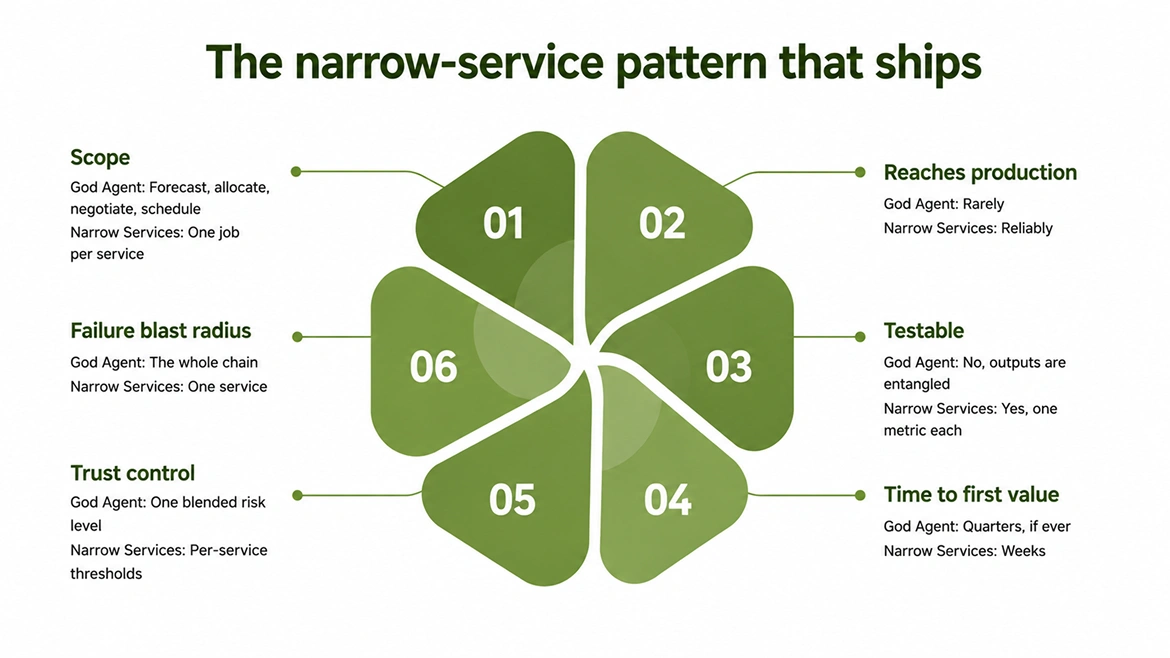
| Dimension | God Agent | Narrow Services |
|---|---|---|
| Scope | Forecast, allocate, negotiate, schedule | One job per service |
| Time to first value | Quarters, if ever | Weeks |
| Testable | No, outputs are entangled | Yes, one metric each |
| Failure blast radius | The whole chain | One service |
| Trust control | One blended risk level | Per-service thresholds |
| Reaches production | Rarely | Reliably |
Where AI genuinely helps: forecasting, triage, routing
AI earns its place in three supply-chain jobs in particular, and it is worth being precise about what it does in each. In all three, the win comes from reading messy, high-volume signal that rules and spreadsheets miss, not from making the final call alone.
- Demand forecasting. This is the clearest win. A trained model reads seasonality, promotions, price changes, weather, and lead-time shifts together and predicts demand better than a moving average ever could. Around 87 percent of enterprises now use AI for forecasting for exactly this reason. It is a prediction problem, which is what machine learning is built for.
- Exception triage. Supply chains generate a flood of exceptions: late shipments, short deliveries, mismatched invoices, supplier emails announcing a change. An AI service can read that unstructured mess, classify each item, draft the response, and route the few that need a person. It clears the noise so your planners work the real problems.
- Routing inputs. AI is excellent at predicting the numbers that routing depends on: how long a stop will actually take, which deliveries will fail, when traffic will bite. It predicts; it does not decide the route. That distinction matters, and the next section explains why.
Where deterministic optimization still wins
Here is the contrarian part buyers rarely hear from an AI vendor: for the actual routing and allocation decision, a deterministic optimizer still beats an LLM, and it is not close. Vehicle routing with hard constraints, time windows, vehicle capacity, and driver-hour limits, is a math problem with a provably good answer. A solver like a mixed-integer or constraint-programming engine finds routes that are feasible and near-optimal every time. An LLM guesses, and a guessed route that violates a driver-hours rule is not a rounding error, it is an illegal dispatch.
So the right architecture pairs them. AI predicts the messy inputs; the solver makes the constrained decision. Ask an LLM to optimize a fleet and you get confident, unverifiable output. Ask it to estimate demand and stop durations, then hand those to a solver, and you get the best of both. Here is how the split tends to land by task.
| Task | Best tool | Why |
|---|---|---|
| Demand forecasting | ML model | Learns nonlinear patterns from history and outside signals |
| Vehicle routing, hard constraints | Deterministic solver | Guarantees feasible, near-optimal routes; math, not a guess |
| Exception triage and summarizing | LLM | Reads unstructured emails and notes, classifies, drafts |
| Inventory allocation under fixed rules | Solver (MILP) | Exact, auditable, repeatable optimization |
| Anomaly detection in telemetry | ML model | Catches patterns across high-volume data at scale |
| Document and invoice extraction | LLM | Pulls structured fields out of unstructured text |
The lesson: do not let "AI" flatten into a single hammer. A serious supply-chain build is a toolbox where machine learning, large language models, and classic operations-research solvers each do the part they are best at.
The data-foundation problem
The quiet killer of supply-chain AI is not the model, it is the data underneath it. Most pilots fail because they run on fields that were designed for accounting and compliance, not prediction. An ERP records what finance needs to close the books. It does not reliably capture the actual delivery time, the real reason a shipment was short, or a clean, single identity for each product across three systems. Feed that to a model and it learns your data-entry habits, not your demand.
This is why our machine learning development work on supply chain usually spends more effort on the data foundation than on the algorithm. Before a forecast is worth anything, you need consistent SKU identities, event dates that reflect reality, exceptions logged as structured data instead of buried in email, and a source of truth for what happened versus what was planned. That work is unglamorous and it is the whole game. A mediocre model on clean data beats a brilliant model on the fields your AP team happened to fill in.
Setting human trust-thresholds
A trust-threshold is the explicit line where the AI acts on its own and where it hands the decision to a person. It is the safety mechanism that lets you deploy at all, and most stalled pilots never defined one. The reason it matters is blunt: only about 10 percent of supply-chain leaders say they trust AI to make critical decisions unsupervised. That is not fear of change, it is a rational read of the stakes. Thresholds turn that caution into a shippable design instead of a veto.
In practice a threshold reads like a rule the business can sign off on. Auto-approve a replenishment order under a set value when model confidence is high; escalate anything larger or less certain to a planner. Let the triage service close routine exceptions on its own; route anything touching a top customer to a human. As the service proves itself, you raise the line and widen its autonomy. This is also how you know it is working, and I have laid out the full method for how to measure AI ROI, because a service you cannot measure is one you cannot trust to run alone.
How we ship supply-chain AI that sticks
Our approach is the opposite of the god agent. We start by finding the one job where a narrow service pays back fastest, usually demand forecasting for a high-value category or exception triage for one busy workflow. We fix the data foundation under that single job, ship a working version in around two weeks, set an explicit trust-threshold, and prove the number before we touch the next service. Boring, sequential, and it reaches production, which the all-in-one build rarely does.
We are a CMMI Level 5 team of 80-plus engineers who have delivered for 700-plus companies across the US, UK, UAE, and Australia, and the supply-chain lesson has been consistent: the winners resist the urge to automate the whole chain in one shot. If you are evaluating AI demand forecasting and route optimization software and want a build that survives your real data instead of a demo that only works on clean slides, tell us what you are trying to fix and we will help you pick the first narrow service worth shipping.
Frequently Asked Questions
Does AI demand forecasting actually beat traditional methods?
Yes, when the data is clean and the scope is narrow. Modern ML models read seasonality, promotions, weather, and other signals that spreadsheets miss, and around 87 percent of enterprises now use AI for forecasting. But a model fed messy, inconsistent history will underperform a simple baseline. The forecast is only as good as the data foundation under it.
Should route optimization use AI or a solver?
For routing with hard constraints, time windows, vehicle capacity, and driver hours, a deterministic solver still wins. It guarantees feasible, near-optimal routes that an LLM cannot. Use AI to predict the inputs, such as demand, travel times, and no-shows, then feed those into the solver. The pattern that ships is AI for prediction, solver for the decision.
Why do so many supply-chain AI pilots fail?
Most stall because teams build one god agent meant to forecast, allocate, negotiate, and schedule at once, on messy data. MIT found roughly 95 percent of enterprise GenAI pilots deliver no measurable P&L impact. Narrow, single-purpose services on a clean data foundation are what actually reach production and hold up.
What is a human trust-threshold in supply-chain AI?
A trust-threshold is the explicit line where the AI acts on its own versus where it hands off to a person. For example, auto-approve a reorder under a set value at high confidence, and escalate anything above it. Only about 10 percent of supply-chain leaders trust AI for unsupervised critical calls, so thresholds are how you ship safely.
How long does the first supply-chain AI service take to build?
A single, well-scoped service, say demand forecasting for one product category or exception triage for one workflow, is usually a few weeks of work once the data is accessible, not a year. We often ship a first working version in around two weeks. The data cleanup is the variable that moves the timeline.
Have a project in mind? Let's scope it together.
You get a named team, written estimates, full code and IP ownership, and 48-hour response times. CMMI Level 5 certified. 700+ projects delivered across the UK, US, UAE, and Australia.