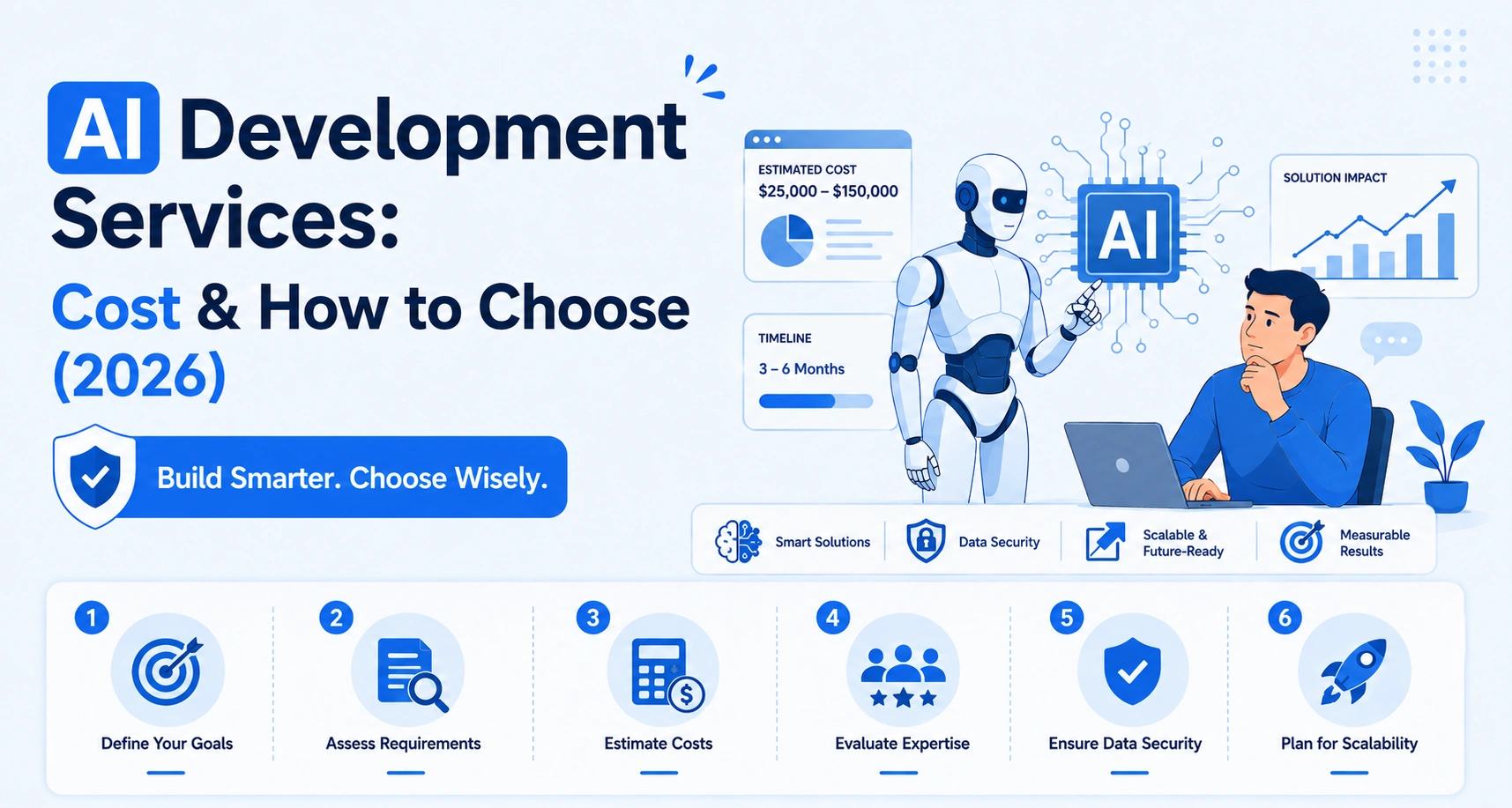
Most buyers approach AI development the wrong way — they evaluate vendors on the pitch deck rather than the process. This guide covers what AI development services actually include, what they cost across different engagement models, and the six questions that actually predict whether a project survives contact with real data.
The number that matters more than the price tag: Roughly 56% of CEOs report zero financial impact from AI so far, and only about a quarter of organizations have converted 40% or more of their AI pilots into production. Most of that gap is not a pricing problem. It’s a scoping problem — the PoC never had a clear metric to graduate against in the first place.
The phrase “AI development services” covers a lot of ground. It includes everything from a four-week proof of concept testing a single prediction model to a twelve-month engagement building a production-grade multi-agent system with its own monitoring infrastructure. Knowing what you’re actually buying — and how to tell whether a vendor can deliver it — matters more than any comparison table of tech stacks.
This guide answers the questions buyers actually search for: what the work involves, what it costs, whether offshore means lower quality, and what a real vendor-vetting checklist looks like.
| Quick Reference | |
|---|---|
| Scope | Strategy, custom ML, generative AI, computer vision, AI agents, MLOps |
| Typical cost range | $3,000 (scoped PoC) to $24,000+ (enterprise build) |
| Engagement models | Fixed price, dedicated team, staff augmentation |
| MVP timeline | 6–12 weeks (single use case, clean data); 4–6 months (multi-source, compliance-heavy) |
| Quality signal | CMMI Level 5 process maturity, ISO 27001, SOC 2 |
| Most common failure mode | Scoping problem — no clear success metric before building |
| Shanti Infosoft track record | 700+ projects, CMMI Level 5, 4.9-star Clutch rating |
What Are AI Development Services, Exactly?
AI development services are the work of designing, building, and maintaining AI systems that solve a specific business problem — as opposed to buying an off-the-shelf tool and hoping it fits. A generic chatbot plugin and a custom-trained support agent that actually knows your product catalog are both “AI,” but only one of them was built for you.
In practice, the category breaks into six areas:
- AI strategy and consulting — figuring out which use case is actually worth building, before any code gets written.
- Custom machine learning development — models trained on your data for prediction, classification, or forecasting.
- Generative AI and LLM integration — chatbots, content generation, and retrieval-augmented systems grounded in your own documents.
- Computer vision — object detection, quality inspection, OCR, and similar visual tasks.
- AI agents — systems that don’t just answer questions but complete multi-step tasks: booking, routing, escalating, updating records.
- MLOps and LLMOps — the monitoring, retraining, and versioning layer that keeps a model accurate after launch instead of quietly drifting.
Most vendors are strong in two or three of these and thin everywhere else. Ask a prospective partner to walk you through a real project in each category they claim — not just the two they pitch first.
What Does an AI Development Company Actually Do, Day to Day?
The work moves through five stages: readiness assessment, proof of concept, build, deployment, and ongoing MLOps. Skipping the first two is where most AI projects quietly go sideways.
The readiness assessment sounds like a formality. It isn’t. It’s where a good partner tells you your data isn’t clean enough yet, or that the use case you picked won’t move a number the business actually tracks. A partner who skips straight to “let’s build” is optimizing for a signed contract, not for your outcome.
At Shanti Infosoft, that discipline comes from operating as a CMMI Level 5 organization — the highest tier on the model. In practice, it means every AI engagement runs through a documented process: a defined intake, a PoC with a go/no-go checkpoint before the full build, and a deployment plan that includes monitoring from day one. Across 700+ delivered projects for clients in the US, UK, UAE, Australia, and Canada, the projects that failed weren’t the technically hard ones. They were the ones where the client and the vendor skipped the readiness conversation and jumped to building.
The proof-of-concept stage is where assumptions meet real data. You test the highest-priority use case, set a performance baseline, and get an honest go or no-go before spending real budget on a full build. A partner who has never told a client “this isn’t ready yet” is a partner who hasn’t been doing this long enough.
How Much Do AI Development Services Cost in 2026?
There is no single number, because “AI development” spans a $3,000 chatbot prototype and a $45,000 enterprise fraud-detection platform. What actually drives cost is the engagement model you pick, not just the project size.
| Engagement Model | Best For | Typical Cost Logic |
|---|---|---|
| Fixed price | Well-defined scope, single use case, clear success criteria | Priced against a fixed spec; cheapest per feature, least flexible if requirements shift |
| Dedicated team | Ongoing AI product development, multiple use cases over time | Monthly rate per role (ML engineer, data engineer, PM); scales with headcount, high flexibility |
| Staff augmentation | You have in-house AI leadership but need extra hands | Hourly or day rate per specialist slotted into your existing team and process |
Real generative AI project pricing runs roughly $3,000 to $24,000-plus depending on scope — which tracks with what we see across fixed-price PoCs versus full production builds. The number that should worry you more than the price tag: roughly 56% of CEOs report zero financial impact from AI so far, and only about a quarter of organizations have converted 40% or more of their AI pilots into production. Most of that gap is not a pricing problem. It’s a scoping problem, where the PoC never had a clear metric to graduate against in the first place.
If a vendor gives you a number without asking about your data quality, your integration points, or your success metric first, that number is a guess.
Not sure which engagement model fits your project?
We’ll scope it with you, ask the right questions about your data, and give you a straight answer on what a realistic PoC looks like — before anyone signs anything.
Book a Free Scoping CallIn-House vs. Outsourced AI Development — Which Is Right for You?
Build in-house if AI is a core, durable competitive advantage tied to proprietary data you’ll keep improving for years. Outsource, or go hybrid, if you need speed, specialized skills you don’t have time to hire for, or compliance expertise your team hasn’t built yet.
Three questions settle it faster than a long pros-and-cons list:
- Will this AI capability still matter in three years, or is it a one-off project? Durable advantage leans in-house eventually, even if you outsource the first build.
- Do you have the data infrastructure already, or does someone need to build that too? If the answer is “someone needs to build that too,” you’re not choosing a model trainer. You’re choosing a partner who can also do data engineering.
- Can you hire and retain ML engineers faster than a specialist firm can staff your project? For most companies outside Big Tech, the honest answer is no.
Infrastructure and compute for serious AI development are expensive to stand up from scratch, and hiring senior ML talent takes months in most markets. A dedicated team model gets you that expertise on week one instead of month four. We’ve written more on how to weigh this trade-off in our full breakdown of in-house vs. outsourced AI development.
Is an India-Based, CMMI Level 5 AI Partner a Compromise on Quality?
No, and the assumption that it is has gotten more outdated every year. CMMI Level 5 certification measures process maturity, not geography — and it is the same standard whether the team sits in San Francisco or Indore.
Here is the part most vendor comparison guides skip: they are written by US or European agencies, for US or European buyers, and the “offshore” question never comes up because it is not their question to answer. But it is a real question a lot of founders and CTOs are actually searching for, and avoiding it does not make the decision easier.
What actually determines quality is process discipline, not location: documented QA gates, code review standards, security certifications, and whether the team you are pitched is the team you will actually work with. Shanti Infosoft has delivered 700+ projects at CMMI Level 5 maturity with a 4.9-star Clutch rating, for clients across the US, UK, UAE, Australia, and Canada — working across time zones that most clients initially assume will be a problem and stop worrying about within the first sprint. The cost advantage of an India-based team is real: it typically runs 40–60% lower than US or Western European rates for comparable seniority. But that is a side effect of the market, not the reason to hire one. The reason is the same reason you would hire any partner: can they show you a process, and can they show you the receipts.
Ask any AI vendor, regardless of location, for two things: a case study in a domain close to yours, and a straight answer on which specific engineers will be on your project. If either answer is vague, the geography was never the risk.
The Real Checklist: How to Vet an AI Development Company
Most “how to choose an AI partner” checklists repeat the same six generic items. Here is the shorter, sharper version that actually predicts whether a project survives contact with real data.
- Ask for a case study in your domain, not just a portfolio page. A polished logo wall tells you nothing. A specific result in an industry close to yours tells you they have hit your kind of edge cases before.
- Ask who is assigned to your project by name and seniority, and whether they stay through delivery. Mid-project turnover is one of the most common, least-discussed reasons AI initiatives lose momentum.
- Ask how they handle MLOps after launch. A team that cannot describe retraining schedules, drift monitoring, or prompt versioning is building something that looks good in the demo and degrades quietly in production.
- Check for real certifications, not just claims. CMMI Level 5, ISO 27001, SOC 2 — whatever is relevant to your data sensitivity. Ask to see the certificate, not just the badge on the homepage.
- Watch for the “thin wrapper” red flag. If every answer routes back to “we’ll just call an API and prompt it,” you are paying custom-development rates for something you could build with a weekend and a tutorial.
- Get a clear PoC exit criterion in writing before you sign anything larger. If nobody can tell you what “PoC succeeded” looks like in numbers, the full build is being sold on hope.
We go deeper on the interview questions worth asking directly in 10 questions to ask an AI development company.
How Long Does an AI MVP Actually Take?
A focused AI MVP — one use case, clean-enough data, a single integration point — typically takes six to twelve weeks from kickoff to a working pilot. Add multiple data sources, compliance review, or a multi-agent system, and that stretches to four to six months.
The variable that moves the timeline more than anything else is not team size. It is data readiness. A team that starts building the week your data is actually clean will beat a bigger team that started three weeks earlier on messy data — every time — because half of that head start gets spent discovering the mess mid-build instead of before it.
AI Consulting vs. AI Development — Are They the Same Thing?
No. AI consulting is the strategy layer: figuring out which use case is worth pursuing, whether your data supports it, and what the realistic ROI looks like before anyone writes a line of model code. AI development is the build layer that comes after.
You want consulting first if you are still validating feasibility and do not yet have a scoped use case. You want development first only if the use case, data, and success metric are already nailed down — which, if you are being honest, is rarer than most teams think. Our AI consulting service page covers how we run that first stage before any development work starts.
Not sure whether you need consulting or development first?
We run a structured readiness assessment that tells you which use case is worth building, whether your data supports it, and what success looks like in numbers — before any build starts.
Book a Free AI Readiness Call Send Us a MessageFAQ
The Short Version
AI development services span consulting, custom ML, generative AI, computer vision, AI agents, and MLOps — priced through fixed-price, dedicated-team, or staff-augmentation models running roughly $3,000 to $24,000-plus depending on scope. The decision that matters more than budget is picking a partner with real process discipline, documented in certifications like CMMI Level 5, not picking based on geography. Read more on our AI development services page.
If an LLM-powered use case is what you are evaluating, explore our generative AI development service for more on how we approach RAG, fine-tuning, and production LLM deployment.
Ready to build AI that actually moves a number?
Start with a free readiness call — we’ll tell you whether your use case is ready to build, and what it would take to get there. Shanti Infosoft has delivered 700+ projects at CMMI Level 5 maturity across the US, UK, UAE, Australia, and Canada.
Book Your Free Readiness Call →