
Most brokerages I talk to do not need an AI strategy. They need a build order. The question is no longer "should we use AI" - 97 percent of agents already do, and PropTech drew 16.7 billion dollars in funding in 2025 - it is "what do we automate first, and what do we leave alone." Get that sequence wrong and you burn budget on a flashy tool nobody adopts. Get it right and each build pays for the next. When a brokerage hires us for AI integration, my first job as the person running delivery is not to pick a model. It is to put the work in the right order.
So this is a sequencing playbook, not a tool list. I will give you the exact order we build in - lead qualification first, then transaction coordination, then document abstraction - and the line we draw between the repeatable 80 percent you should automate and the human 20 percent you should protect. The short version: automate the admin, keep the negotiation.
of real estate agents now use AI tools in their business, up from 80 percent in 2024
in PropTech funding in 2025, up roughly 68 percent year over year
field-level accuracy when AI abstracts the 40 to 60 documents in one transaction
What to automate first in a brokerage
The short answer: start with lead qualification, then transaction coordination, then document abstraction. That order is not arbitrary. You automate the highest-volume, most repeatable, lowest-risk task first, because it pays back quickest and it teaches your team how these systems behave before anything touches a live contract. Lead qualification is that task. Every brokerage has more inquiries than agents can chase, and most of the work is the same handful of questions asked over and over.
The mistake I see most is starting at the glamorous end - an AI that "writes offers" or "predicts the market" - while agents still lose leads because nobody answered the website chat at 9pm. Fix the boring, high-frequency work first. That is where the hours actually leak, and it is the fastest thing to prove.
The build sequence, and why this order
Three builds, in order, each one setting up the next. Here is the logic in plain terms.
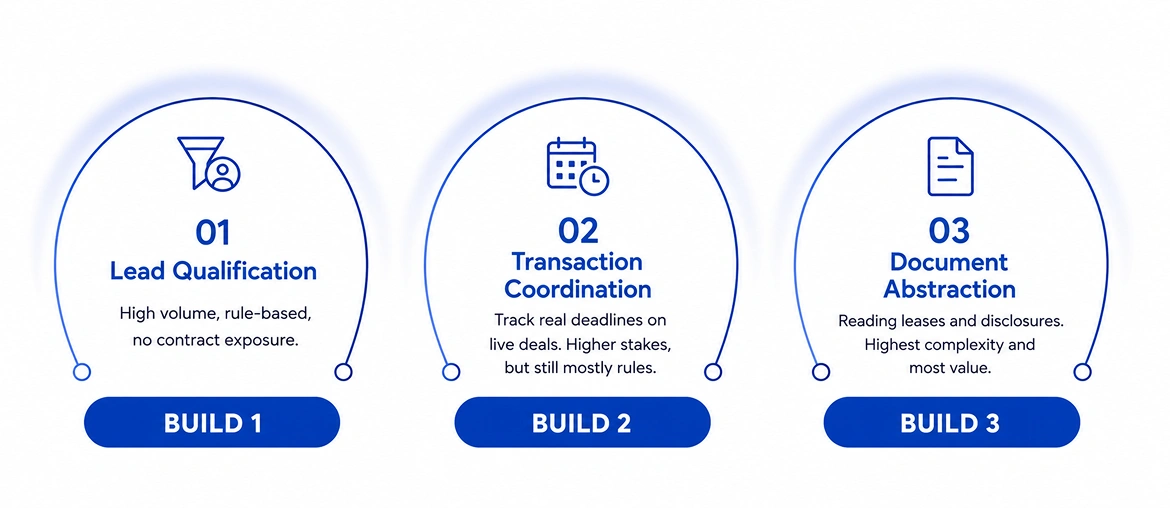
- 1. Lead qualification (weeks, low risk). High volume, rule-based, no contract exposure. The fastest payback and the safest place for your team to learn how AI behaves.
- 2. Transaction coordination (higher stakes). Now you are tracking real deadlines on live deals, so accuracy matters more, but the logic is still mostly rules and dates.
- 3. Document abstraction (highest complexity). Reading leases and disclosures is the hardest to get right and the most valuable, so you do it once the team already trusts the first two systems.
Notice the pattern: risk, value, and complexity all climb as you move down the list, and so does the trust you have earned to run each layer. Skipping to build three on day one is how pilots stall. Earn it in order.
Build one: the lead-qualification chatbot
A lead-qualification chatbot sits on your website and listing pages, talks to a new inquiry the moment it lands, and captures the four things an agent actually needs: budget, timeline, financing status, and area or property type. Then, and this is the part that matters, it hands the agent a structured intent summary, not a raw transcript. "Pre-approved buyer, 650k to 720k, wants a 3-bed in the north suburbs, ready in 60 days" beats a name and a phone number every single time.
Two reasons this goes first. Speed: leads that get a reply in minutes convert far better than ones that wait until morning, and a bot never sleeps. Structure: when the agent picks up, they are not starting cold, they are continuing a qualified conversation. This is exactly the kind of AI chatbot development that earns its keep, because it turns a form fill into a briefed handoff. The bot does the intake. The agent does the relationship.
Build two: the transaction-coordination agent
A transaction-coordination agent tracks the 30-plus deadlines between an accepted offer and closing so none of them slip. A single deal carries inspection periods, the appraisal, loan and title contingencies, the earnest-money deadline, disclosure delivery, HOA document review, and the final walk-through, each with its own date and several with money attached if you miss them. That is a tracking problem, and tracking is exactly what software does not get tired of at 11pm on a Friday.
This is the build that protects real money. A missed contingency date can forfeit a deposit or hand the other side a clean way out of the deal. The agent here watches every date, sends the reminder before it matters, and flags the item drifting while there is still time to act. It is worth being precise about the word agent, because a coordination agent is not a chatbot; it takes actions and follows a process rather than just answering, which is exactly the difference between a chatbot and an agent. What it does not do is negotiate the extension. It makes sure a human knows one is needed.
Build three: document abstraction
Document abstraction means using AI to read the leases, disclosures, purchase agreements, and title reports in a deal and pull the fields that matter - dates, parties, amounts, and specific clauses - into your CRM without anyone retyping them. A single transaction can involve 40 to 60 documents, and in production, field-level extraction runs around 98 to 99 percent accuracy when the pipeline is built and reviewed properly.
This comes last for a reason: it is the hardest and the most regional. A disclosure form in one state is not the one next door, lease clauses vary, and a wrong date here has consequences. So this is genuinely custom AI development, not an off-the-shelf toggle, and we always keep a person reviewing anything that changes money or a deadline. Automate the reading and the pre-fill; keep the human on the sign-off. Done right, it turns hours of manual data entry per deal into a quick review.
The 80/20: automate the repeatable, keep negotiation human
Here is the rule that keeps a rollout honest: automate the repeatable 80 percent, keep the human 20 percent human. The 80 percent is the admin - qualifying, tracking, reading, following up. The 20 percent is where deals are won or lost: pricing strategy, negotiation, and the emotional work of guiding someone through the biggest purchase of their life. A bot cannot read a seller's hesitation or talk a nervous buyer off a ledge, and it should not try. This is the split I walk every brokerage through before we build a thing.
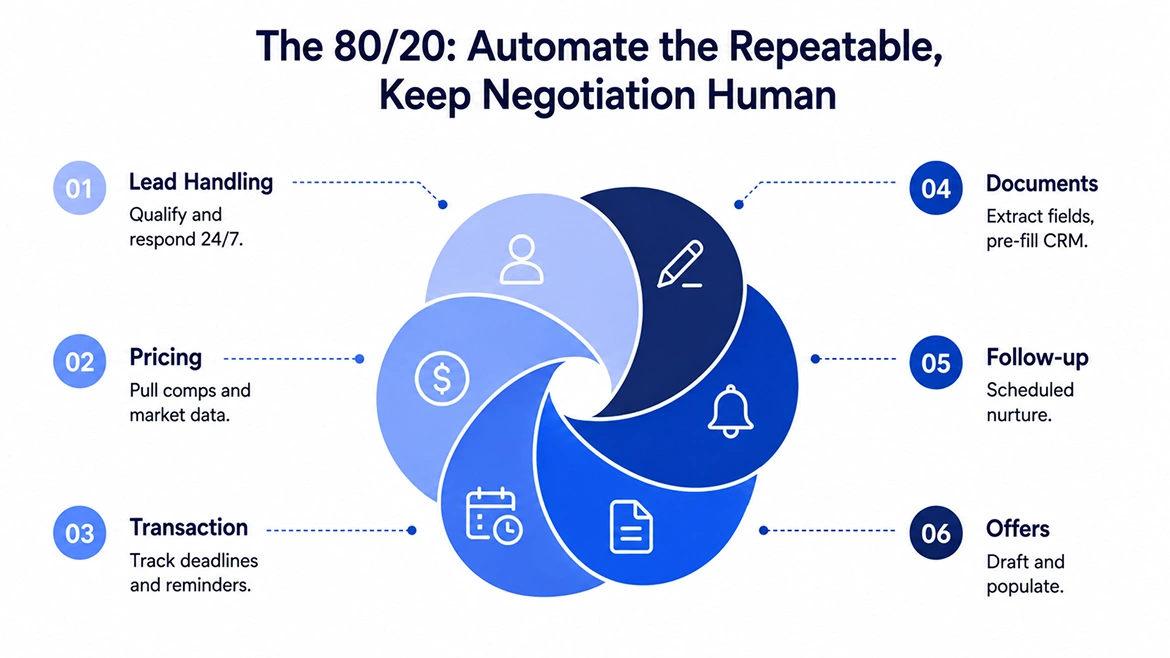
| Part of the deal | Automate (the 80%) | Keep human (the 20%) |
|---|---|---|
| Lead handling | Qualify, capture intent, respond 24/7 | Building the relationship and trust |
| Pricing | Pull comps and market data | The pricing strategy and the recommendation |
| Transaction | Track 30-plus deadlines, send reminders | Negotiating extensions and resolving disputes |
| Documents | Extract fields, pre-fill the CRM | Signing off on anything touching money or dates |
| Follow-up | Scheduled nurture and reminders | The hard call when a deal is falling apart |
| Offers | Draft and populate the paperwork | The negotiation itself |
Integrations and data quality: CRM and MLS
None of these builds are worth much in a silo. The value shows up when the qualification bot, the coordination agent, and the document reader all read from and write to the same place - your CRM and your MLS. Most brokerages run a CRM such as Follow Up Boss, kvCORE, or BoomTown and pull listing data from the MLS through its API. The integration work is what turns three clever tools into one system where nobody re-keys anything.
And here is the unglamorous truth: the whole thing is only as reliable as your data. If your CRM is full of duplicate contacts and stale listing statuses, the AI will confidently act on bad information. Before you automate, clean up. We spend more delivery time on data plumbing and de-duplication than most clients expect, because that is where reliability is actually decided, not in the model.
Rolling it out without losing the room
Roll it out in phases, one build at a time, and let each one earn trust before you add the next. The failure mode is the big-bang launch: three systems at once, agents overwhelmed, quiet abandonment within a month. Instead, ship the qualification bot, let agents feel it save them time, then add coordination, then documents. Adoption is the whole game. The best system nobody uses returns nothing.
Set your human gates explicitly, measure the things that matter - speed to lead, deadlines caught, hours saved per deal, and agent adoption - and expand from there. Done in this order the gains stack, and the payoff shows up in the same place any AI impact on business growth shows up: agents spending more time selling and less time on admin.
We are a CMMI Level 5 team of 80-plus engineers who have delivered for 700-plus companies, and the pattern holds across every rollout I have run: sequence beats scope. If you are weighing where to start in your brokerage, tell us what your team spends its day on and we will map the build order with you. It almost always starts with the lead nobody answered last night.
Frequently Asked Questions
What should a real estate brokerage automate first?
Start with lead qualification. A chatbot on your site and listings can capture budget, timeline, financing status, and area, then hand the agent a structured intent summary instead of a raw name. It is the highest-volume, most repeatable task, it pays back fastest, and it teaches your team how these systems behave before you touch a live deal.
Will AI replace real estate agents?
No. AI handles the repeatable 80 percent, meaning qualification, deadline tracking, document reading, and follow-up, so agents spend more time on the 20 percent that wins business: pricing strategy, negotiation, and steadying a nervous buyer or seller. The brokerages pulling ahead are not cutting agents. They are removing the admin drag that keeps agents off the phone.
What is a transaction-coordination agent?
It is software that tracks the 30-plus deadlines between an accepted offer and closing: inspection, appraisal, loan and title contingencies, disclosure delivery, and the walk-through. It watches the dates, sends reminders, and flags anything at risk of slipping. A missed contingency can kill a deal or forfeit a deposit, so this is where automation protects real money.
How accurate is AI at reading real estate documents?
In production, field-level extraction on leases, disclosures, and purchase agreements runs around 98 to 99 percent when the pipeline is built and reviewed properly. That is accurate enough to pre-fill your CRM and flag key dates, but not to remove the human. We keep a person reviewing anything that changes money or a deadline.
How long does it take to roll out AI in a brokerage?
Plan in phases, not one big launch. A first lead-qualification chatbot can be live in about two weeks; transaction coordination and document abstraction each take longer because they touch contracts and integrations. Most brokerages get the first build in front of agents inside a month, then add the next piece once the team trusts the first.
Have a project in mind? Let's scope it together.
You get a named team, written estimates, full code and IP ownership, and 48-hour response times. CMMI Level 5 certified. 700+ projects delivered across the UK, US, UAE, and Australia.