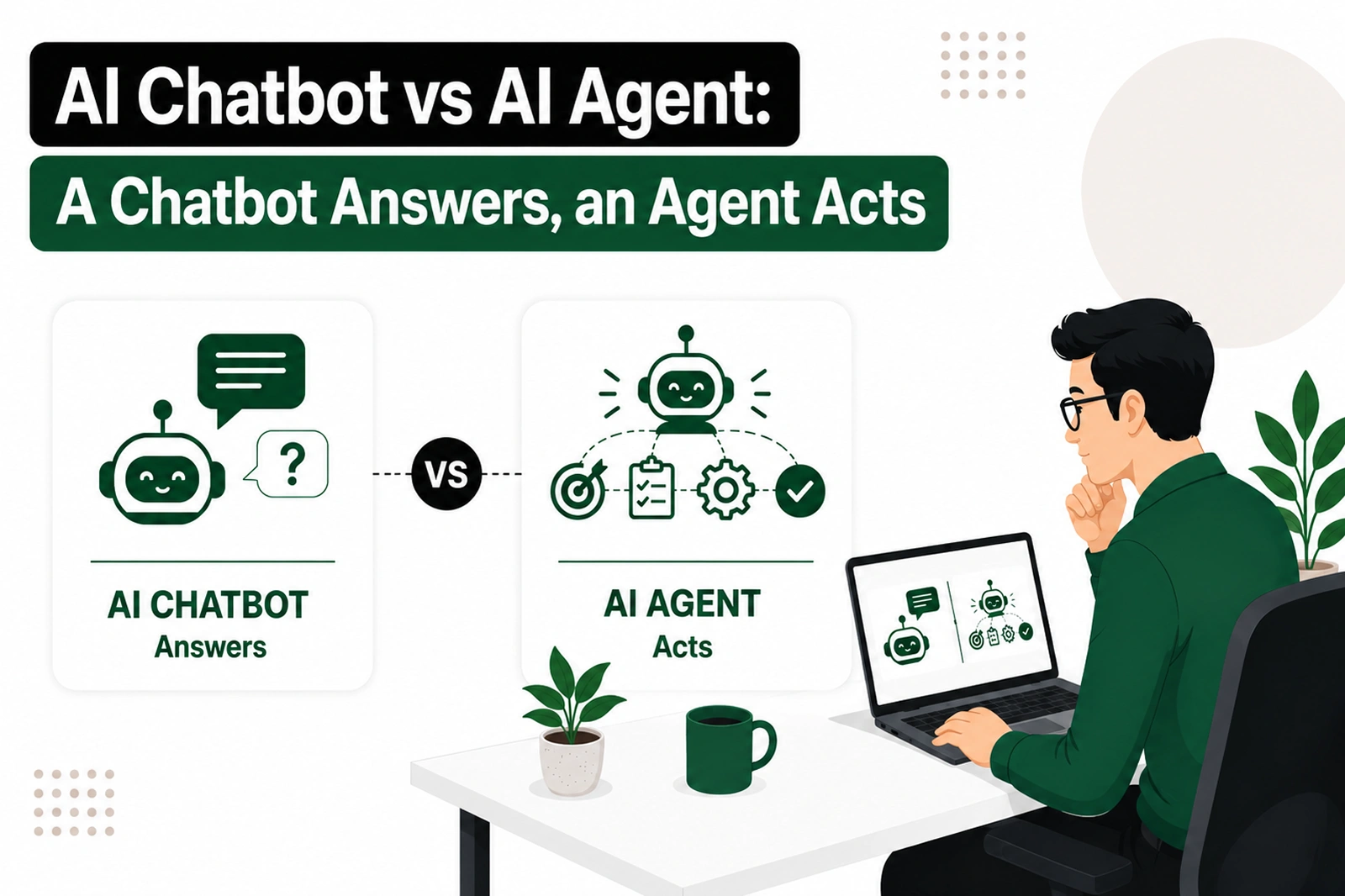
Everything is being called an "AI agent" right now. The chatbot on a pricing page, the autocomplete in a writing tool, a script that calls one API - all suddenly "agents." It muddies a real and useful distinction, and it leads founders to pay agent prices for chatbot work, or to expect chatbot reliability from something that can actually take actions on their behalf. We build both, and when a client comes to us for AI chatbot development or a full agent, the first thing we do is figure out which one the problem actually needs.
So let me draw the line cleanly, because the difference is not academic. It changes what you scope, what you budget, and how much you have to worry about it doing something wrong. The short version: a chatbot answers, an agent acts. You ask a chatbot and it replies with words, and that is the end of it. An agent can plan a multi-step task, call tools and systems, decide as it goes, and change something in the real world.
What a real agent build typically costs versus a grounded chatbot for the same domain
Share of repetitive support tickets a well-grounded chatbot can deflect on its own
All it takes to pick the right tool - "answer" points to a chatbot, "do" points to an agent
What exactly is an AI chatbot?
A chatbot is a conversational interface that takes a question and returns an answer. It can be very smart - powered by a strong language model, grounded in your documents so it answers from real facts - but its job ends at the reply. It reads your content and talks; it does not reach into your booking system or your CRM and change anything.
This is not a put-down. A good chatbot is genuinely useful and far cheaper to build and run. Most "we need AI on our website" requests are, correctly scoped, chatbot requests. Where chatbots earn their keep:
- Answering FAQs and policy questions from your own content.
- Helping people find the right product, page, or document.
- First-line support that deflects the repetitive 60 to 70 percent of tickets.
- Internal knowledge lookup so staff stop pinging each other for the same answer.
To answer from your real, current data instead of guessing, most serious chatbots use retrieval. If that term is new, our explainer on RAG versus fine-tuning versus prompt engineering covers how a bot gets grounded in your facts, which is the single biggest factor in whether a chatbot feels trustworthy or makes things up.
What exactly is an AI agent?
An agent is a system that takes a goal, breaks it into steps, uses tools to act, observes the result, and keeps going until the goal is met or it hits a limit you set. The model is the brain, but the agent is the brain plus hands - access to tools, the ability to decide which tool to use, and a loop that lets it act, check, and adjust.
The defining word is "act." An agent does not just tell a patient the next open slot. It checks the calendar, books the slot, sends the confirmation, and flags the front desk if something looks off. That capability is powerful, and it is exactly why agents carry more cost, more risk, and more need for guardrails than a chatbot. What separates a real agent from a chatbot wearing the label:
- Tool use. It calls APIs, queries databases, and triggers workflows, not just generates text.
- Planning. It decides the sequence of steps instead of following one hard-coded path.
- Memory and state. It carries context across steps, so step four knows what happened in step one.
- Autonomy with boundaries. It acts on its own within limits you define, and escalates when it should not decide alone.
Chatbot vs agent: how do they compare?
Here is the side-by-side we walk clients through. The pattern is consistent: agents do more, and in exchange they cost more, take longer, and demand more care. Read it top to bottom and you can usually feel which column your project lives in.
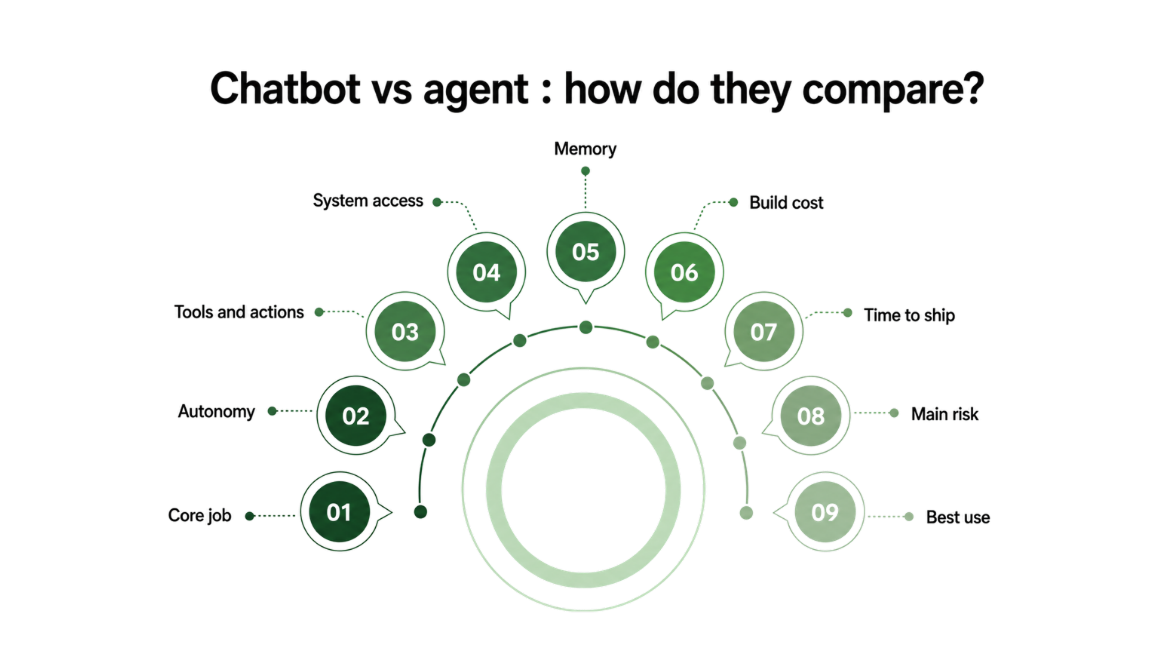
| Dimension | AI Chatbot | AI Agent |
|---|---|---|
| Core job | Answers questions | Completes tasks and takes actions |
| Autonomy | None - one turn, then waits | Plans and acts across steps on its own |
| Tools and actions | None - reads content, replies | Calls APIs, books, updates, sends |
| System access | Read-only (your content) | Read and write (CRM, calendar, APIs) |
| Memory | Within a conversation | Across steps and tool calls (task state) |
| Build cost | Lower | 2x to 3x higher |
| Time to ship | Weeks | Weeks to months |
| Main risk | A wrong answer | A wrong action with real consequences |
| Best use | Support, FAQ, search, info | Scheduling, data entry, workflows, ops |
Which one should you build for your need?
Match the tool to the verb in your problem. If the thing you want is fundamentally "tell people something" or "answer questions," build a chatbot - cheaper, faster, lower risk. If the thing you want is "do something" - move data between systems, complete a booking, process a request end to end - you need an agent, and you should budget for the extra rigor. A quick way to decide:
- Write the outcome as a verb. "Answer" and "explain" point to a chatbot. "Book," "update," "process," "route," and "reconcile" point to an agent.
- Ask what happens if it is wrong. A wrong sentence is recoverable. A wrong action - a double-booked patient, a wrongly refunded charge - costs real money or trust. Higher stakes mean more guardrails, which means agent-grade work.
- Count the systems it must touch. Zero or read-only means a chatbot. Writing into one or more live systems means an agent.
- Be honest about your data and process. An agent automating a broken process just breaks it faster. Fix the process, or scope a chatbot first.
A concrete example from our work. A client asked for an "AI agent" for their support inbox. We dug into what they actually needed, and most of it was answering the same product questions over and over - a chatbot job. So we shipped a grounded chatbot first. It deflected the bulk of repetitive tickets in a few weeks at a fraction of the cost. Only then did we look at the one workflow that genuinely needed action, issuing a specific kind of refund within strict limits, and built a narrow agent for just that, with a hard cap and a human approval step above a threshold. Same project, two tools, money spent in the right order. Had we built the full agent on day one, we would have spent three times as much to automate work the chatbot already handled. The same "chatbot first, focused agent second" pattern is what we followed when we built AI for dental practices, where the answer side and the booking side had very different risk profiles.
What about cost and complexity?
The cost gap is real, and it is mostly not the model - it is everything around the model. A chatbot's complexity is largely retrieval and conversation quality. An agent adds tool integrations, permission and safety layers, state management, error handling for when an action half-completes, and a lot more testing, because you are now testing actions in live systems, not just sentences. Rough shape of where the effort goes on an agent build, from our projects:
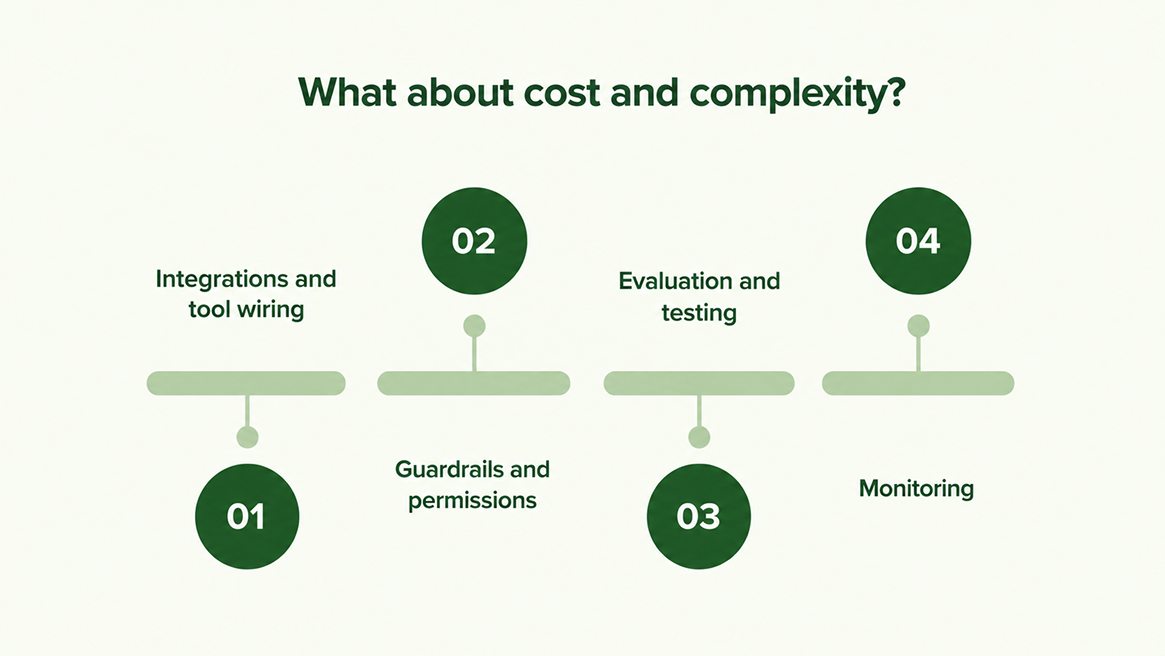
- Integrations and tool wiring - often the largest chunk, because every system has its own quirks.
- Guardrails and permissions - what it may do alone, what needs a human, and hard limits it cannot cross.
- Evaluation and testing - far heavier than a chatbot, because a bad action is not just a bad answer.
- Monitoring - you need to see what the agent did, not just what it said, so you can catch problems fast.
None of this means agents are not worth it. When the task is repetitive, high-volume, and currently eating staff hours, an agent pays for itself quickly. It just means you should not pay agent prices when a chatbot solves the actual problem, and you should not expect a chatbot budget to deliver something that safely acts on your systems. If you want to see how these scope decisions shake out across real projects, our write-up on custom AI development walks through how we size the work before a line of code gets written.
How we approach this at Shanti Infosoft
We start by pinning down the verb. If your need is to answer and inform, we build a grounded chatbot and keep it lean. If your need is to act, we scope a proper agent with the guardrails, permissions, and monitoring that acting on real systems demands - and we are upfront when a cheaper chatbot would do the job just as well. Most of our engagements end up as a chatbot first, then a focused agent for the one or two actions that genuinely move the needle.
If you are trying to figure out which side of this line your idea sits on, tell us the outcome you want and we will tell you straight whether you need an answer or an action, and what it actually takes to build it well.
Frequently Asked Questions
What is the difference between an AI chatbot and an AI agent?
A chatbot answers questions with words and stops there. An AI agent takes a goal, plans the steps, uses tools to act on real systems, and completes a task - it books the appointment, updates the record, sends the email. A chatbot informs. An agent does. That single capability, taking action, is the whole distinction.
Is an AI agent just a chatbot with extra features?
No. An agent adds tool use, planning, memory across steps, and bounded autonomy so it can act on live systems. A lot of what is marketed as "agentic" is really a chatbot with one API call bolted on. If it cannot take a multi-step action without a human clicking through every step, it is a chatbot with better marketing, not an agent.
Which is cheaper to build, a chatbot or an agent?
A chatbot is cheaper and faster - usually weeks, with light guardrails. An agent typically costs 2x to 3x more for the same domain because of tool integrations, permission layers, state handling, and far heavier testing, since you are now testing real actions in live systems, not just sentences. Budget for the extra rigor before you start.
Do I actually need an AI agent, or will a chatbot do?
Write your outcome as a verb. "Answer" or "explain" means a chatbot. "Book," "update," "process," or "reconcile" means an agent. Then ask what a mistake costs: a wrong sentence is recoverable, a wrong action costs money or trust. Most "we need an AI agent" requests are, correctly scoped, chatbot jobs.
Can I start with a chatbot and upgrade to an agent later?
Yes, and we recommend it. Ship a grounded chatbot first to prove the model understands your domain and that people use it, then graduate the one or two highest-value actions into a focused agent. You de-risk the expensive build by learning on the cheap one, and you avoid paying agent prices for work a chatbot already handles.
Have a project in mind? Let's scope it together.
You get a named team, written estimates, full code and IP ownership, and 48-hour response times. CMMI Level 5 certified. 700+ projects delivered across the UK, US, UAE, and Australia.