If you have been researching AI development services cost in India, you have probably seen quotes ranging from $5,000 to $45,000 on what sounds like the same project. That gap is not random — it reflects the genuine range of what AI development involves depending on what you are building, how prepared your data is, and who you are working with. This guide covers commercial AI product development and walks through what drives cost, shares estimates with honest caveats, and gives you a framework for evaluating any number you receive.
From our engagements: For a US-based fintech client, we built a RAG pipeline that ingested regulatory documentation and surfaced compliance guidance directly inside their workflow tool — a 40% reduction in manual document review time, delivered within a four-month engagement. For a UK healthcare startup, we developed a symptom classification model integrated with their patient intake system, deployed within 14 weeks on a budget that would have covered roughly two months of a single US-based ML engineer.
Quick Answers
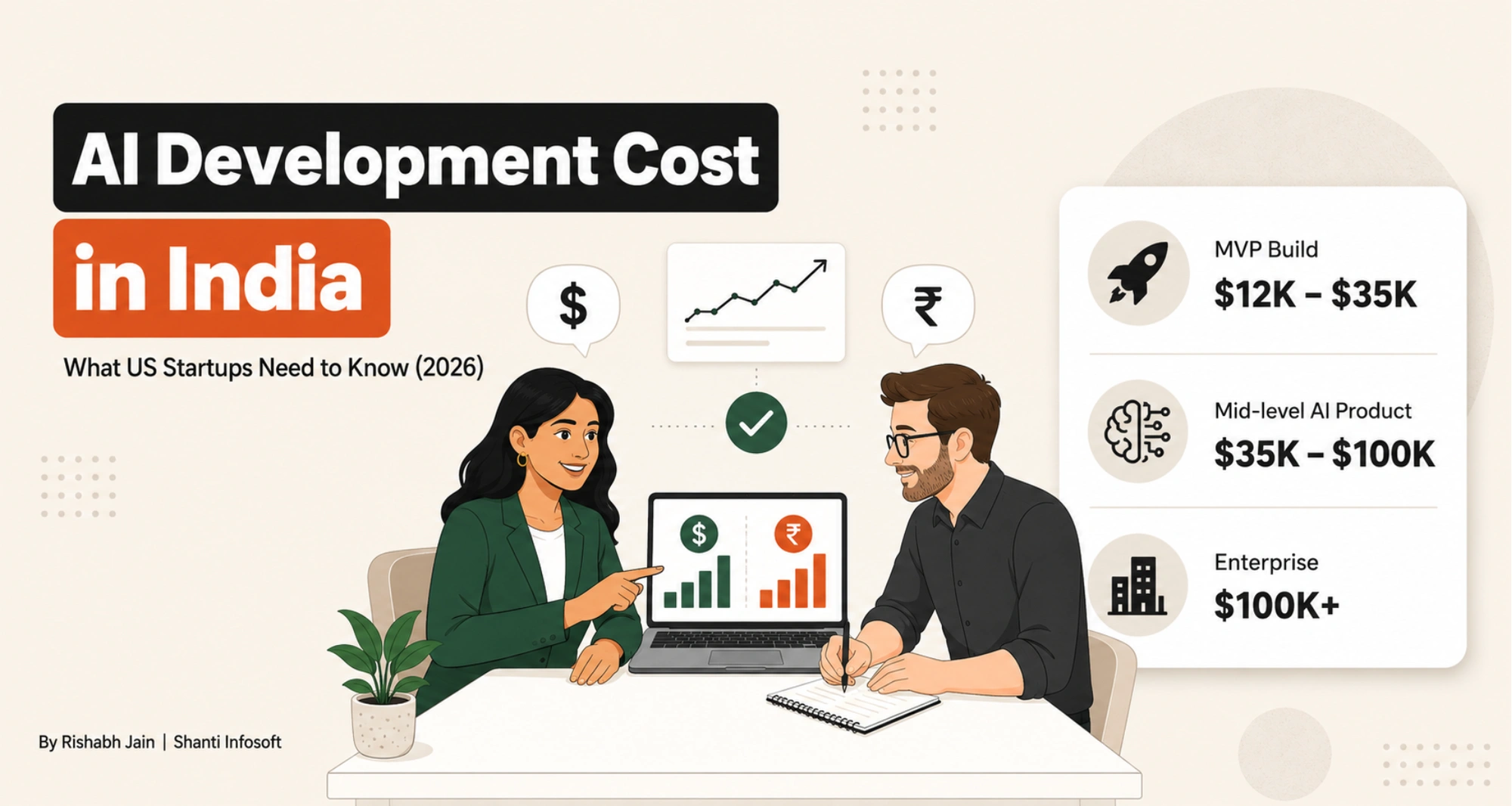
How much does AI development cost in India? For a startup-level AI MVP, budget $12,000 to $21,000. Mid-level AI products with custom models and multiple integrations typically run $21,000 to $35,000. Enterprise-grade systems start at $35,000 and scale upward depending on model complexity, compliance requirements, and infrastructure scope.
Why does the cost vary so much? AI development cost in India varies because of four factors: data readiness, model complexity, the number of integrations, and compliance requirements. A GPT-4 integration with a clean UI is a fundamentally different build from a fine-tuned proprietary model with a data pipeline and HIPAA compliance. For most founders, discovery and data readiness drive cost more than coding hours.
Why US Startups Outsource AI Development to India
The case for outsourcing AI development services in India comes down to four factors. Cost is the most obvious, but not necessarily the most important once you have made the strategic decision to go offshore.
Cost efficiency. Senior AI/ML engineers in the US command six-figure salaries that rise sharply at senior levels. Reputable Indian development firms charge a fraction of the equivalent hourly rate without a meaningful gap in technical output for most startup use cases. Savings typically land between 60 and 75 percent for comparable project delivery.
Talent access. India has a deep and mature AI/ML engineering pool. Cities like Bengaluru, Hyderabad, Pune, and Indore have engineers with production experience in NLP, computer vision, LLM integration, RAG pipelines, and enterprise-grade ML systems.
Time zone collaboration. The US–India time zone difference of roughly 9 to 12 hours is often framed as a concern. In practice, most teams find a workable rhythm through async-first workflows and defined daily overlap windows. Work handed off at the end of a US business day typically returns with progress the next morning.
Scalability. Expanding a US-based AI team from three engineers to ten in 90 days is a significant recruiting challenge. Through an established AI development company in India, scaling headcount on an active project is operationally much simpler, both in logistics and cost. The execution risk sits in vendor selection and project management discipline, not the geography itself.
What Actually Drives AI Development Cost in India
Understanding cost drivers lets you evaluate any quote intelligently, not just compare numbers in isolation.
Discovery and Strategy
Before any code is written, there needs to be a clear picture of what you are building, what data you have, what infrastructure it will run on, and how success is measured. Discovery covers requirement analysis, feasibility scoping, architecture design, and tech stack decisions. For a well-defined project this might take one to two weeks. For a complex AI system with ambiguous requirements, it can take four to six weeks. Founders who rush discovery routinely pay for it in rework costs later. Typical cost range: $2,000–$8,000
Data Collection and Preparation
This is the most frequently underestimated line item — and the single biggest hidden variable in the entire cost equation. ML models need clean, structured, labeled data. Data preparation can account for 20 to 40 percent of total project cost on custom-trained models. Pre-trained foundation models dramatically reduce this burden — they are not always the right choice, but when they are, the cost difference is significant. Typical cost range: $3,000–$20,000+
Model Selection and Training
The most consequential technical decision in any AI project is which approach to take:
- API integration (OpenAI, Anthropic, Google): fastest to build, lowest upfront cost, ongoing API fees, limited customization
- Fine-tuning a foundation model: moderate cost, good domain-specific performance, requires cleaner input data
- Custom model training from scratch: highest cost and timeline, justified only where off-the-shelf models demonstrably fall short
The majority of commercially successful startup AI products in 2025–2026 use fine-tuned or well-prompted foundation models with RAG, not custom training from scratch. If a vendor recommends ground-up model development for a use case that pre-trained models handle well, press them on why. Typical cost range: $5,000–$25,000+
UI/UX and Frontend Integration
AI functionality needs an interface — a user-facing web app, mobile application, admin dashboard, or an API your existing product consumes. Frontend work is often estimated separately and is easy to undercount when comparing vendor quotes that do not itemize clearly. Typical cost range: $5,000–$19,000
Backend and API Integration
Your AI capability needs to connect to your existing infrastructure: databases, authentication systems, CRMs, third-party data sources, and internal APIs. Clean backend integration is where production-quality AI products are separated from fragile demos that work in staging but break in production. Typical cost range: $4,000–$17,000
Cloud and Infrastructure
AI workloads are compute-intensive. Training and inference on AWS, Google Cloud, or Azure carry real cost implications, particularly for larger models or high-traffic applications. GPU instance selection, inference optimization, auto-scaling architecture, and cold-start handling all affect both the build cost and your ongoing monthly operating expense. Typical build cost: $2,000–$15,000 setup, plus ongoing monthly cloud costs
Testing and Quality Assurance
AI testing is not the same as traditional software testing. You are evaluating model accuracy, testing for edge cases and failure modes, checking for output bias, and validating behaviour across diverse input conditions. This requires engineers who understand both software QA methodology and ML evaluation frameworks. Typical cost range: $3,000–$12,000
Compliance and Security
If your product handles healthcare data (HIPAA), financial data, or EU user data (GDPR), compliance is a build requirement, not an add-on. US startups consistently underestimate this line item. In regulated verticals, compliance can add 15 to 25 percent to total project cost. Build it in from the start — retrofitting compliance into a live AI system costs significantly more.
Post-Launch Support and Maintenance
AI models drift over time as real-world inputs diverge from training distribution. Production AI products require ongoing monitoring, periodic retraining or prompt tuning, performance optimisation, and dependency updates. This is a recurring budget item, not a one-time cost. Typical monthly cost: $800–$5,000+
Estimated AI Development Cost Ranges in India
These numbers assume a defined scope, reasonable data readiness, standard commercial compliance requirements, and use of foundation models where appropriate. Treat these as a calibration tool, not a proposal. The most common mistake at this stage is requesting a fixed price before scope is defined — a reputable AI development company in India will always want a discovery phase first.
| Project Type | What's Typically Included | Estimated Cost Range |
|---|---|---|
| Small AI MVP | Foundation model API integration, simple UI, basic backend, 1–2 system integrations, 8–12 week timeline | $12,000–$21,000 |
| Mid-Level AI Product | Fine-tuned model or RAG pipeline, custom UI, multiple integrations, data pipeline, 3–6 month timeline | $21,000–$35,000 |
| Enterprise AI Solution | Custom or advanced fine-tuned model, enterprise integrations, compliance layer, scalable infrastructure, security review, 6–12 month timeline | $35,000–$42,000+ |
India vs US AI Development: A Decision Framework
The figures below are directional benchmarks. Actual figures will vary based on scope, seniority mix, and project complexity. What this table does not capture is the management overhead of running an offshore engagement — founders who treat the relationship as purely transactional consistently report poor outcomes; those who invest in clear communication rhythms consistently do well.
| Decision Factor | US-Based Team | India-Based Firm (Reputable) |
|---|---|---|
| Hourly development rate | $150–$250/hr (senior) | $25–$65/hr (senior) |
| Small AI MVP total cost | $25,000–$38,000 | $12,000–$21,000 |
| Mid-level AI product total | $38,000–$43,000 | $21,000–$35,000 |
| Time to engage senior AI team | 8–16 weeks recruiting | 2–4 weeks via established firm |
| Overhead (benefits, equity, HR) | High — standard in US tech hiring | Not applicable in firm model |
| IP and contract protection | Standard | Strong — see IP section below |
How IP Protection Actually Works With an Indian Development Partner
For most US founders, IP protection is the anxiety that sits just below the cost question. The honest starting point is that NDAs alone are not enough — what actually protects your IP is a combination of legal structure, process discipline, and the firm's internal security posture.
Legal protections. A well-drafted Master Service Agreement (MSA) with a US-governed IP assignment clause ensures that all code, models, training data outputs, and documentation produced during the engagement are your property from day one — not the vendor's. Supplement this with a mutual NDA and a Data Processing Agreement (DPA) if you are sharing user data.
Access and code security. Your codebase should live in your own repository. Engineers should access it through role-based permissions that are revoked the moment the engagement ends. Reputable firms use VPN-restricted environments, enforce two-factor authentication, and prohibit engineers from copying code to personal devices.
Data handling. If your project involves sensitive user information, that data should never leave a controlled environment. Ask whether the vendor has SOC 2 or ISO 27001 certifications that govern their internal data handling practices.
CMMI Level 5 and what it means for IP: CMMI Level 5 is a process maturity certification — it means the firm has documented, repeatable, and continuously improving processes across every stage of a project. In practical terms for IP protection, it means there are formal access control protocols, documented handoff procedures, and audit trails built into the workflow. Most development firms, including most in India, do not hold this certification. Shanti Infosoft is CMMI Level 5 certified.
How to Reduce AI Development Cost Without Sacrificing Quality
- Start with an MVP, not a full product. Scope your first version around the single AI capability that delivers core value. Validate it with real users, then build on a working foundation.
- Define scope tightly before engaging developers. Ambiguous requirements generate expensive revisions. Write user stories, define success in measurable terms, and list your non-negotiables before your first vendor conversation.
- Use foundation models where they are sufficient. For many startup use cases — assistants, document processing, content generation, search — a well-implemented GPT-4, Claude, or Gemini integration with RAG delivers 80–90% of the value at a fraction of custom model training cost.
- Get your data in order before the project starts. Data readiness is the single largest hidden variable in AI development pricing. Arriving with clean, labeled data is one of the most direct ways to control your budget.
- Choose vendors with reusable components. Experienced AI teams carry pre-built infrastructure — a slightly higher-rate experienced team often costs less in total than a cheaper one building everything from scratch and accumulating technical debt.
- Invest in documentation on both sides. Clear specifications from you and clear technical documentation from your vendor reduce the ambiguity that becomes expensive later. Ask for architecture documents, API specs, and runbooks as deliverables.
Why Choose Shanti Infosoft for AI Development
Shanti Infosoft is an Indore-based software development company founded in 2013 with CMMI Level 5 certification — a process maturity standard that most firms in this space do not hold. We have delivered over 700 projects across the US, UK, UAE, Australia, and Germany.
Our AI development practice covers the full commercial product stack: LLM integration and fine-tuning, RAG pipeline development, NLP systems, computer vision, AI-powered SaaS products, and AI agent development. We work primarily with startup and mid-market clients who need production-grade AI, not research demonstrations.
You can review more of our delivery history on the Shanti Infosoft portfolio page — real projects, real clients, real timelines. The company was founded by Rishabh Jain, who has spent more than a decade building software products for international clients and is directly reachable on LinkedIn for founders who want a direct conversation before making any vendor decision.
What we hear most from US clients after an engagement is not a comment on price. It is that the process felt controlled — clear scoping conversations, honest timelines, and delivery that tracked to what was discussed.
Get a realistic cost estimate for your project
In a first scoping conversation we will tell you which project type your idea maps to, what the honest cost and timeline range looks like for your scope, and whether there is a lower-cost starting point worth considering before committing to a full build.
Book a Free 20-Min Call Send Us a MessageFrequently Asked Questions
Conclusion
The AI development services cost in India is not a single number — it is a function of what you are building, how prepared your data and requirements are, and which vendor you choose. The financial case for working with an Indian development firm is well-established. So is the risk of selecting on price alone.
Founders who get strong outcomes from Indian AI development partnerships approach them as strategic vendor relationships — clear scoping, aligned incentives, and enough communication investment to keep the work on track. The ones who struggle typically rushed vendor selection, skipped discovery, or handed off a vague brief and expected a finished product. If you are ready to get specific, connect with our AI development company in India — we will give you an honest cost and timeline range for your scope within 48 hours.
Ready to get a real cost estimate?
Shanti Infosoft is a CMMI Level 5 certified AI development company in India with 700+ projects delivered for clients across the US, UK, UAE, and beyond. In a first scoping conversation, we will tell you which project type your idea maps to, what the honest cost and timeline range looks like, and whether there is a lower-cost starting point worth considering before committing to a full build.
Book Your Free Scoping Call →