


Book it, join it, play it
A multi-sport marketplace where players find coaching, join paid tournaments, rent facilities and host their own games — priced in the player's own currency and language.
Industry
- Sports & recreation
Who it serves
- Players
- Coaches
- Facilities & organizers
What we did
- Product design
- UI/UX
- Front-end
Reach
- Multi-currency
- English & Arabic
What is Playzoon?
Amateur sport is coordinated across a dozen apps and group chats — a coach on WhatsApp, a court booked by phone, a tournament run off a spreadsheet. Playzoon puts finding, booking, paying and playing in one place.
One account that plays every role
A single profile lets a person book a coaching session in the morning, join a paid tournament in the afternoon and host their own pick-up game in the evening. The same account is a buyer, a participant and a host without ever switching apps.
Why is booking amateur sport this hard?
Four different transactions hide behind one word, "play". A coaching course, a facility hire, a tournament entry and a hosted pick-up game each price, schedule and refund differently, and a single marketplace has to hold all four without feeling like four products.
| To play, you used to | Off the platform | In Playzoon |
|---|---|---|
| Find a coach | Ask around, message on WhatsApp | Browse trainings with schedule, coach and reviews |
| Book a session | Agree a price by chat, pay in cash | Pick a package and pay in your own currency |
| Enter a tournament | A spreadsheet and a bank transfer | Pay and join, with your name on the roster |
| Book a court | Call the venue and hope | See availability, amenities and the hourly rate |
| Run your own game | Round up friends by text | Host a game and collect a roster on the platform |
What can a player actually do?
Six screens carry the product, and the path between them is the point — from choosing how to pay for training to confirming a tournament seat, nobody leaves the platform to finish the job.
Trainings
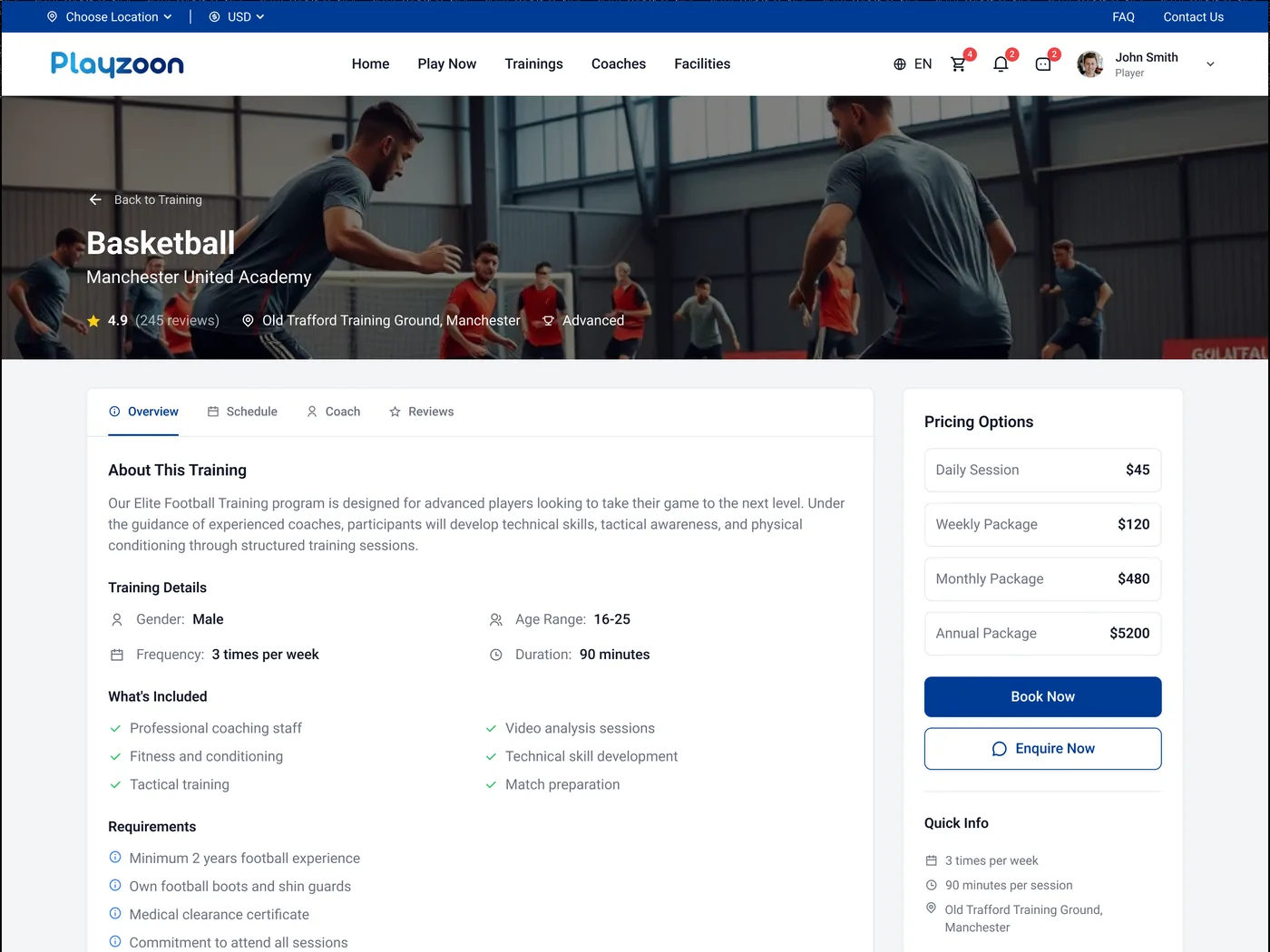
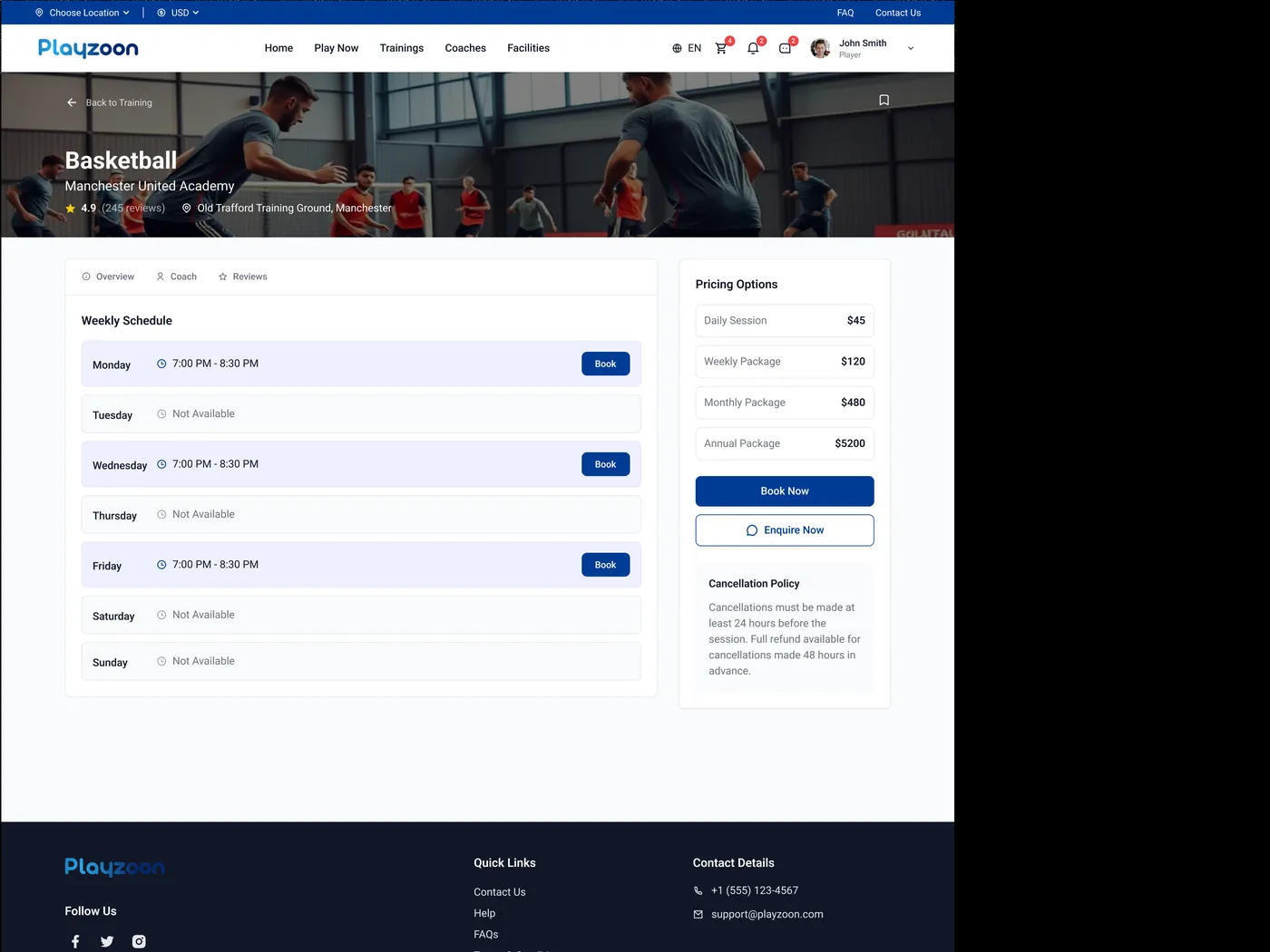
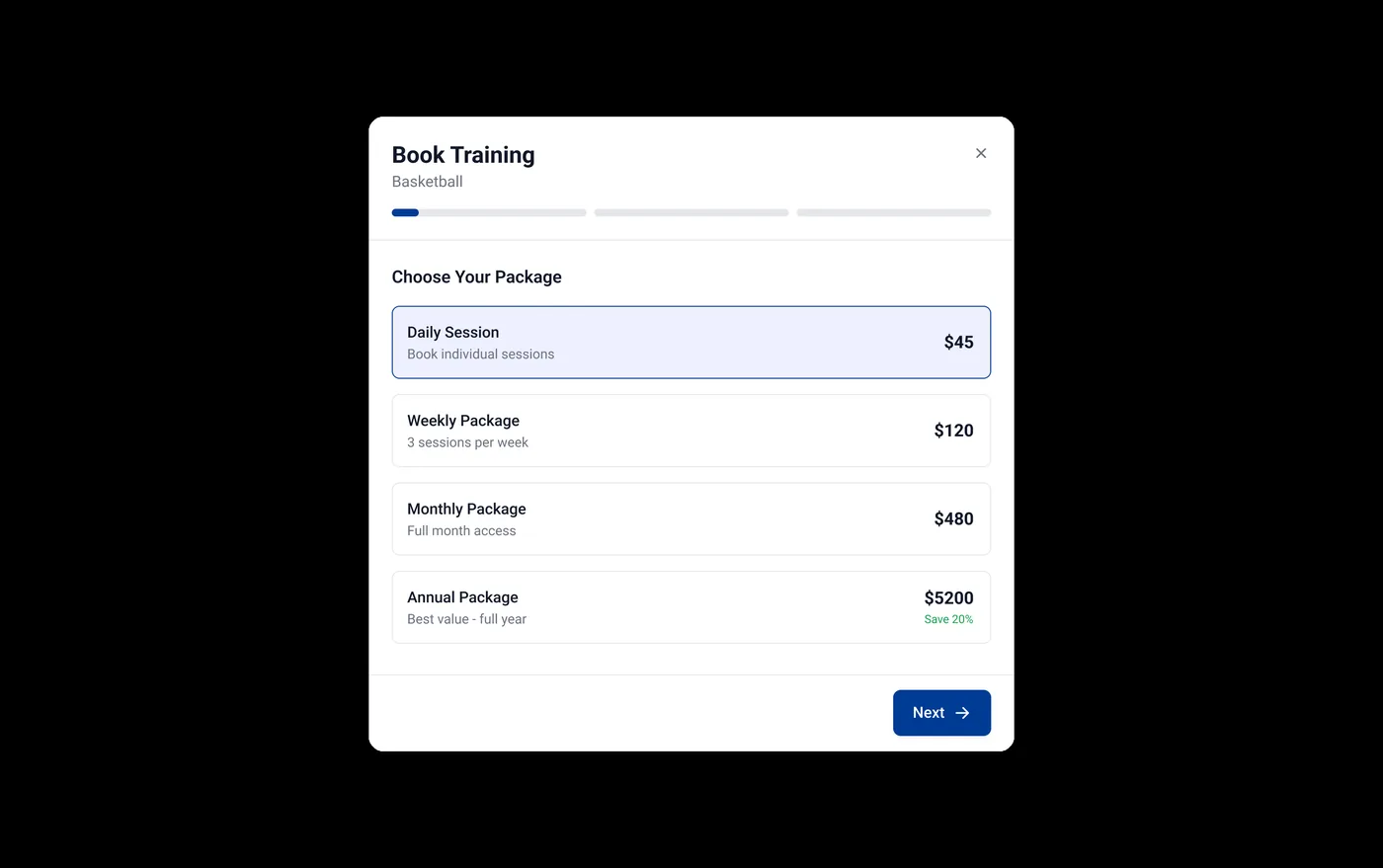
4 booking typesEvery training is a bookable product with Overview, Schedule, Coach and Reviews tabs, sold as a daily session, a weekly or monthly package, or a full course.
- Weekly schedule
- Package pricing
- What's included
Tournaments
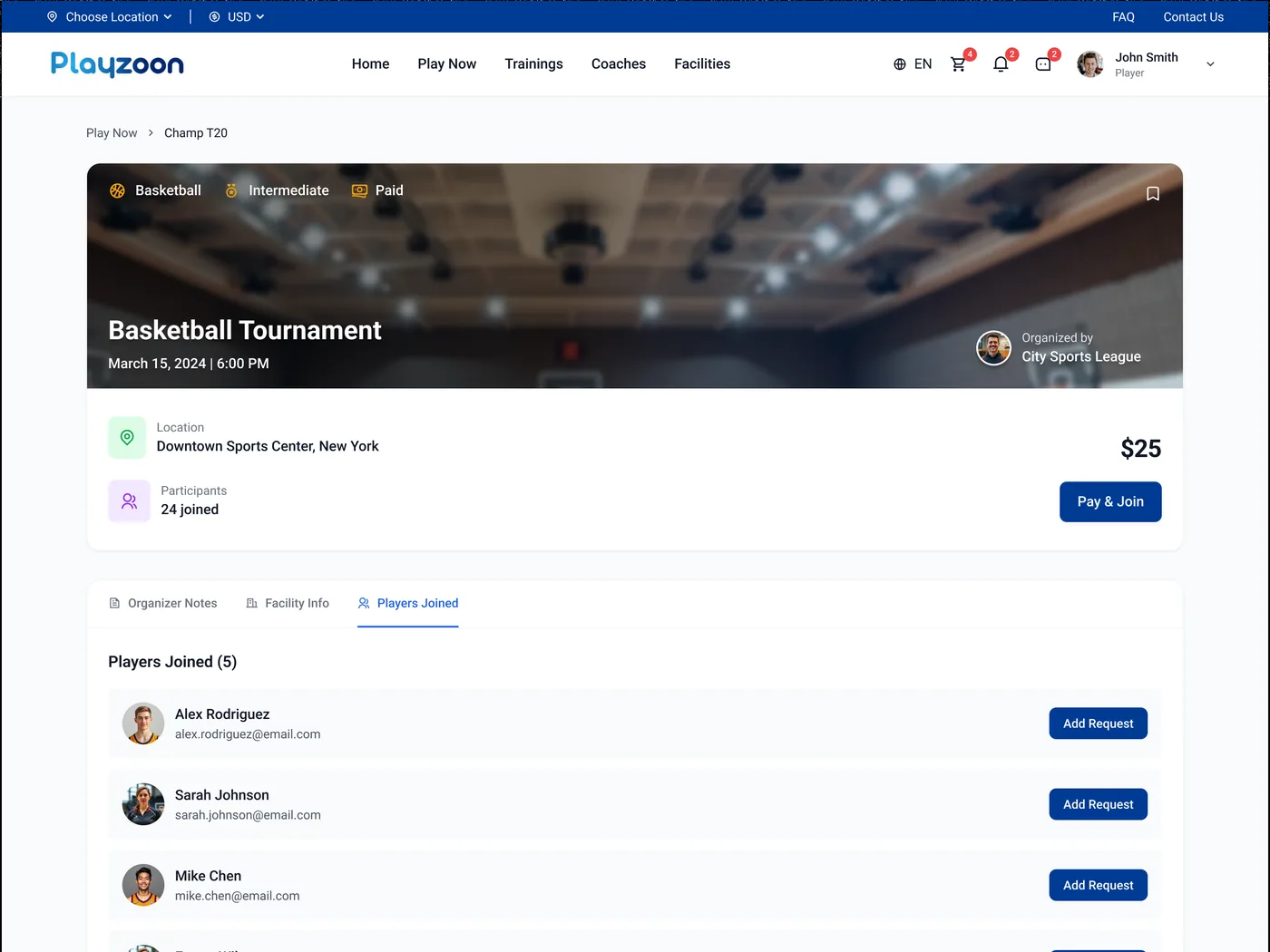
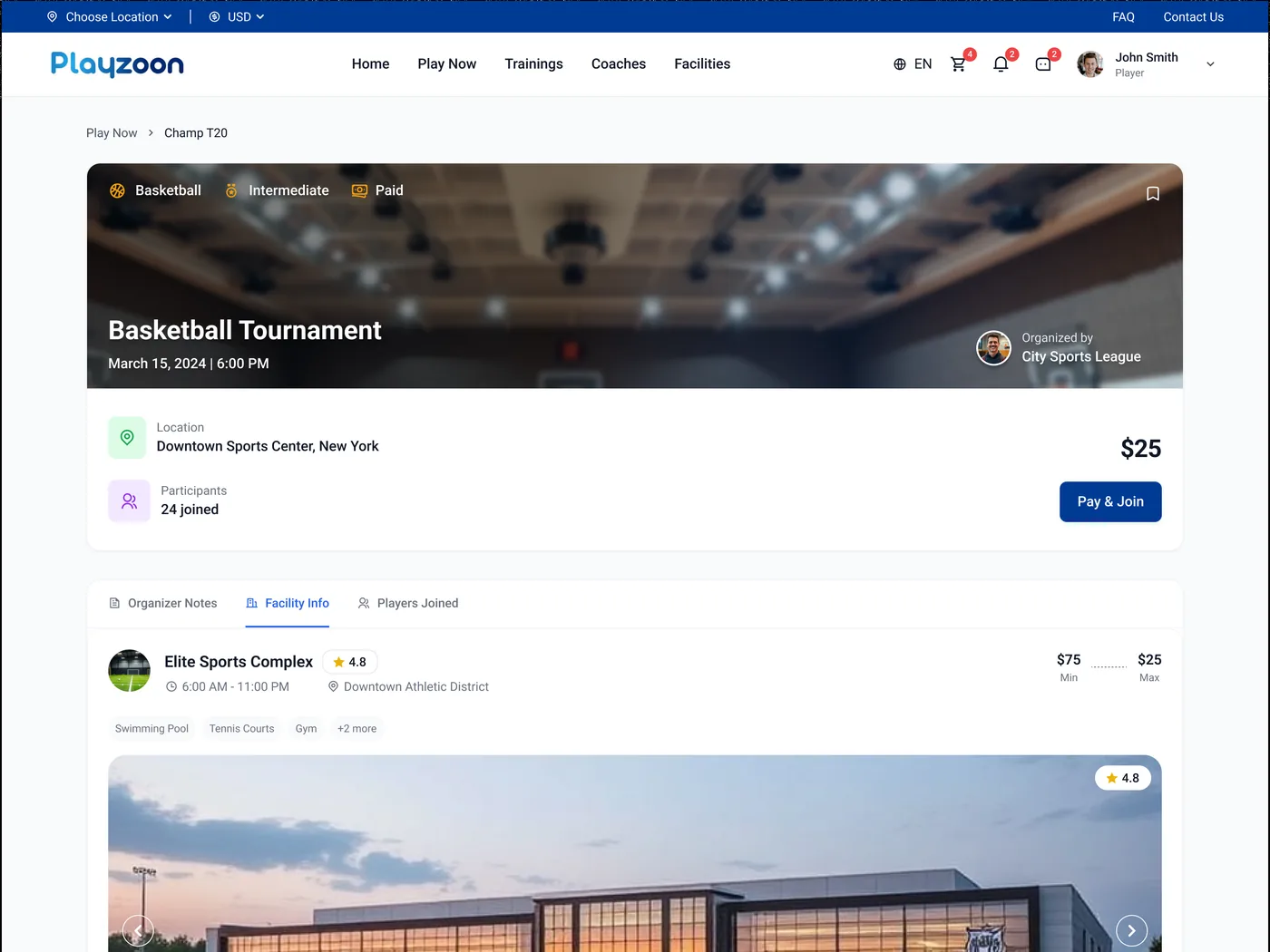
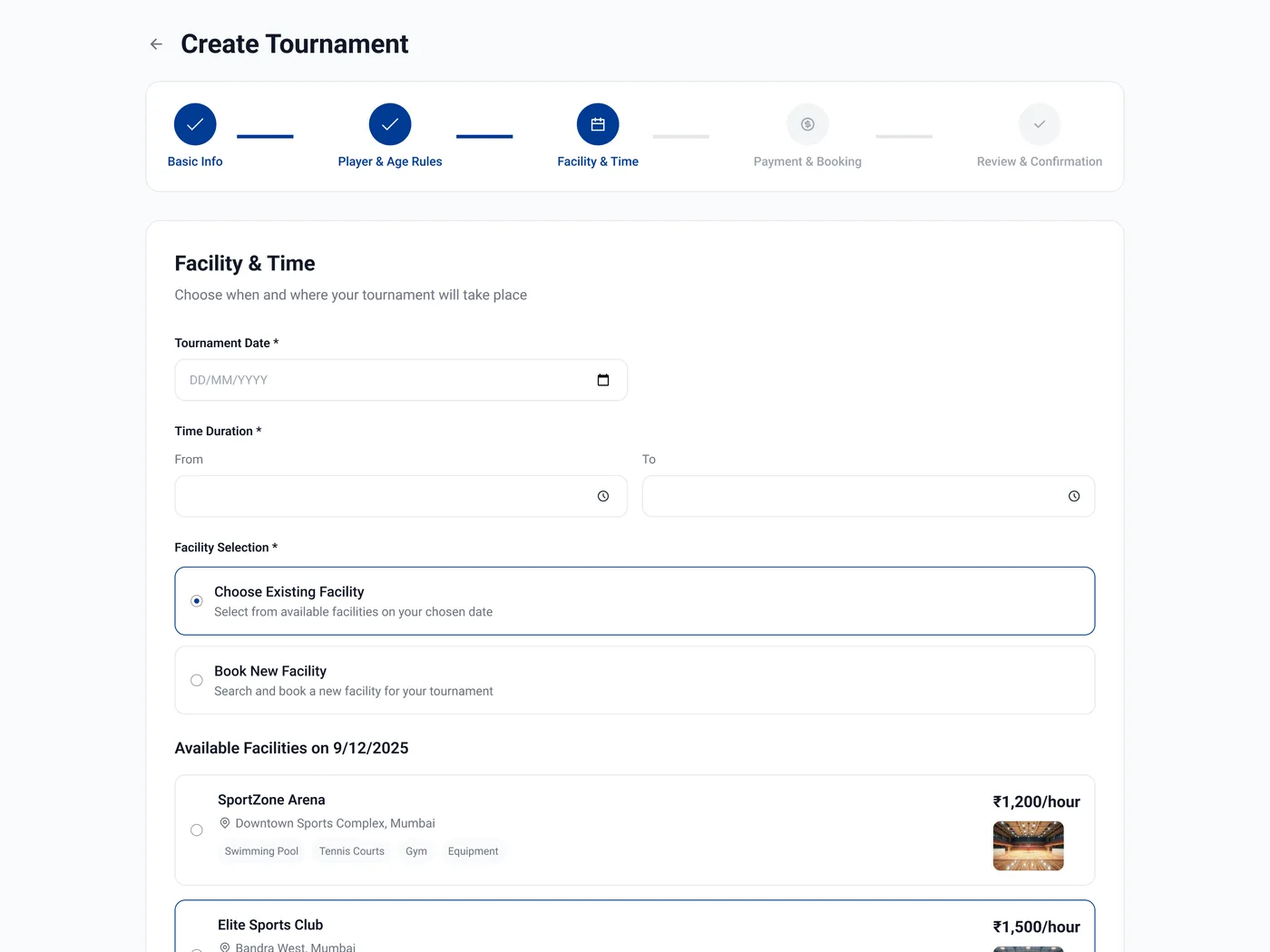
5-step builderOrganizers create paid tournaments through a staged wizard; players see notes, facility and roster before paying to join.
- Create wizard
- Players joined
Facilities
Bookable inventoryCourts and complexes with amenities, opening hours and hourly rates, bookable on their own or attached to a tournament.
- Opening hours
- Amenities
Players & coaches
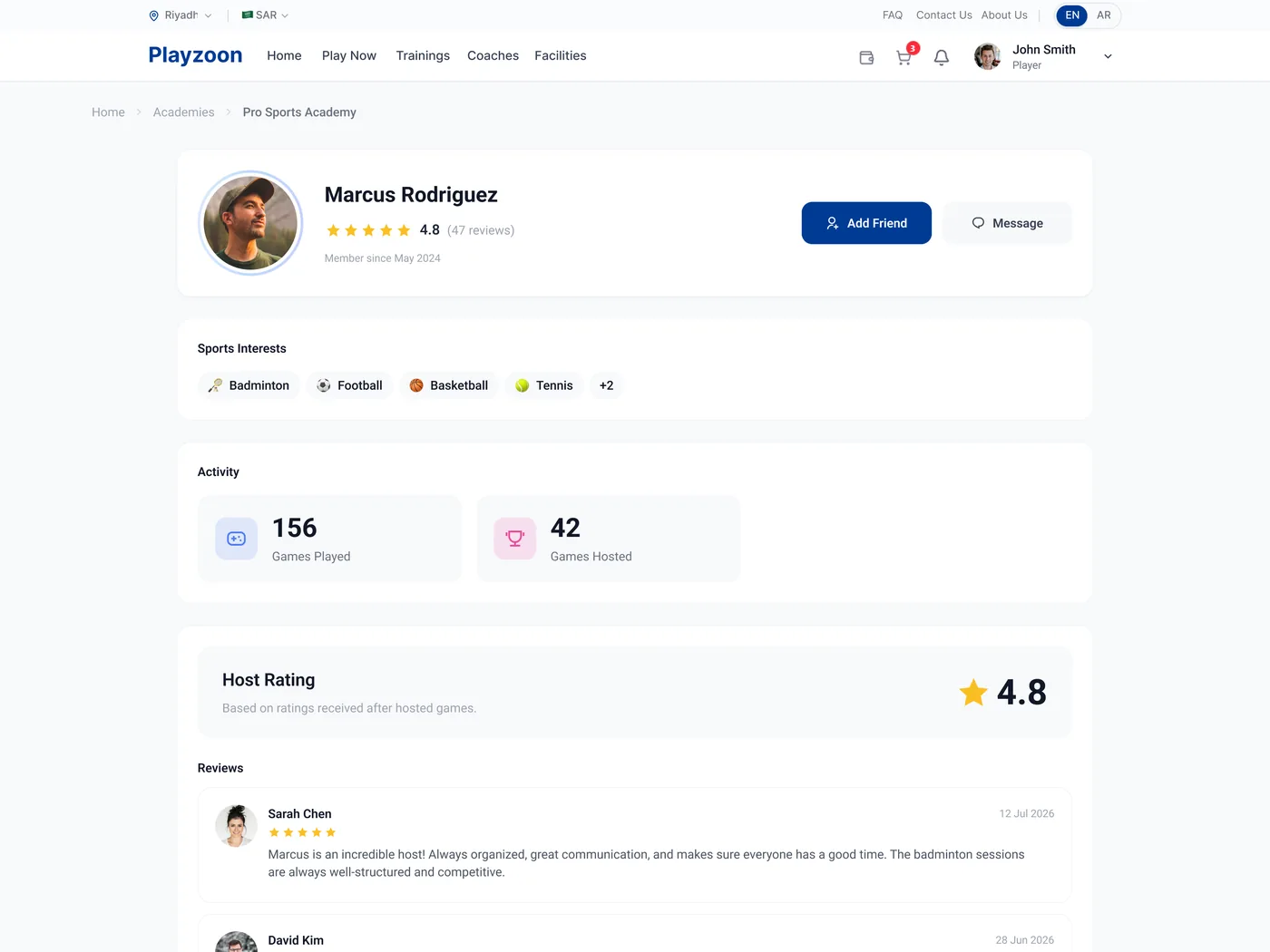
Host or joinPlayer profiles carry interests, a games history and a host rating; coach profiles carry the trainings they run, so the same directory finds the person to learn from and the people to play with.
- Host rating
- Add friend
- Reviews
Cart & checkout
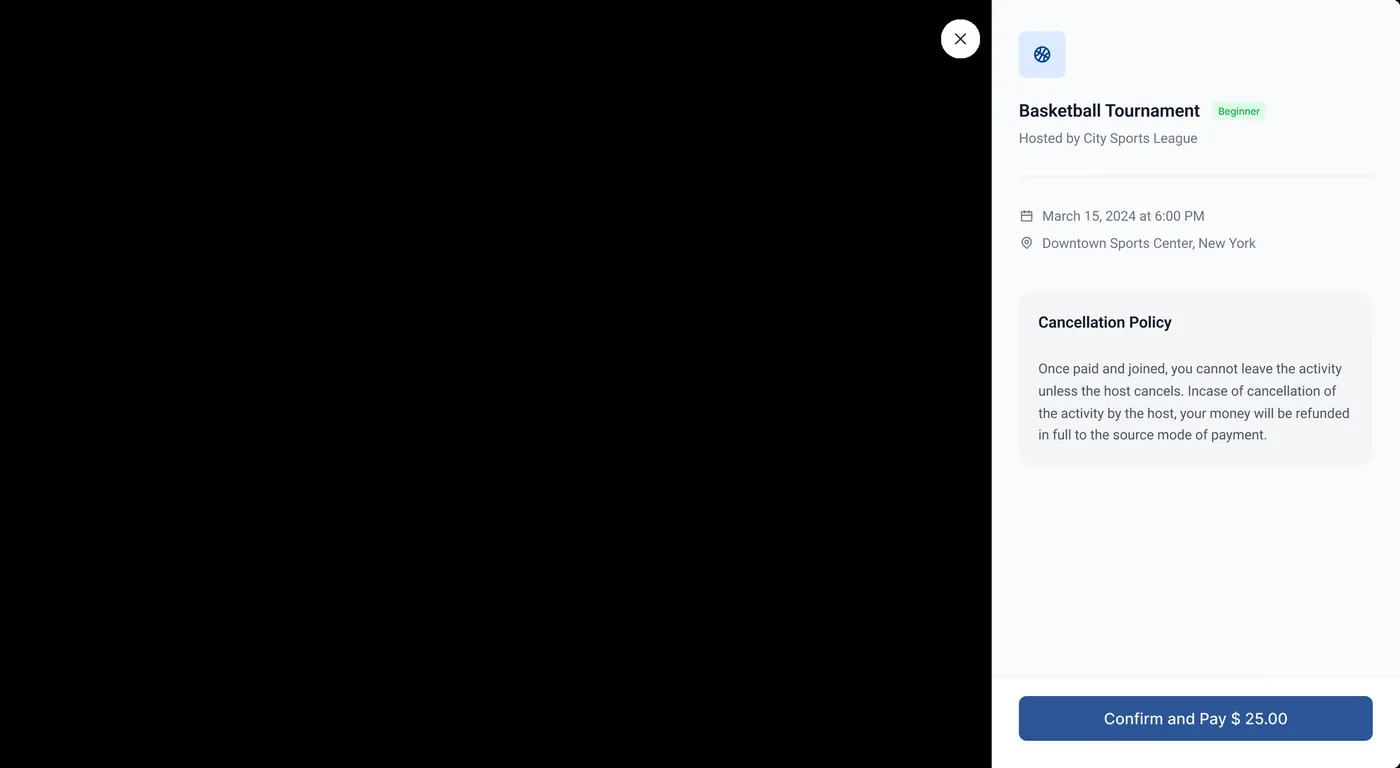
Multi-currencyA cart and a slide-in payment panel take a booking or an entry to a paid confirmation, priced in the player's chosen currency.
- Currency switch
- Confirm & pay
Localisation
EN & ARA location and currency selector and a full English/Arabic switch run across every surface, so the platform reads natively for each market.
- English / Arabic
- Location aware
How did we build it?
The brief was one word — "play" — hiding four different transactions. The work was making them feel like one product without pretending they are the same.
Building a sports marketplace
The questions we hear first from anyone building a booking marketplace.
Ask us yoursHow long does it take to build a sports booking marketplace?
A first working version usually takes eight to sixteen weeks, and the driver is not the number of screens but the number of distinct transactions. Playzoon carries four — coaching, tournaments, facilities and hosted games — each with its own pricing and cancellation rules, so it is a larger programme than a single-booking app. We phase it so one transaction ships and proves out before the next is added.
Can one platform handle bookings, tournaments and facility hire together?
Yes, and Playzoon is the proof. The trick is to model them as separate booking objects that share one identity, cart and checkout, rather than forcing them into a single template. A coaching package, a tournament seat and an hourly court booking then price and schedule on their own terms while the player experiences one account.
Does it support multiple currencies and languages?
It does. A location and currency selector sits in the top bar, prices display in the player's chosen currency, and the interface switches fully between English and Arabic including right-to-left layout. Building that in from the first screen is far cheaper than retrofitting it, which is why we treat localisation as a starting constraint.
How much does a platform like this cost to build?
It depends on how many transaction types and roles are in scope, and no honest number comes off a feature list alone. The biggest cost drivers are the number of separate paid flows, whether payments and payouts are handled in-platform, and how many languages and currencies are supported. Shanti Infosoft scopes it on a short call and returns a fixed quote.
Related work
Building a marketplace with more than one way to pay?
Tell us how your business actually works and we will tell you honestly what it takes to build. See more of our work or what we do.
Book a 15-minute call