


Book it, or say g'day first
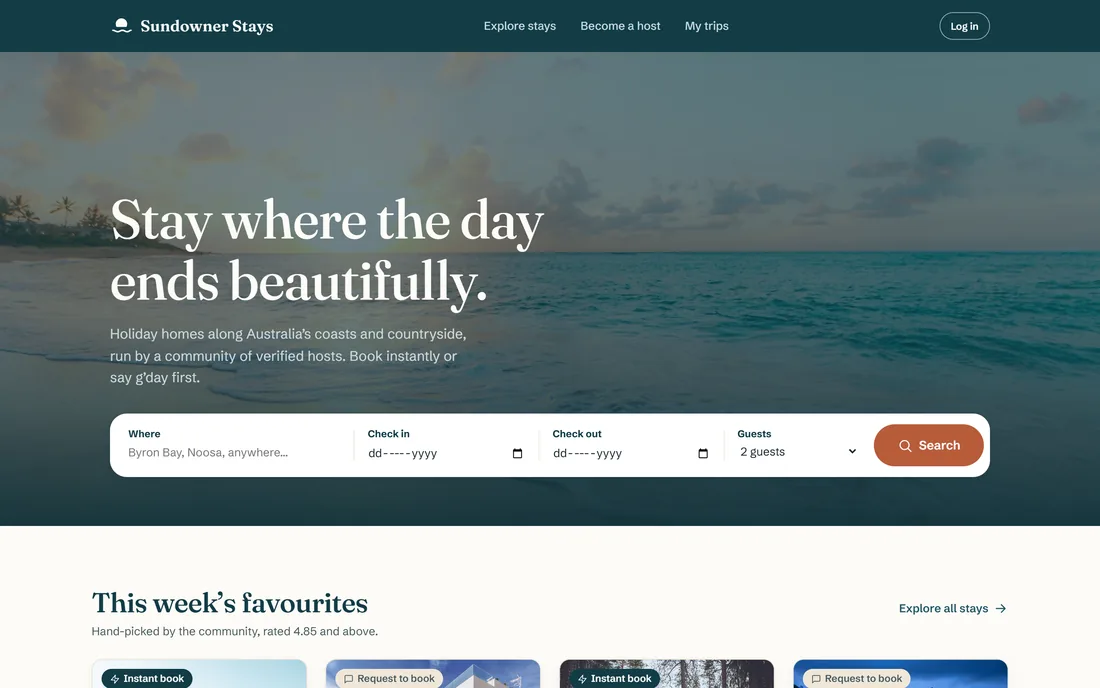
A community-run holiday rental marketplace for Australian coastal and country homes. Guests filter, compare and book two different ways; hosts list, price, approve and get paid; a moderation console keeps both sides honest.
Sector
- Travel & hospitality
- Short-stay holiday rentals
Booking model
- Instant book
- Request-to-book, 24h reply
- Payment released after check-in
What we did
- Product & scope modelling
- Design system + UX/UI
- Front-end engineering
Surfaces
- Guest site & trips
- Host dashboard, calendar, payouts
- Community moderation console
What kind of marketplace is it?
Most holiday-rental platforms optimise for volume: more listings, faster checkout, less contact between the two people involved. Sundowner Stays is built the other way round - smaller, verified, and unembarrassed about a host wanting to say hello first.
A community, not a marketplace
Every host clears ID, property and payout checks before a listing goes live, every review comes from a completed stay, and money is held until after the guest has walked through the door. The product's job is to make those three promises visible at the moment a guest is deciding.
What makes a two-sided rental platform hard to design?
Guests and hosts want opposite things from the same screen. A guest wants certainty now; a host wants a say in who sleeps in their house. A marketplace that only serves one of them loses the other, so three tensions had to be designed rather than argued away.
| Running a holiday let | Spreadsheets, email and a listing site | With Sundowner Stays |
|---|---|---|
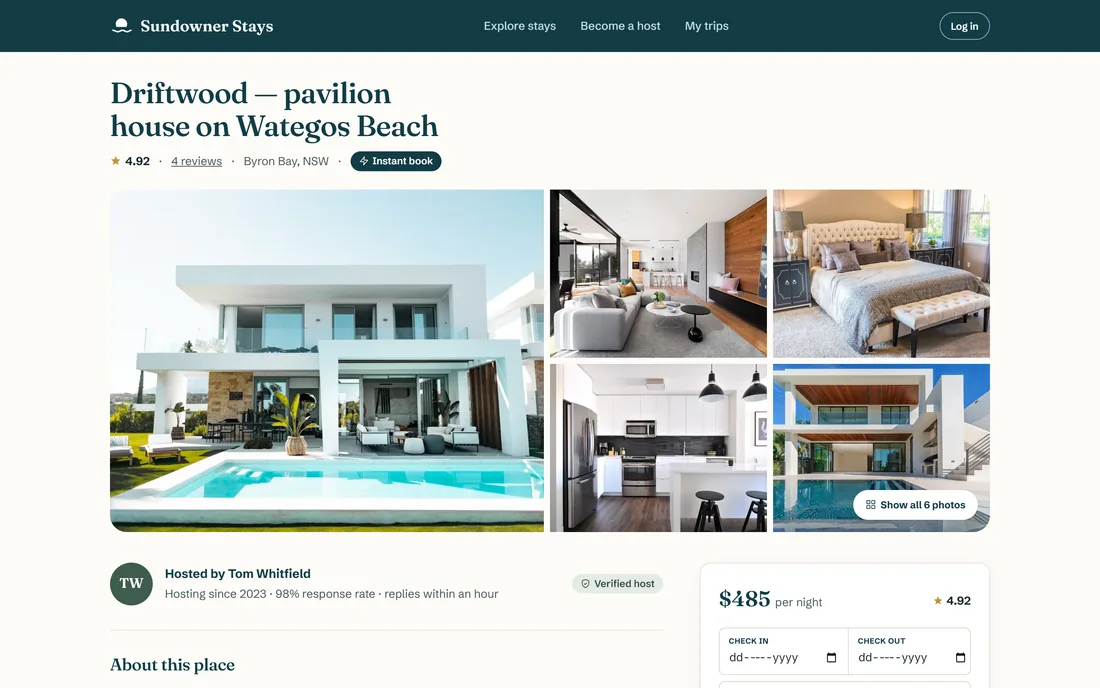
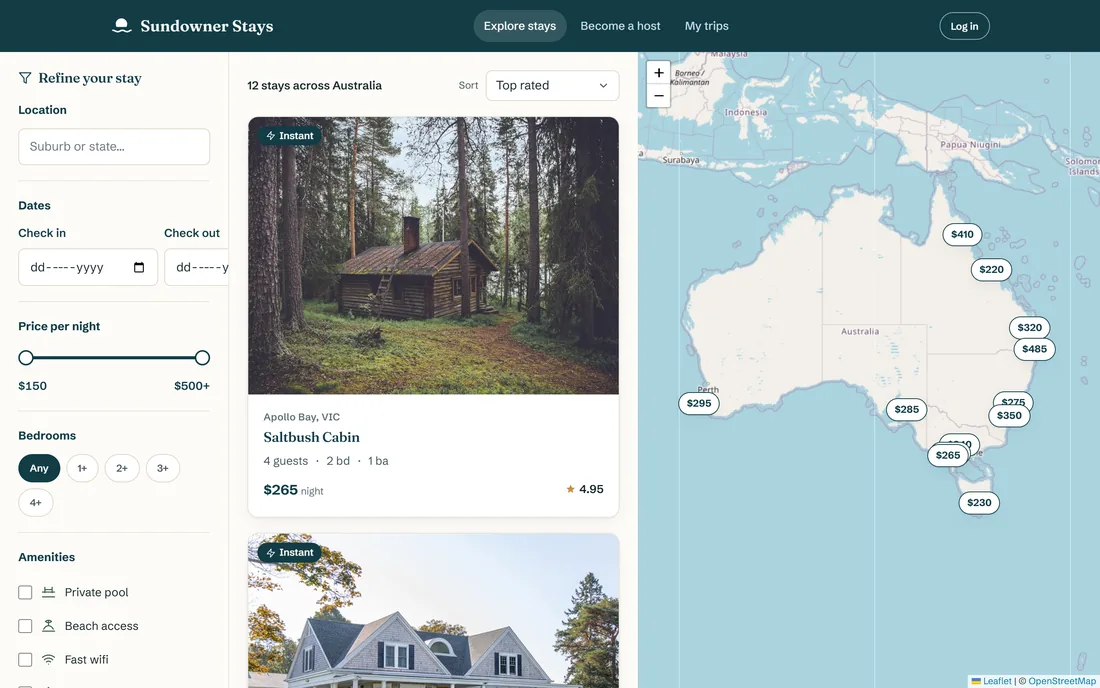
| Getting found | One listing, one channel, one photo set | Filtered search across location, dates, price, rooms and ten amenities |
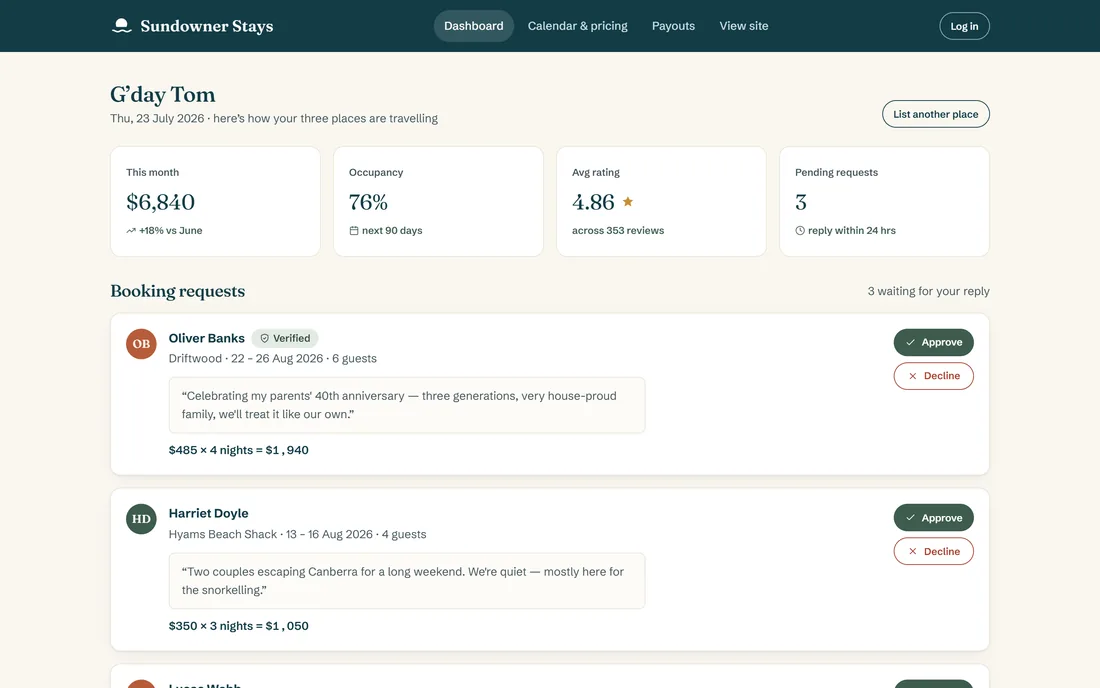
| Saying yes to a guest | A message thread and a gut feeling | A request with the guest's note, verification status and value, flagged if it looks wrong |
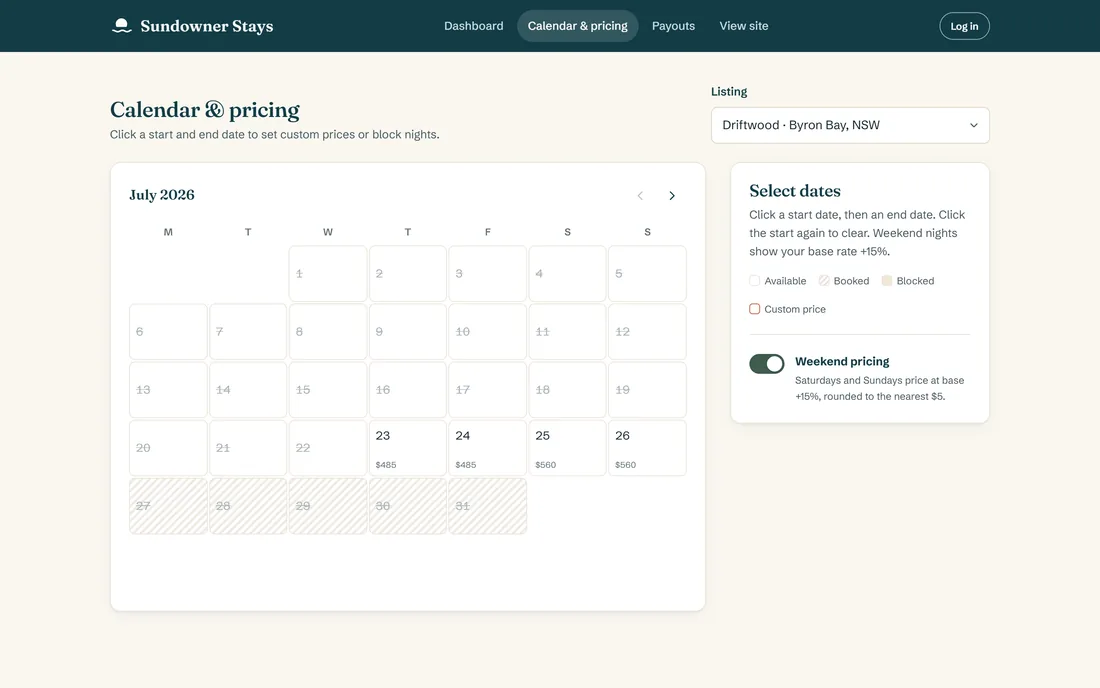
| Setting prices | A rate you change and forget | A per-listing calendar with weekend uplift, custom ranges and blocked nights |
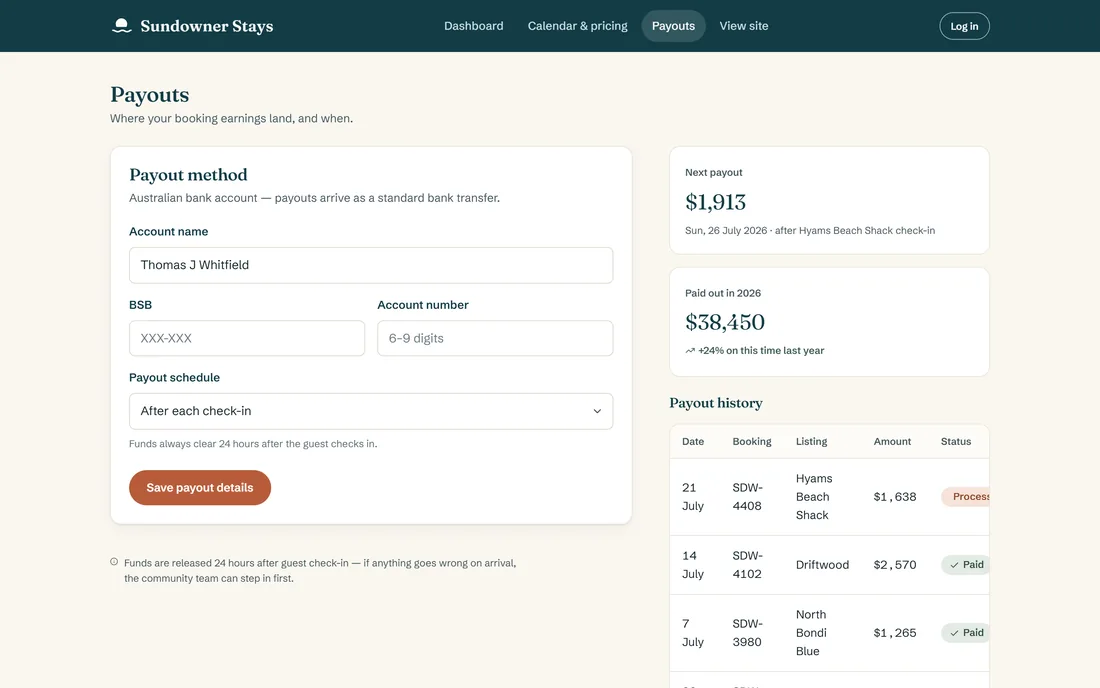
| Getting paid | Chase an invoice, hope for a transfer | A payout schedule you choose, released 24 hours after check-in |
| Trust | Screenshots of old reviews | Verified ID, property and payout checks before a listing goes live |
| Reviews | Whoever shouts loudest | Written after checkout by a guest who actually stayed |
| Bad actors | Discovered afterwards | A moderation queue plus flags for off-platform payment and duplicate listings |
What does it actually look like?
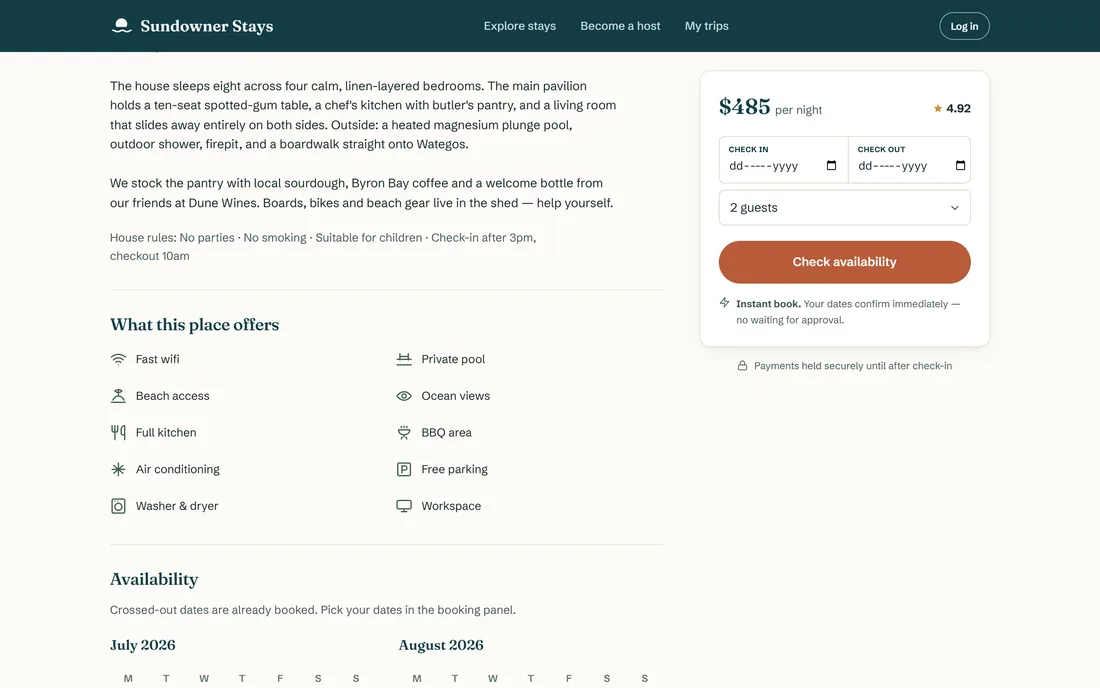
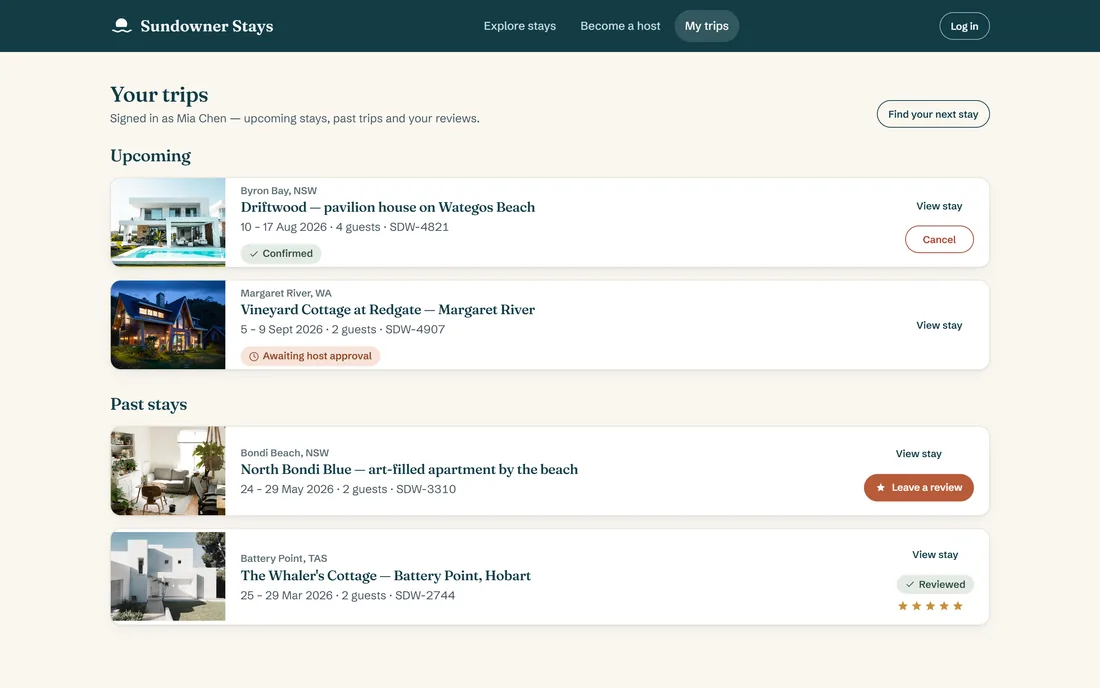
Both sides of the marketplace, drawn from one design system - the guest's search and listing pages, the host's dashboard, calendar and payouts, and the console the community team works from.
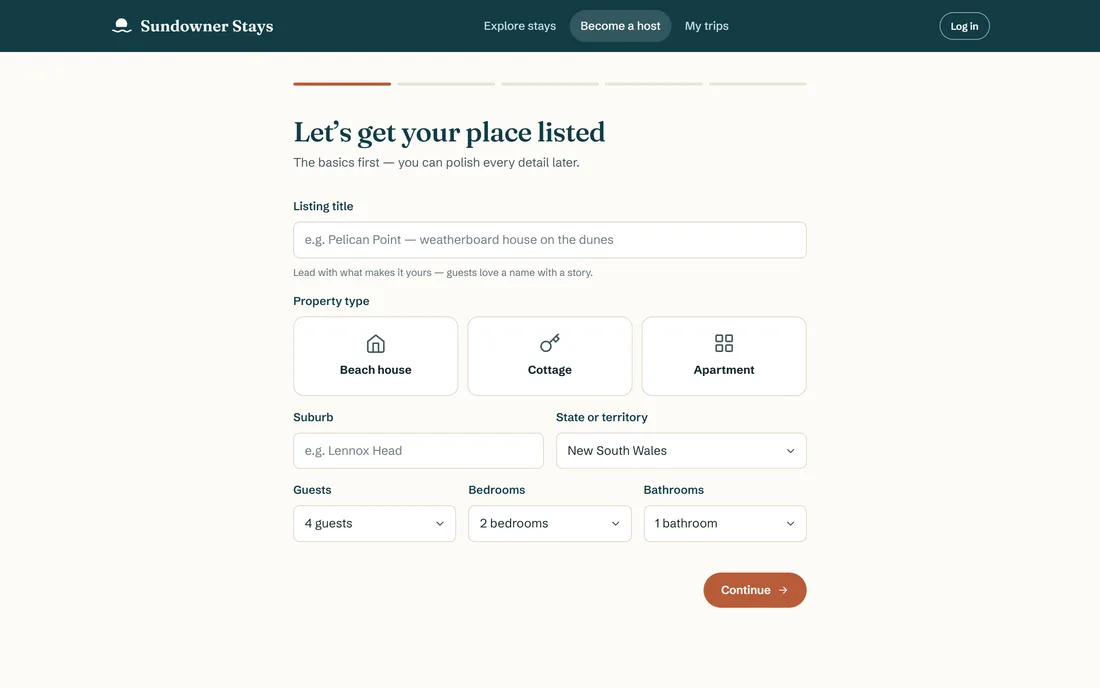
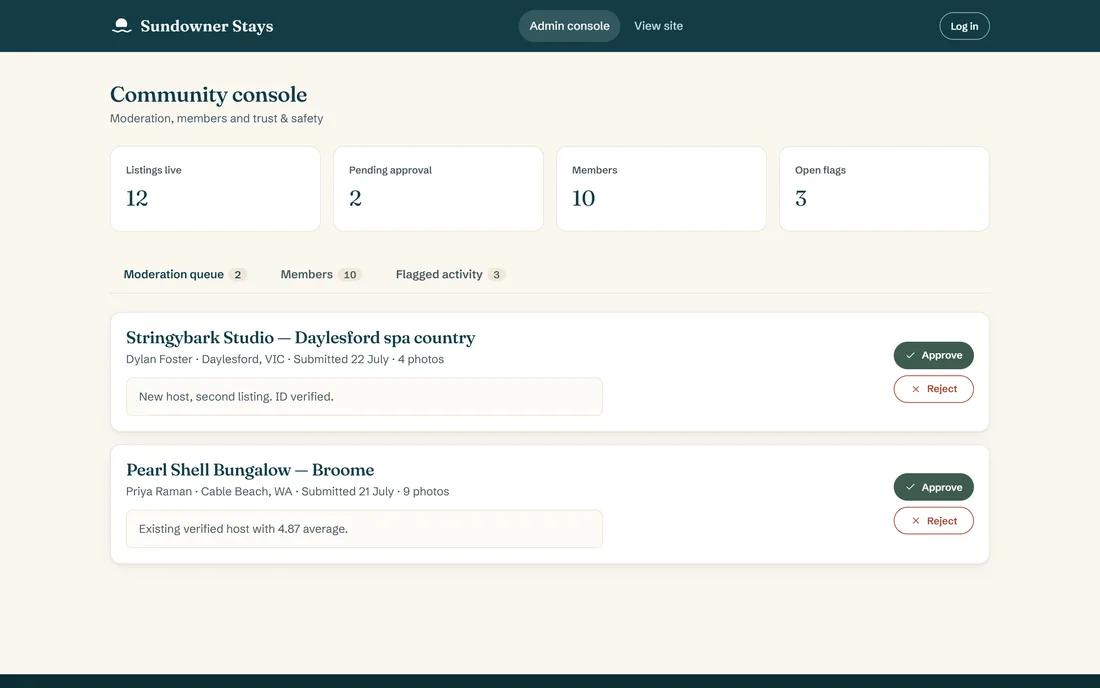
What happens between finding a home and the host being paid?
Nine steps, and the interesting thing is who is acting at each one. Two of them are the guest, two are the host, and the rest are the platform doing the work that makes a stranger's beach house feel safe to book.
- 01
Search and filter
Where, when, how many, and the things that actually matter - pool, pets, fireplace, fast wifi.
Guest - 02
Read the listing
Photos, amenities, house rules, a live availability calendar and reviews from completed stays.
Guest - 03
Book instantly, or ask
Instant book confirms on the spot. Request-to-book sends a note the host answers within 24 hours.
Guest - 04
The host answers
Requests land on the host dashboard with the guest's words, their verification and the total at stake.
Host - 05
Payment is held
The guest is charged, but the money sits with the platform rather than moving straight to the host.
System - 06
The stay happens
Address and access details are released once the booking is confirmed, and the trip shows in My trips.
Guest - 07
The payout clears
Funds are released 24 hours after check-in, on the schedule the host picked - per stay, weekly or monthly.
System - 08
The review is written
After checkout, and only after a completed stay, so the public score means something.
Guest - 09
Moderation keeps up
New listings are approved by a person, and off-platform payment attempts or duplicates surface as flags.
Moderator
Scroll the path sideways to follow it step by step
What does any two-sided booking marketplace need?
Seven things separate a marketplace people come back to from one they use once. They came out of building this, and they hold well beyond holiday rentals.
- Two booking modes, not one. Instant book and request-to-book serve different hosts. Forcing everyone into either loses you half the supply.
- Trust signals where the doubt is. Verification belongs next to the price on the listing, not on an about page nobody opens.
- Money held until the service starts. Releasing funds after check-in gives the platform something to work with when arrival goes wrong.
- Pricing as a calendar. Rates change by season, weekend and whim; a single nightly-rate field guarantees the calendar drifts out of date.
- Reviews gated on a completed booking. A score anyone can write is worthless, and everyone on both sides knows it.
- An empty state that helps. "No stays match those filters" has to offer the next move, because that screen is where people leave.
- Moderation as a queue, not a favour. Approvals, member management and flagged activity need a real console, or trust work quietly stops happening.
What does it look like, and why?
Deep ocean carries the identity, terracotta is the single action colour, and eucalyptus marks trust and success - so a warm rust button always means "this commits you to something". Sand and paper neutrals keep the photography, which is the real content, in front.
Aa
Primary typeface
Fraunces
A B C D E F G H I J K L M N O P Q R S T U V W X Y Z
a b c d e f g h i j k l m n o p q r s t u v w x y z
0 1 2 3 4 5 6 7 8 9 & ? ! £ $ €
56pxStay where the day ends beautifully.H136pxHomes along the coastH222pxSaltbush Cabin, Apollo BayH316pxBody copy, at a 16px floor with 1.6 line heightBody15pxSecondary UI text and helper linesSmall13pxCaptions, meta lines and table headersCaptionA warm serif for headlines and a clear grotesk for everything you actually have to read - the pairing that lets a listing page feel like a place rather than a database row. Body text never drops below 16px and all body pairings meet WCAG AA. Fraunces and Schibsted Grotesk are open-licence typefaces; the specimen above falls back to the nearest available face if they are not installed on your device.
Building a holiday rental marketplace
The questions operators and founders ask us first, answered plainly.
Ask us yoursHow long does it take to build a holiday rental marketplace?
A two-sided platform at this scope - guest search and booking, host onboarding, calendar and payouts, plus a moderation console - is a several-month programme. The date is driven less by screen count than by payments: holding funds, releasing them on a trigger, handling refunds and cancellations, and reconciling all of it is the part that needs real care. We normally ship the guest side and a minimal host side first, then calendars, payouts and moderation.
Should we offer instant book or request-to-book?
Both, and let the host choose per listing. Instant book converts better and suits hosts who want volume; request-to-book keeps the hosts who want a say in who stays, and those are often the homes that make a small marketplace worth visiting. Supporting only one quietly costs you supply on one side or bookings on the other.
When should a host actually get paid?
After the guest has arrived, not when they book. Sundowner Stays releases funds 24 hours after check-in, which leaves the platform something to work with if the property is not as described. Hosts pick the cadence after that - per stay, weekly or monthly - so the rule protects guests without making hosts wait for no reason.
How do you keep listings and reviews trustworthy?
Three mechanisms, all visible in the product. Listings pass ID, property and payout checks before going live and are approved by a moderator. Reviews can only be written after a completed stay, and they feed the public score. And a flag queue surfaces the patterns that precede trouble - off-platform payment offers, duplicate listings, review anomalies.
Can this model work outside holiday rentals?
Yes. The hard parts - filtered search, two booking modes, held payments, calendar pricing, verified supply and a moderation queue - are the same for equipment hire, studio and venue booking, or any marketplace where a stranger hands over something valuable for a fixed window.
Related work
Building a marketplace with two sides to keep happy?
Tell us how your business actually works and we will tell you honestly what it takes to build. See more of our work or what we do.
Book a 15-minute call