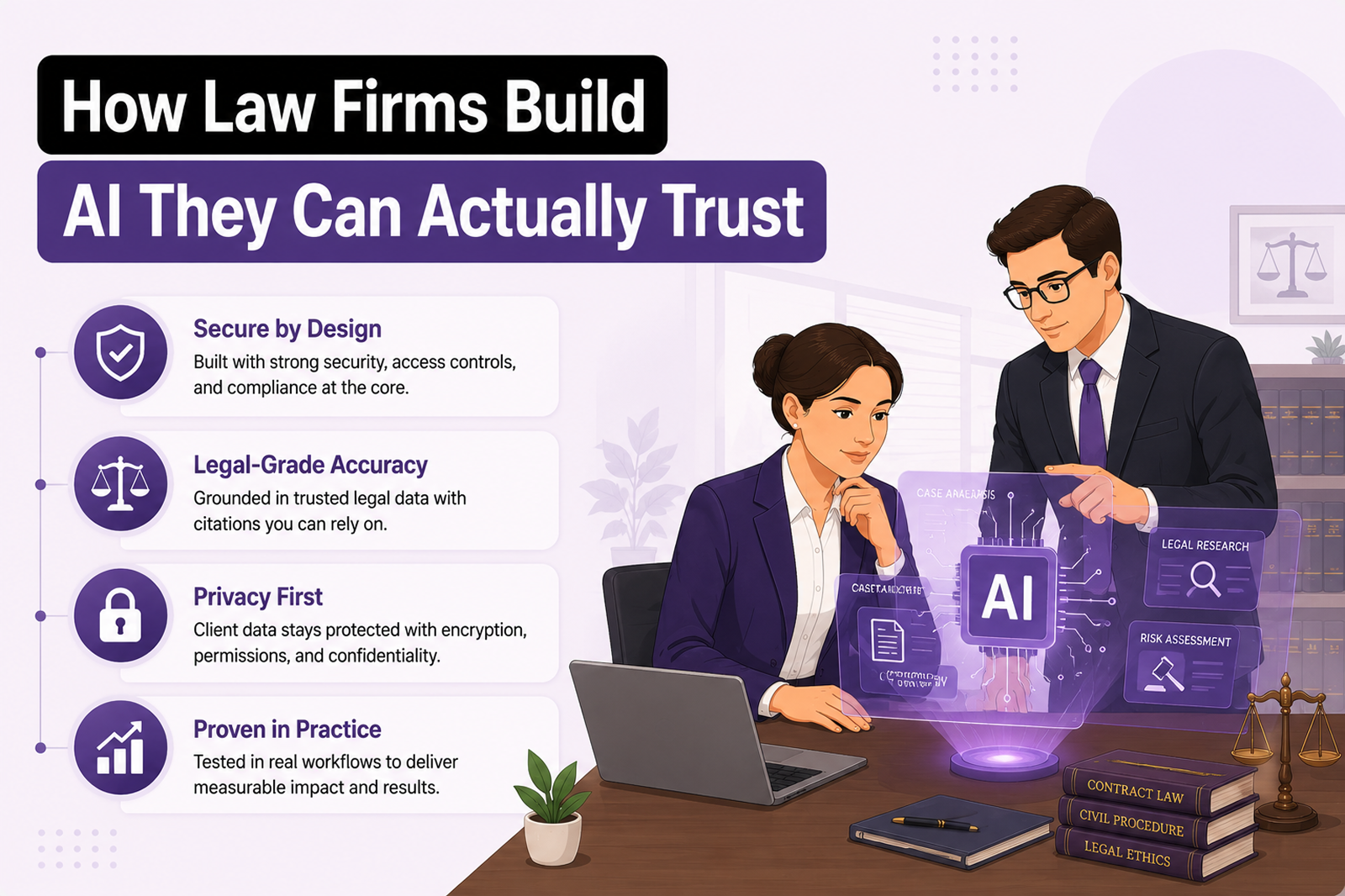
Every law firm I talk to in 2026 has the same question, just phrased in different states of panic: can we actually trust this thing? A partner saw a demo where an AI answered a research question in nine seconds flat, and now the firm wants one. Then someone read about the lawyers who got sanctioned for filing a brief full of cases that did not exist, and the enthusiasm cools. Both reactions are correct, and the gap between them is the entire engineering problem. It is why serious AI development for legal work looks nothing like plugging a chatbot into your document store.
The short version: a legal AI you can trust is not a smarter model, it is a system built around the model. A jurisdiction-scoped retrieval pipeline, a layer that verifies every citation actually exists, and lawyer sign-off gates you are not allowed to skip. The model is the easy part. Everything that keeps it out of a disciplinary hearing is the hard part, and that is what this piece is about.
of law firms had adopted AI by mid-2026, up from 19% in 2023
of queries where leading legal-research AI still hallucinates (Stanford)
a US firm sanctioned for AI-fabricated case citations
Where AI helps in a law firm, and where it fails
Here is the honest map. AI is genuinely good at the parts of legal work that are retrieval and pattern-matching: first-pass contract review, pulling clauses out of a 90-page agreement, summarizing a deposition, triaging which of 400 documents are worth a human's time. It is structurally unreliable at the part everyone actually wants it for, which is reasoning over the law, deciding what a case means, whether it controls, and how it applies to your facts.
Adoption already happened. By mid-2026, 83 percent of firms reported using AI in some form, up from just 19 percent in 2023, so the useful question is no longer whether to use it but where it is safe to. And that distinction is not a temporary limitation you can prompt your way out of. Retrieving a document is a search problem, and search is solvable. Reasoning about whether that document supports your argument is judgment, and the model does not have any. It has a very good impression of what legal judgment sounds like, which is precisely the trap. So the rule we build to is simple: let AI narrow and organize, let a lawyer decide. Every design choice below follows from that one line.
Why legal AI hallucinates: the citation problem
Legal AI hallucinates because a language model generates the most plausible next words, and a fabricated case citation is extremely plausible text. "Smith v. Jones, 412 F.3d 550 (9th Cir. 2004)" has the exact shape of a real citation whether or not that case has ever existed. The model is not lying. It has no concept of existing. It is pattern-completing, and citations are a very regular pattern to complete.
This is not a rare edge case. Stanford researchers found that leading, purpose-built legal-research tools still hallucinate on somewhere between 17 and 33 percent of queries, and those are the good, retrieval-backed products, not a raw consumer chatbot. In 2026 a US firm learned the public version of this lesson when it was sanctioned for filing AI-generated citations to cases that did not exist. That was not a freak accident. It was the default behavior of an ungrounded model meeting a court that checks its work. If your legal AI can emit a citation it has not verified, that outcome is a matter of time, not luck.
Jurisdiction-scoped RAG: grounding on the right corpus
The first real fix is retrieval, done properly. Generic RAG, retrieval-augmented generation, grounds a model's answer in documents you actually control instead of its training memory. For legal work the twist is jurisdiction. A California employment ruling is worse than useless in a Texas matter, and a 2019 case that has since been overturned is a liability, not a source. So the corpus is not "all law." It is the right law, scoped to the jurisdiction, court level, practice area, and recency the matter demands.
Building that means a curated legal corpus, statutes, regulations, and case law from sources you trust, chunked and indexed so retrieval returns the relevant passages, not just document titles. Then you filter hard: jurisdiction tags, date ranges, and treatment flags so overruled authority never surfaces as support. Done right, the model stops reaching into its memory and starts answering from documents you can point to. That is the whole difference between "the AI says" and "here is the paragraph it is standing on."
The citation-verification layer: does this case exist, and say this?
Grounding reduces hallucination. It does not eliminate it, because a model handed ten real cases can still cite an eleventh it invented, or cite a real case for a proposition that case never made. So you add a layer that treats every citation as guilty until proven real. This is the single most important component in a legal AI, and the one most demos quietly do not have.
Mechanically it runs after generation and does two checks on every citation the model produced. One: does this case exist, meaning does the citation resolve to a real document in the legal database? Two: does it actually say this, meaning does the cited source genuinely support the claim the model attached to it, or was it grabbed for the wrong point? Citations that fail either check are flagged, stripped, or sent back for regeneration before a human ever reads the draft. It is deterministic code, not another model's opinion, and that is the entire point. You do not fight one hallucination with another.
The lawyer-in-the-loop gates you cannot skip
No verification layer makes a lawyer optional. The whole system is designed to make the lawyer faster and better informed, not absent. So you build explicit gates, points where a qualified human must review and approve before the work advances, and you make them mandatory in the workflow, not a polite suggestion a rushing associate can click past at 11pm.
Where the gates sit depends on stakes. A first-pass clause extraction that a lawyer will read anyway needs a light touch. Anything that reasons over law, forms an argument, or goes near a court or a client needs a hard stop with a named human on the record. This is also where regulated-industry discipline pays off. The same reason AI projects die faster in fintech and healthtech is that the tolerance for a confident wrong answer is basically zero, and legal is no different. The gate is not bureaucracy. It is the thing standing between a useful draft and a sanctioned filing.
What to build first: contract review, clause extraction, research triage
If you are starting, build where AI retrieves and drafts, not where it decides. The highest-return, lowest-risk entry points are first-pass contract review, clause extraction, and research triage, high-volume repetitive work that currently eats junior hours and where a human reviews the output anyway. Save the tasks that require reasoning over law for later, behind heavier gates, or not at all. Here is the split we walk firms through.
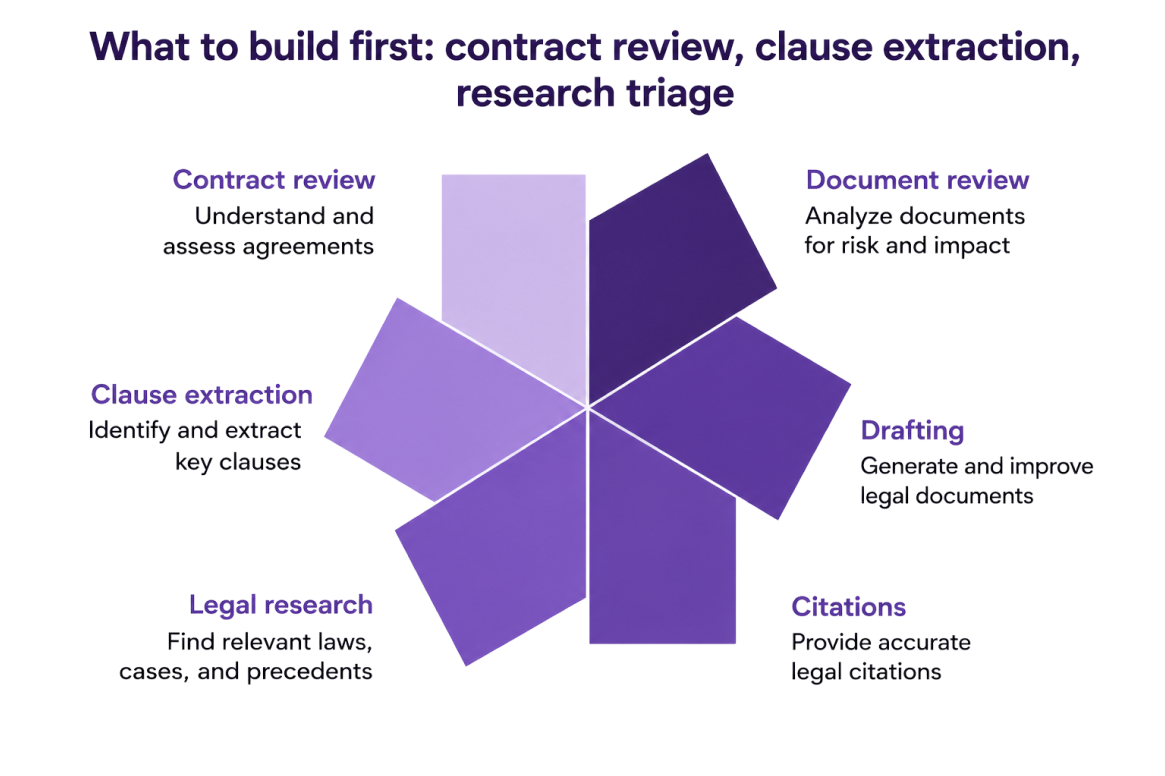
| Legal task | Where AI wins (retrieval and drafting) | Where it structurally fails (reasoning over law) |
|---|---|---|
| Contract review | First-pass flagging of risky or missing clauses | Deciding whether a term is acceptable for this deal |
| Clause extraction | Pulling every indemnity or termination clause from long agreements | Judging whether the clause is enforceable in this jurisdiction |
| Legal research | Triaging which cases and documents are worth reading | Concluding which case controls and how it applies to your facts |
| Document review | Summarizing and clustering thousands of discovery documents | Making the privilege or relevance call that carries consequences |
| Drafting | Producing a first draft from a known template and inputs | Constructing a novel legal argument from scratch |
| Citations | Finding candidate authorities to check | Vouching that an authority exists and says what is claimed |
Read the table as one rule repeated six times. The left column is where the model narrows the search space, the right column is where a human closes it. Every safe legal-AI product I have seen lives almost entirely in the left column and routes the right column to a person, deliberately.
Confidentiality and privilege guardrails
None of this matters if you leak the client's file. Legal work is privileged and confidential by default, which rules out the easy path of piping matter documents into a public model that may log prompts or train on inputs. The corpus, the prompts, and the outputs all have to stay inside a boundary you control, with access scoped per matter so the model working a divorce case cannot retrieve a document from an unrelated M and A file.
In practice that pushes most firms toward a private or on-premise deployment rather than a shared consumer endpoint, which is a real trade-off between control and convenience worth thinking through. It is the same private versus on-prem data-residency decision every regulated buyer faces. On top of the deployment choice you want per-matter access controls, prompt and output logging for your own audit trail, and a hard rule that privileged material never touches a model whose data handling you have not verified in writing. Thoughtful AI integration into your existing document and practice-management systems is what makes those controls real instead of aspirational. If you would not email a document to a stranger, it does not go into a consumer chatbot.
How we build legal AI
Our approach starts from the assumption that the model is the commodity and the safeguards are the product. So on a legal build we spend most of the effort on the corpus, the retrieval filters, the citation-verification layer, and the human gates, the parts a demo never shows because they are invisible when everything works and career-ending when they are missing. This is the same discipline behind our custom AI development generally: engineer the system around the model, not faith in the model.
We are a CMMI Level 5 team of 80-plus engineers who have delivered for 700-plus companies, and legal is exactly the kind of high-stakes, low-tolerance domain where that process discipline earns its keep. The firms that get value from AI are not the ones with the fanciest model. They are the ones who treated reliability as an architecture problem and refused to ship without the verification and the gates. If you are weighing a legal AI build and want to know where the real risk sits before you spend a dollar on it, tell us what you are trying to build and we will show you the parts that actually keep you safe.
Frequently Asked Questions
Can law firms trust AI for legal research?
Not the raw model output. Standalone legal-research AI still hallucinates on 17 to 33 percent of queries in Stanford's testing, and those are the good purpose-built tools. You make it trustworthy by grounding answers in a curated legal corpus, verifying every citation against a real source, and keeping a lawyer signing off before anything leaves the building. Trust is engineered, not assumed.
Why does legal AI make up case citations?
Because a language model predicts plausible text, and a fabricated citation looks exactly like a real one. If the correct case was never retrieved, the model fills the gap with something that reads right and cites confidently. It is not lying, it has no concept of existing. The fix is retrieval that finds the real case plus a step that verifies it exists.
What is a citation-verification layer?
It is a deterministic check that runs after generation. For every case or statute the model cites, it confirms the citation resolves to a real document in your legal database, and that the document actually supports the claim. Anything that fails is flagged or stripped before a human sees it. It is the single biggest guard against the mistake that gets firms sanctioned.
What should a law firm automate with AI first?
Start where AI retrieves and drafts, not where it reasons over law. First-pass contract review, clause extraction, and research triage are the safe wins, the model narrows and organizes while a lawyer decides. Avoid handing it final legal reasoning or unreviewed filings. The best early targets are the boring, high-volume tasks that currently eat junior hours.
Is client data safe with a legal AI system?
Only if you design for it. Privileged material cannot go to a public model that logs prompts or trains on inputs. Keep the corpus, prompts, and outputs inside a boundary you control, often a private or on-prem deployment, with per-matter access limits. The simple test: if you would not email it to a stranger, do not paste it into a consumer chatbot.
Have a project in mind? Let's scope it together.
You get a named team, written estimates, full code and IP ownership, and 48-hour response times. CMMI Level 5 certified. 700+ projects delivered across the UK, US, UAE, and Australia.