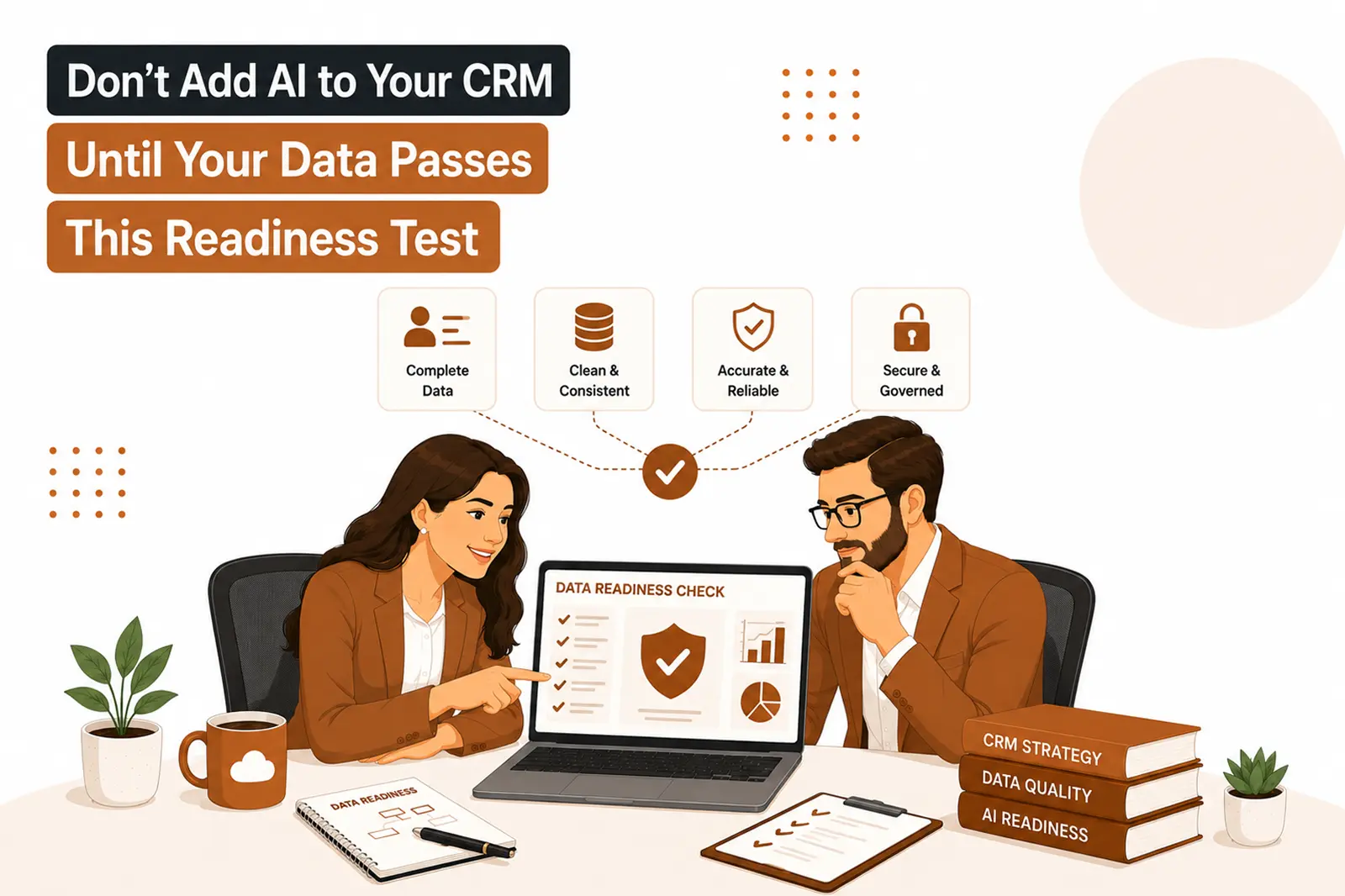
A CRM AI integration readiness checklist tests five things before the build starts: duplicate rate, completeness on the fields your use case reads, record staleness, note quality, and whether permissions can be enforced per user at query time. Fail two and the AI produces fast, confident, wrong answers.
Data readiness is a gate, not a phase. If duplicate rate and field completeness fail their thresholds, the project shouldn't start. AI on a messy CRM doesn't fix the mess, it industrialises it. A bad field used to sit in a dashboard cell nobody read. Now it comes back as a fluent English sentence a rep repeats on a call, and once three reps have been embarrassed by an account brief, the feature is dead.
account duplicate rate at which the project should stop, not start
completeness floor on the specific fields your use case reads
records that must agree with a second source before the data is trusted
What does "AI-ready CRM data" actually mean?
AI-ready CRM data means the records your use case reads are unique, current, complete on the fields that use case needs, and governed by permissions the system enforces per user. Readiness is scoped to a use case, never to the whole database. A CRM can be ready for call summaries and unready for forecasting.
Most audits are scoped wrong. Somebody exports every field in the schema, produces one alarming fill-rate percentage, and the meeting ends without a decision. Flip the order: pick the use case, list the fields it reads, measure those. And empty isn't the same failure as wrong. A close date that auto-populated at record creation is a lie that reads like data.
Why do duplicates break AI answers first?
Duplicate rate is the share of records describing an entity that already exists under another record. It matters first because retrieval fans out across every match. Measure accounts and contacts separately, using fuzzy matching on normalised name, email domain, and phone rather than exact string equality, which finds almost nothing.
Picture one company sitting in your CRM four times. "Bharat Steel Pvt Ltd" from an old import, "Bharat Steel Private Limited" typed by a rep, "bharat steel" from a webform, and a fourth from a sync that only had the domain. Ask for the account status and the assistant either picks one and answers on a quarter of the facts, or blends all four. The blend is worse: internally consistent, false, impossible to spot. Fix identity in the CRM, because query-time dedupe fails the moment the next webform arrives.
Which fields need to be complete, and which don't?
Measure field completeness only on the fields your use case reads, on open records, and treat the number as a gate. Below 90% on that named list, stop. A CRM with two hundred fields at low overall fill can still pass if the eight fields the use case consumes are populated and true.
The interesting failures look complete. A required picklist where most values are "Other" is fully populated and carries nothing. Scoping an AI integration against a client CRM, the first thing worth pulling is value distribution per field, not fill rate. Then check 30 random open records against the last invoice or the email thread. Fewer than 24 agreeing means the fields are decorative.
What happens when the real knowledge lives in free-text notes?
In most CRMs the useful account knowledge sits in call notes, email bodies, and activity comments rather than structured fields. That changes the build. You need retrieval over unstructured text, chunked per record with its object ID and access control list attached, so answers can be traced and filtered by whoever is asking.
Notes are where the competitor mention lives, and the reason the deal stalled in April. Index them and you inherit everything anyone typed without thinking about who'd read it later: a blunt remark about a buyer, a salary figure, an ID number pasted for convenience. Scan first, because pulling content back out of a vector index is a project of its own. Same shape as adding AI to an existing SaaS product, where the hard part is rarely the model.
How much damage do stale and abandoned records do?
A stale record is one whose fields haven't been touched since the process that created them changed, or whose owner has left the company. Measure staleness as days since last activity, segmented by stage. Open opportunities with no activity for a full quarter are the most dangerous input to any AI-generated pipeline summary.
Every CRM I've looked at has a version of this. A rep left two years ago, their forty open opportunities were never reassigned, and those records still say Stage: Negotiation. A human skips them on sight: "those are Ravi's, ignore them." The AI reads Negotiation, reports active pipeline, and puts a total on it. A record nobody will defend in a meeting shouldn't be retrievable.
Whose permissions does the AI answer with?
The AI must answer using the requesting user's access, not the integration account's. That means passing user identity through to retrieval and filtering results against the CRM's own sharing rules at query time. An integration that connects with an admin service account and caches everything creates a disclosure path across territories and teams.
This is the failure I'd most want caught at the gate, because it's silent. A service account syncs the full object graph into a vector store, and the sync boundary is where the sharing model stopped existing. A junior rep asks which deals closed biggest this quarter and gets a clean answer about a territory they can't open in the UI. Nothing was breached. Filter at query time against live sharing, never an index-time snapshot. That's most of the argument in custom AI versus ChatGPT Enterprise.
What does the readiness scorecard look like?
The scorecard turns readiness into a go/no-go call. Each dimension has a measurement you can run in an afternoon with CRM reports and a spreadsheet, plus a stop threshold. One red stops the project. Two ambers means fix first and build second. Record every number before work begins.
These thresholds are the lines I draw, not published benchmarks. Argue them against your own risk tolerance and write down what you settle on. A threshold agreed after you've seen the result isn't a threshold.
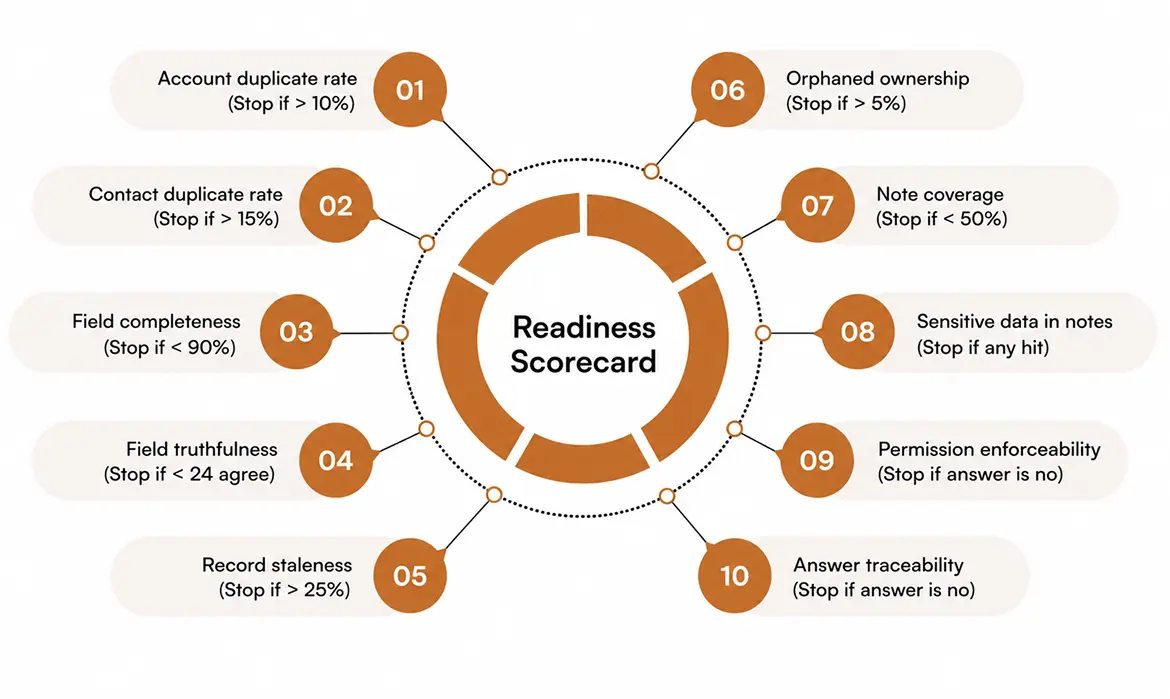
| Dimension | How to measure it | Stop if |
|---|---|---|
| Account duplicate rate | Fuzzy match: normalised name + domain, free-mail excluded | Above 10% |
| Contact duplicate rate | Exact email, plus fuzzy name match within the account | Above 15% |
| Field completeness | Percent non-null on the named list, open records | Below 90% |
| Field truthfulness | 30 random open records checked against a second source | Fewer than 24 agree |
| Record staleness | Open opportunities with zero activity in 90 days | Above 25% |
| Orphaned ownership | Open records owned by deactivated users | Above 5% |
| Note coverage | Open opportunities with a note in the last 60 days | Below 50% |
| Sensitive data in notes | Regex scan: ID numbers, card patterns, approved keywords | Any unremediated hit |
| Permission enforceability | Can retrieval filter by the asking user's live sharing? | Answer is no |
| Answer traceability | Can every answer cite the record IDs it read? | Answer is no |
The last two are binary, and they're where projects quietly fail. Everything above them is a cleanup budget. Those two are architecture, and no amount of hygiene rescues a platform that can't do them.
Which first use case survives imperfect data?
Summarising beats predicting on imperfect data. A summary can be checked against the records it cites, and a wrong one is visible in seconds. A prediction hides its inputs, can't be verified in the moment, and absorbs every error in the fields it consumed. Start where the user can see the evidence.
Rank candidates by verification cost. A pre-call brief shows its work, and the rep catches the error before a customer does. Lead scoring shows nothing: a score of 82 looks identical whether it came from clean records or from four duplicates and a close date from 2023. Summaries also degrade gracefully. A brief that cites what it read just comes back thin.
Who owns a field after the AI writes to it?
Once AI writes to a CRM field, that field needs a provenance flag, a named human owner, and a documented conflict rule. The workable pattern is a draft state: the model writes to a shadow field, a person confirms or edits, and the confirmed value moves to the field of record with its source and timestamp attached.
The failure to design out is silent overwrite. A rep updates Next Steps after a call, the nightly job regenerates it from the transcript, and the rep's version is gone with no error raised. Two weeks of that and the field is noise. Then the audit question: a challenged forecast number traces back to "the model wrote it in July." Name a person per AI-written field, not a team.
How do you measure whether it worked?
Measure adoption, correction rate, and time-to-answer, in that order. Correction rate is the strongest quality signal you have: the share of AI-generated values a human edits before saving. Falling corrections alongside rising adoption means the system is earning trust. Rising corrections means the readiness gate was passed too early.
Baseline before you build. Without a number for how long a pre-call brief takes today, the post-launch review is a debate about impressions, so time five reps with a stopwatch for a week. And skip the volume metric: "four thousand summaries generated this quarter" tells you a cron job ran. For numbers that survive a CFO, see how to measure AI ROI.
The readiness checklist, in order
Run these in sequence. Each gates the next, and the order matters, because measuring fields before you've chosen a use case wastes a week.
- Name the use case in one sentence. "A pre-call brief for the account owner," not "add AI to the CRM."
- List the fields it reads. Six to ten. That list scopes everything below.
- Measure duplicate rate on accounts and contacts, fuzzy matched, free-mail excluded.
- Measure completeness on that list, open records only.
- Spot-check 30 records for truth. Fill rate alone is meaningless.
- Reassign or archive orphaned records and close what's idle a quarter.
- Scan notes for sensitive content before any indexing job runs.
- Confirm per-user permission filtering at query time, against live sharing.
- Confirm traceability. Every answer cites the record IDs behind it.
- Score the gate and write the numbers down. One red stops.
- Assign ownership and provenance for each AI-written field.
- Baseline your metrics before the first line of integration code.
If steps 3 through 6 fail, the honest plan is a remediation engagement followed by an AI build, priced as two things. Selling it as one is how both get delivered badly. At Shanti Infosoft we run this gate before scoping, because a CMMI Level 5 process makes it awkward to promise a date on inputs nobody has measured. For a second opinion on where your CRM sits, book a call and bring a read-only export.
Frequently Asked Questions
How long does CRM cleanup take before we can start an AI project?
It depends on scope, and scoping to a single use case turns a multi-month program into a few weeks. Deduplication is the long pole, because merges need survivorship rules and a review queue.
Can't the AI just handle the duplicates itself?
It can spot that several records look similar. It can't tell you which is authoritative, because that fact isn't in the data anywhere. Ask the model to guess and the answer changes between runs.
What if our reps won't fill in fields no matter what we do?
Design the use case around what they already produce: calls, emails, meetings. Extraction from activity data beats enforcement through required fields. A field that only exists because someone was forced to type it is unavailable.
Is it safe to index CRM notes that contain personal data?
Only with a scan, a remediation pass, and per-user filtering at query time. Indexing removes the practical obscurity that kept a note private. It was visible before, but nobody would have found it.
Should we start with our CRM vendor's built-in AI or a custom integration?
Try the built-in feature and score it against this same gate, honestly. It fails on the same data problems yours would. Vendor tools fall short on answering across systems and enforcing your own permission model.
Have a project in mind? Let's scope it together.
You get a named team, written estimates, full code and IP ownership, and 48-hour response times. CMMI Level 5 certified. 700+ projects delivered across the UK, US, UAE, and Australia.