


A partner,not a vendor.
The website for WK Digital, an Australian technology consultancy building custom software and AI automation for regulated industries - healthcare, aged care, education, government and logistics - on Australian-hosted infrastructure since 2008.
A consultancy that leads with the long relationship
The site's whole argument is 'not a vendor, a long-term technology partner': deep sector knowledge, Australian-hosted infrastructure, and engagements that usually start with one automation and grow from there. It is a corporate website built to make that positioning legible, from the services architecture down to the case-study wall.
Built for regulated sectors
Healthcare, aged care, education, government and logistics - where compliance, privacy and data sovereignty shape every build.
Australian-hosted by design
Infrastructure kept onshore so clients own the design and the data, and stay Privacy Act compliant by default.
Partner, not project
The positioning is a long relationship over a one-off delivery, and the site is structured to prove that at every scroll.
How does a consultancy site prove depth rather than claim it?
Anyone can say 'custom software.' WK Digital's site earns the claim by naming exactly what it builds, for exactly which constrained industries, and how an engagement grows - so a buyer sees substance before they ever book a call.
A buyer can't tell a vendor from a partner on claims alone. Answer → an entry point named as a single, low-risk integration, not a large upfront commitment.
Compliance-bound buyers need data residency answered, not implied. Answer → 'Australian-hosted' as a headline promise, not a footnote.
Sector knowledge is easy to claim and hard to prove. Answer → an industries section that names healthcare, aged care, education, government and logistics by name.
regulated industries named by name - healthcare, aged care, education, government, logistics.
What does the WK Digital site have to get right?
Anyone can say 'custom software.' WK Digital's site earns the claim by naming exactly what it builds, for exactly which constrained industries, and how an engagement grows.
Prove it, don't just say it
- Name exactly what gets built. AI automation, custom software and AI-first web platforms, spelled out, not implied.
- Answer data residency upfront. Australian-hosted infrastructure as a headline, not a footnote.
- Prove sector knowledge. Healthcare, aged care, education, government and logistics named by name.
- Frame the engagement as a relationship. One low-risk automation first, growing into a roadmap.
Why it was hard
- Anyone can say 'custom software.' Claims are cheap; the site has to earn the word with specifics.
- Compliance buyers ask about data residency first. The answer has to be visible before they ask, not after.
- A vendor and a partner look identical on a landing page. The difference has to show up in the site's structure, not just the copy.
- Cautious buyers distrust adjectives. 'Robust' and 'scalable' do less work than a named sector or a real integration.
Three claims the site has to back up
Anyone can write 'custom software' on a homepage. WK Digital's site earns each claim with its own section, backed by a real screenshot rather than an adjective - 3 claims, each proven on its own page.
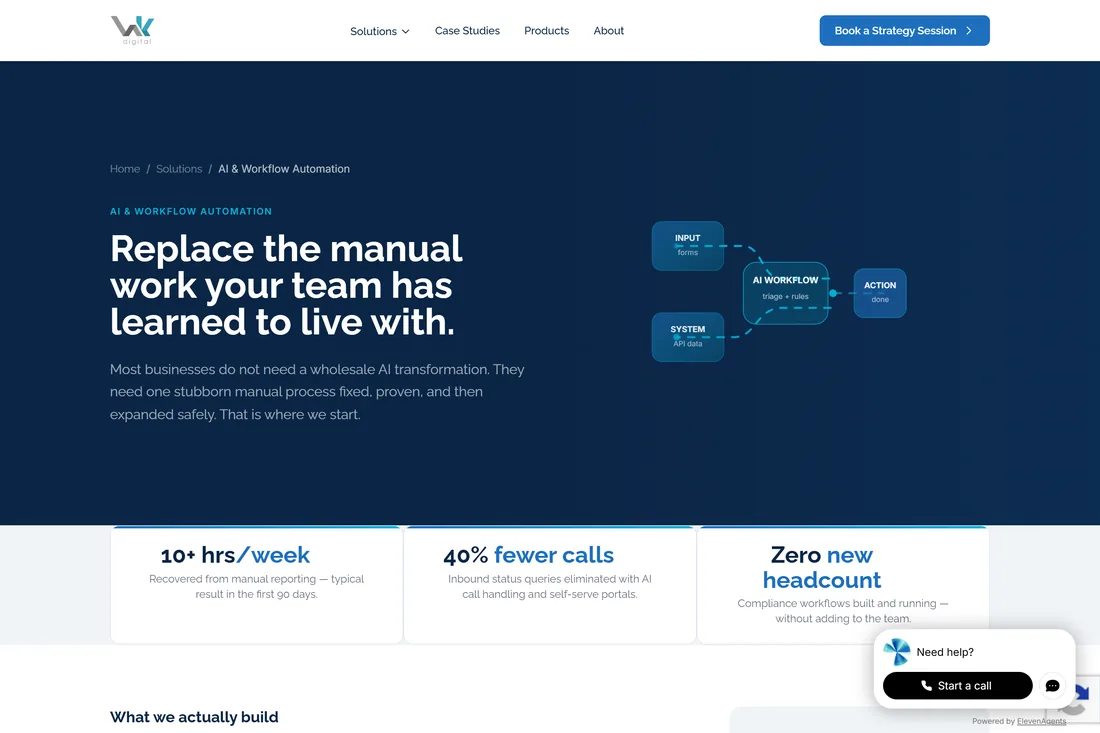
AI & automation
The site leads with a low-risk entry point: replace a single manual process, let the result build the appetite for what comes next.
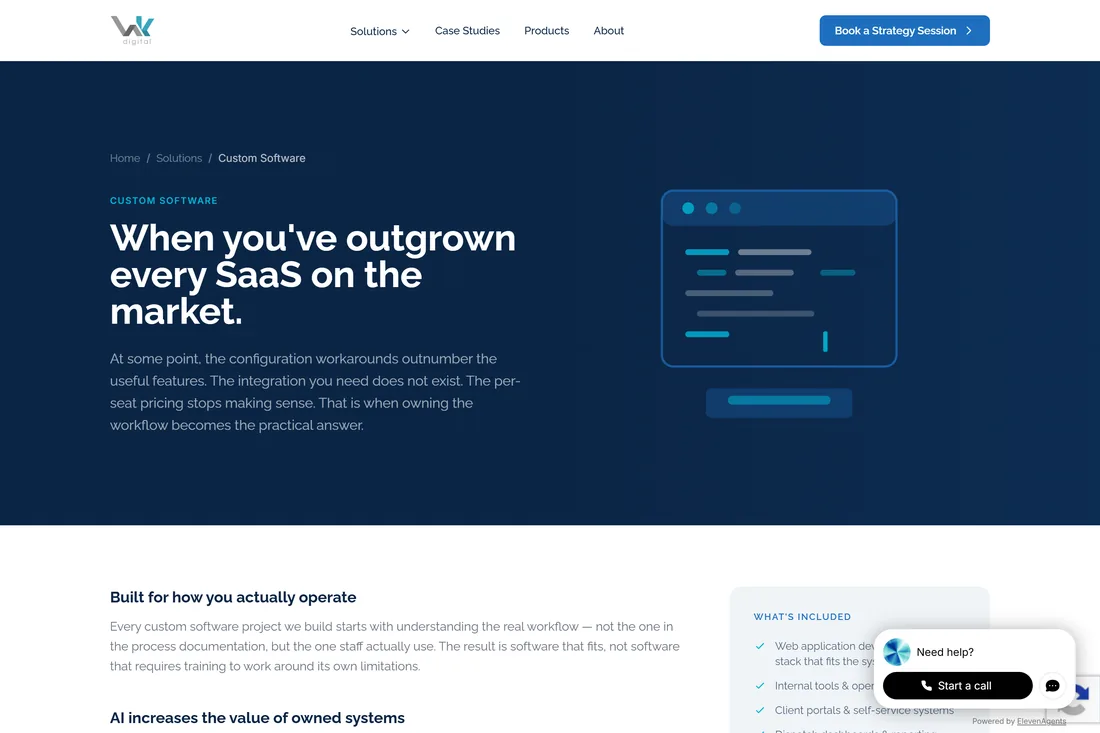
Custom software
For businesses that have outgrown off-the-shelf tools, the site frames bespoke software as the layer everything else is built on.
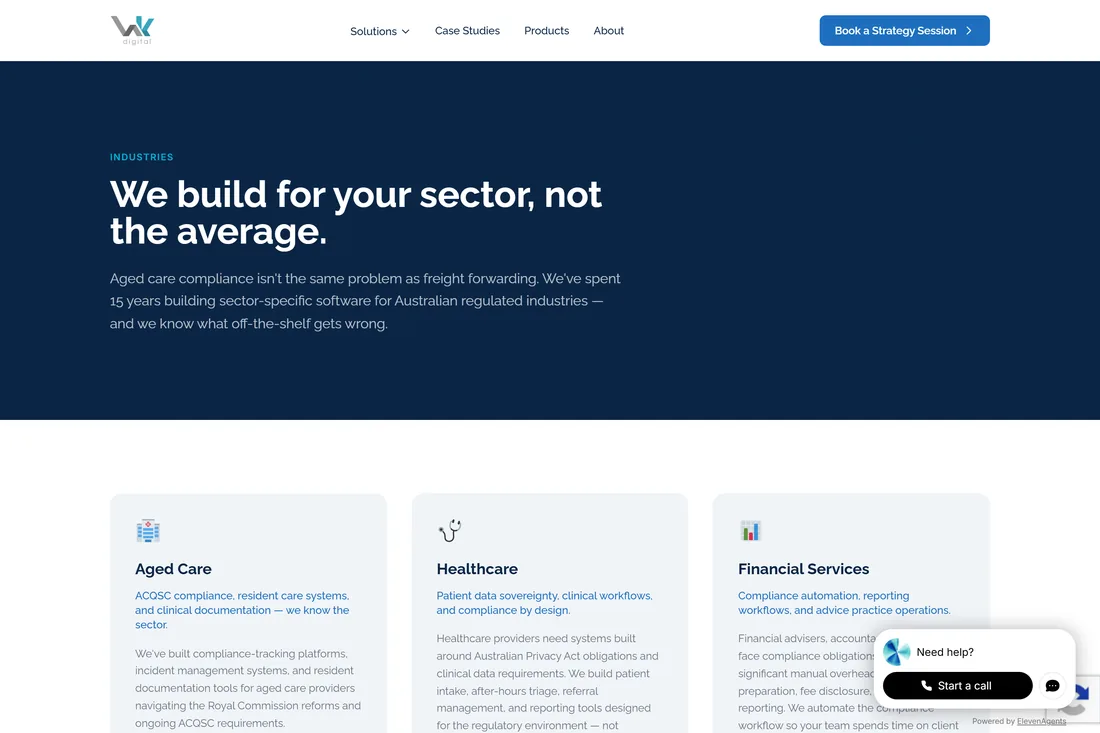
Deep sector knowledge
An industries section spells out the regulated sectors WK Digital knows, so a buyer's constraints are understood before they explain them.
What is the WK Digital homepage doing in the first screen?
Before a buyer scrolls, the hero already answers who this is for and what makes it credible. Hover a pin to see what each element is doing.
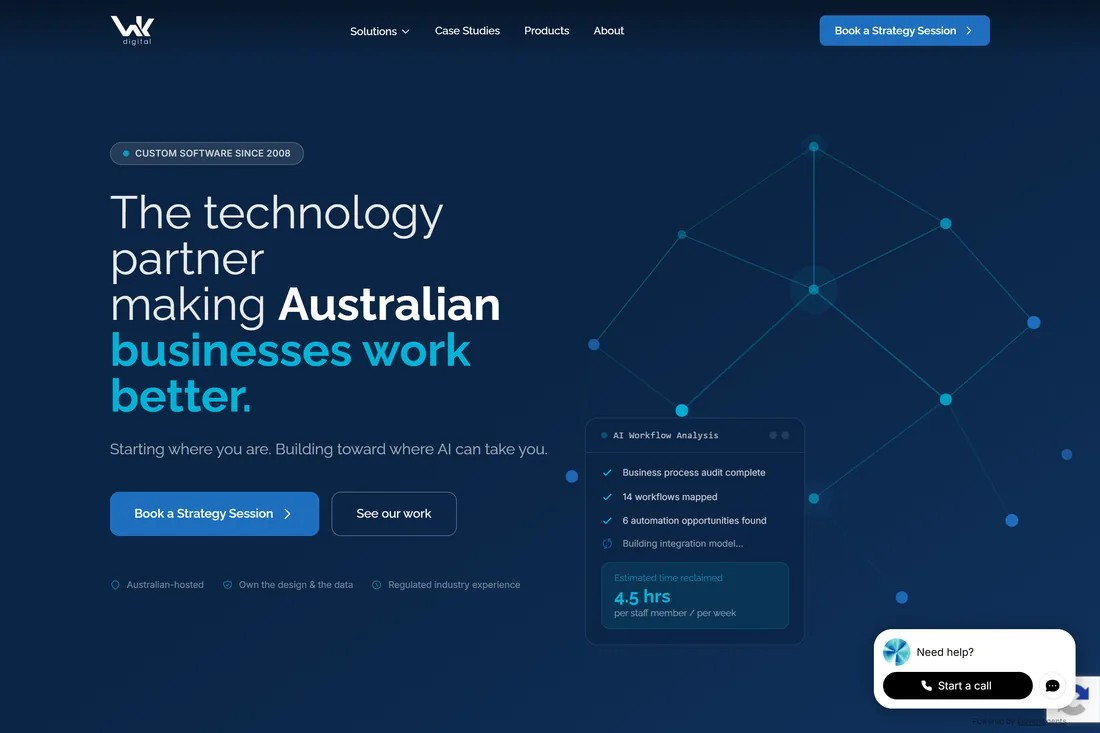
The hero badge doesn't say 'trusted since forever' - it says 2008. A specific year reads as a checkable fact, not a slogan.
Most consultancy homepages open on a generic mission line. This one states the exact positioning - 'the technology partner' - and names the outcome, not the service.
A cold visitor and a ready buyer want different next steps, so the hero offers both: book a strategy session, or go verify the claim in the case studies first.
Australian-hosted, who owns the design and data, and regulated-industry experience are answered in the first screen, before a buyer has to ask.
Instead of an abstract illustration, the hero shows a concrete automation output - workflows mapped, opportunities found, hours reclaimed per week.
What does the site look like, and why?
A deep Australian navy carries the structure, with a confident blue reserved for action and a bright cyan for the highlights and live-system flourishes. The result reads as engineering-serious rather than agency-flashy - appropriate for buyers in compliance-heavy sectors.
Building a consultancy website
What does WK Digital build?
Why does 'Australian-hosted' matter for regulated industries?
How should a consultancy website prove experience?
What is 'AI-first web platforms'?
How long does it take to build a site like this?
Need a site that sells serious technical work?
Tell us what your business actually builds and we'll tell you honestly what it takes to make the site prove it - the positioning, the case studies, the trust signals. No deck, no pitch.