


Five roles, one care record
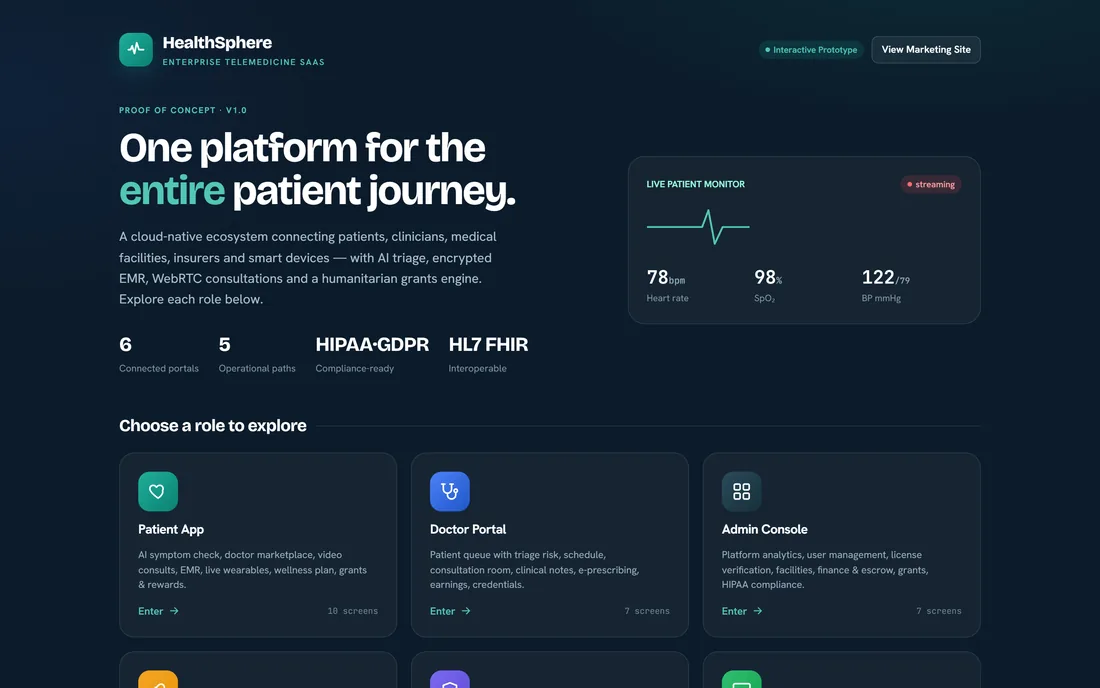
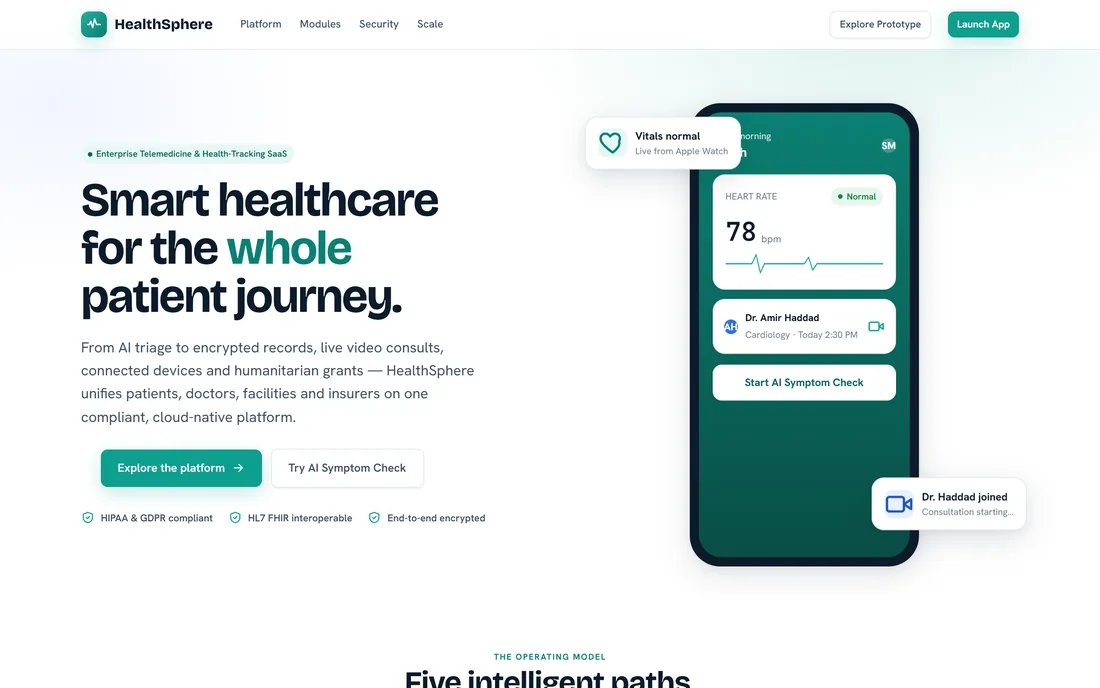
An enterprise telemedicine platform: a patient app, a clinician portal, an admin console, a medical-facility surface and an insurer view, all reading and writing the same encrypted record.
Sector
- Digital health
- Telemedicine SaaS
Platform
- Six connected portals
- 24 screens
Surfaces
- Patient app
- Clinician portal
- Admin console
- Facility + payer
What we did
- Role modelling
- UX + UI design
- Front-end build
What problem does it solve?
Telemedicine rarely fails at the video call. It fails at everything around the call - the referral that arrives by fax, the prescription retyped at a pharmacy, the claim rekeyed by an insurer. HealthSphere covers the whole loop instead of one screen of it.
One record, five different jobs to do
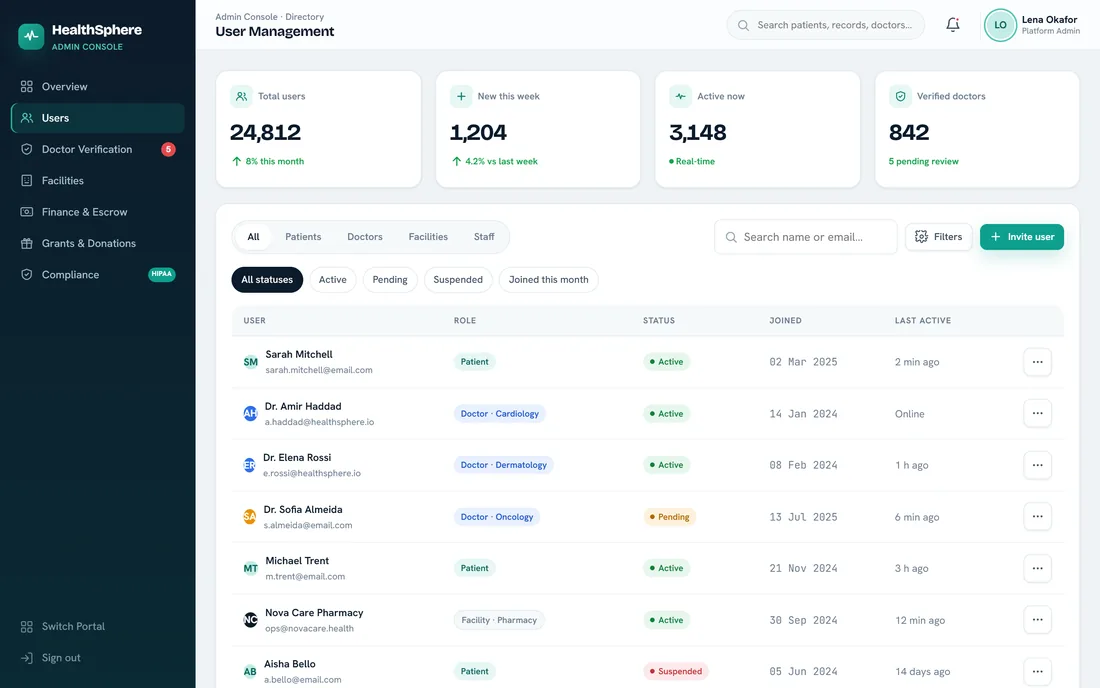
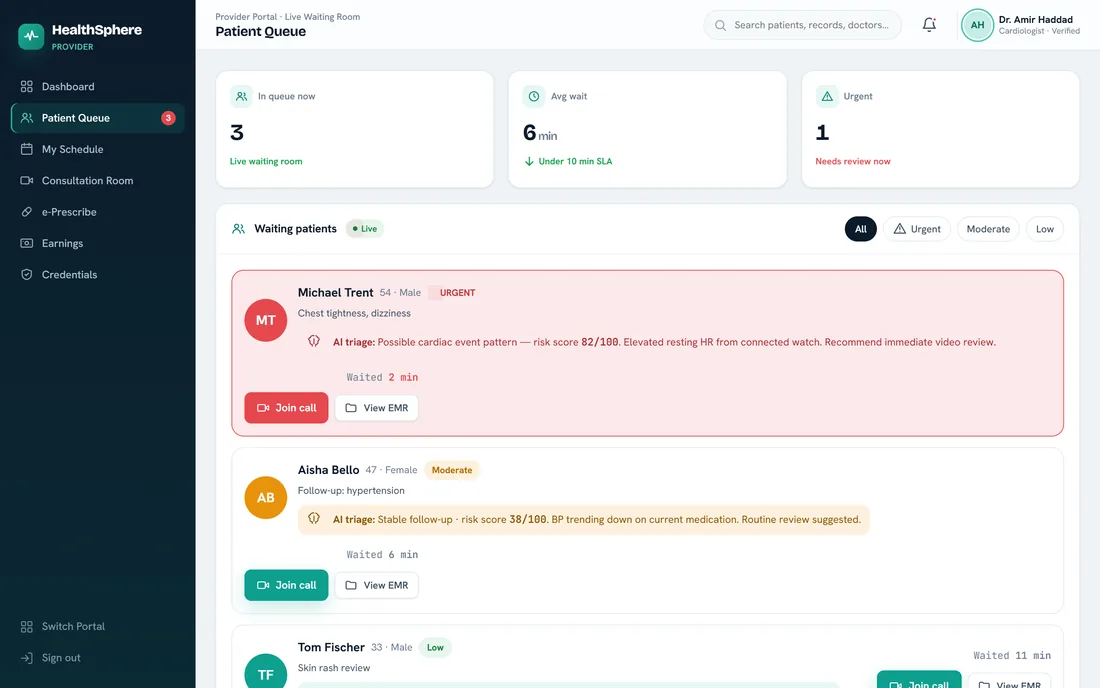
The same consultation looks different to everyone touching it. A patient wants to know when the call starts; a doctor wants triage risk before they join; a pharmacy wants a signed script; an insurer wants a claim it can adjudicate. HealthSphere gives each of them their own surface over one shared record rather than five disconnected tools.
Why is multi-role healthcare software so hard to build?
Three constraints break a single-surface telehealth app the moment it meets a real health system. A platform has to hold all three at once: every party sees a different slice of the same record, clinical urgency has to be triaged before a human is available, and the record has to be defensible to a regulator.
| Step in the journey | Disconnected tools | In HealthSphere |
|---|---|---|
| Symptom to clinician | Patient guesses which specialty to book | AI triage scores urgency and routes to a matched clinician |
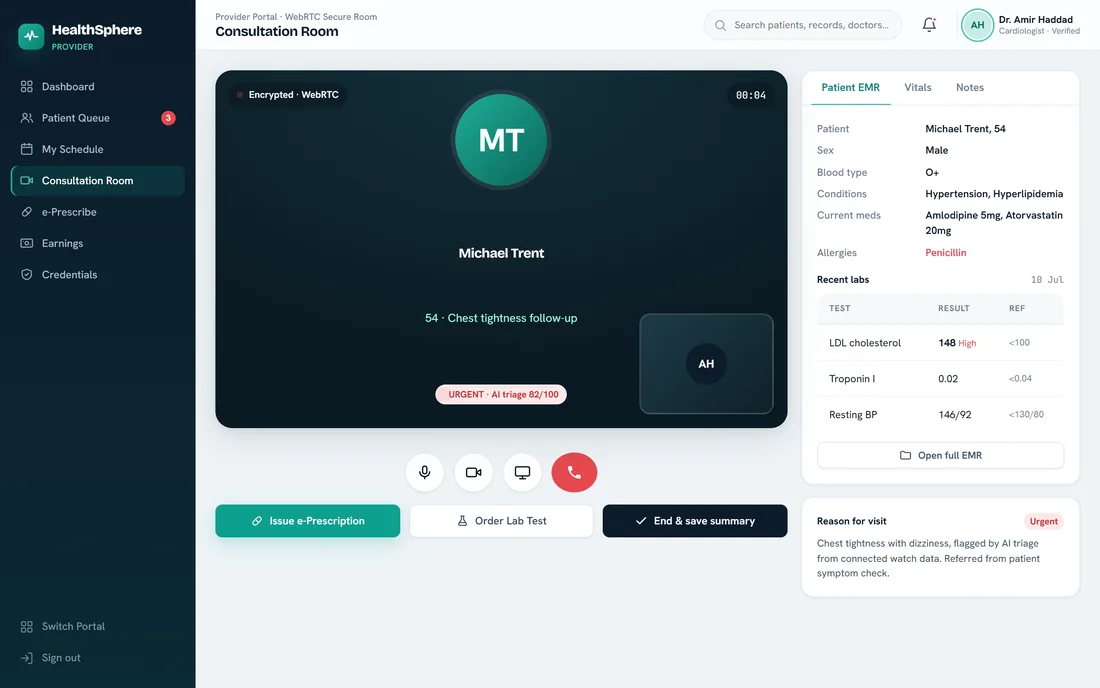
| The consultation | A generic video link outside the record | Consultation room attached to the patient's record and notes |
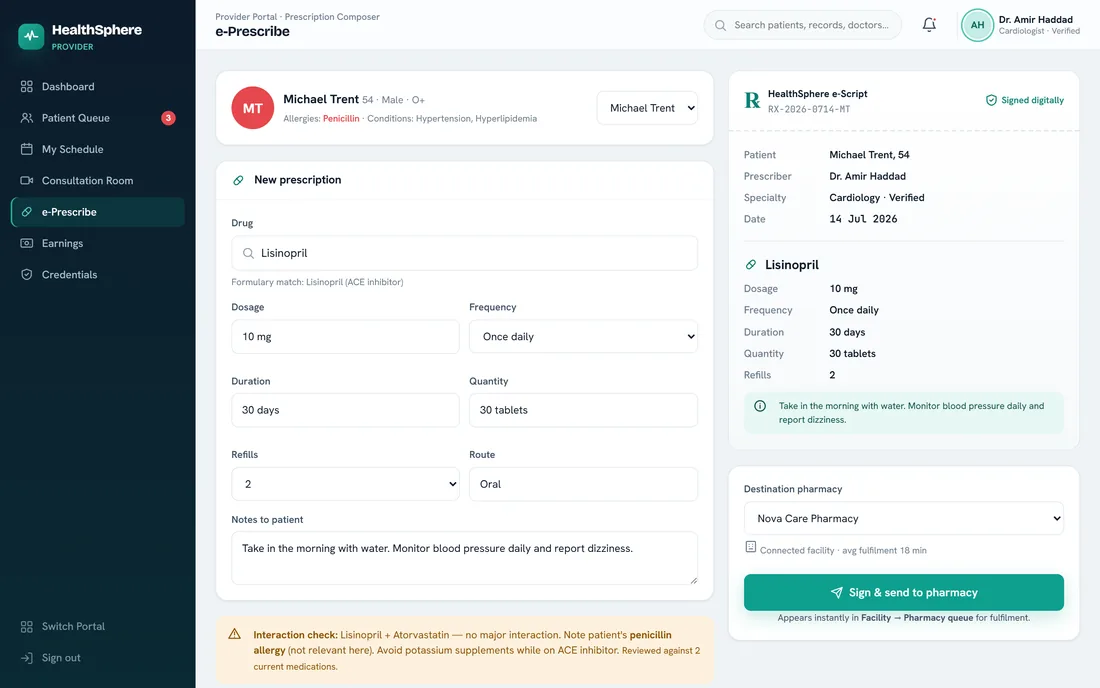
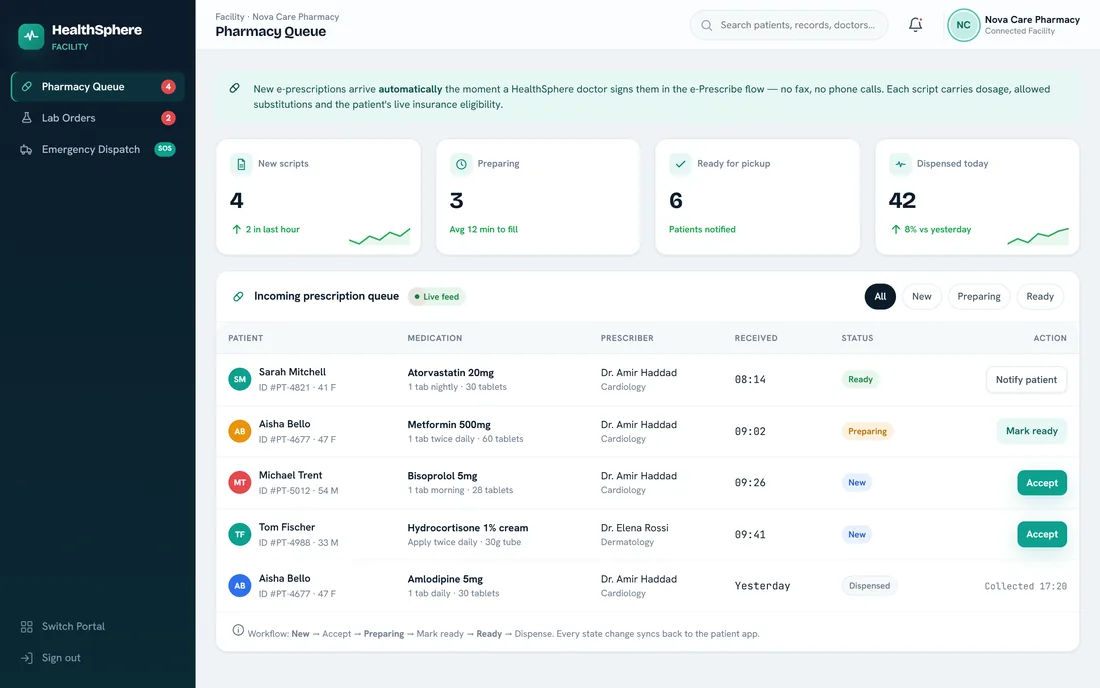
| Prescribing | A script printed, photographed or faxed | e-Prescribe signs it into a connected pharmacy's queue |
| Lab work | A form handed to the patient | Lab order placed and the result uploaded back to the record |
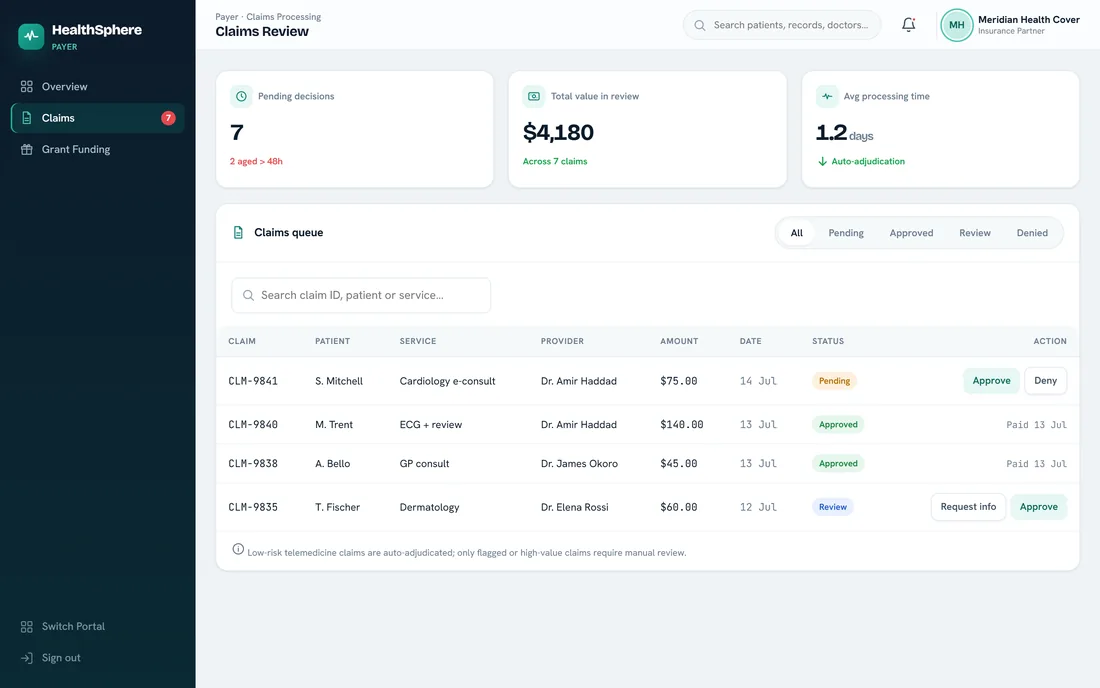
| Paying for it | Claim rekeyed by the insurer weeks later | Claim raised against the consultation in the payer portal |
| Patients who cannot pay | An informal charity process off-system | Anonymised grant case funded through the platform |
What does it do, screen by screen?
The path below follows one patient from a symptom, through a consultation, to a prescription waiting at a pharmacy and a claim sitting with an insurer - each step handled by a different role on the same record.
Encrypted EMR
Core moduleOne auditable medical record carrying history, labs and prescriptions, end-to-end encrypted with an audit trail and FHIR export so the data can leave the platform in a standard shape.
- End-to-end encryption
- Audit trail
- FHIR export
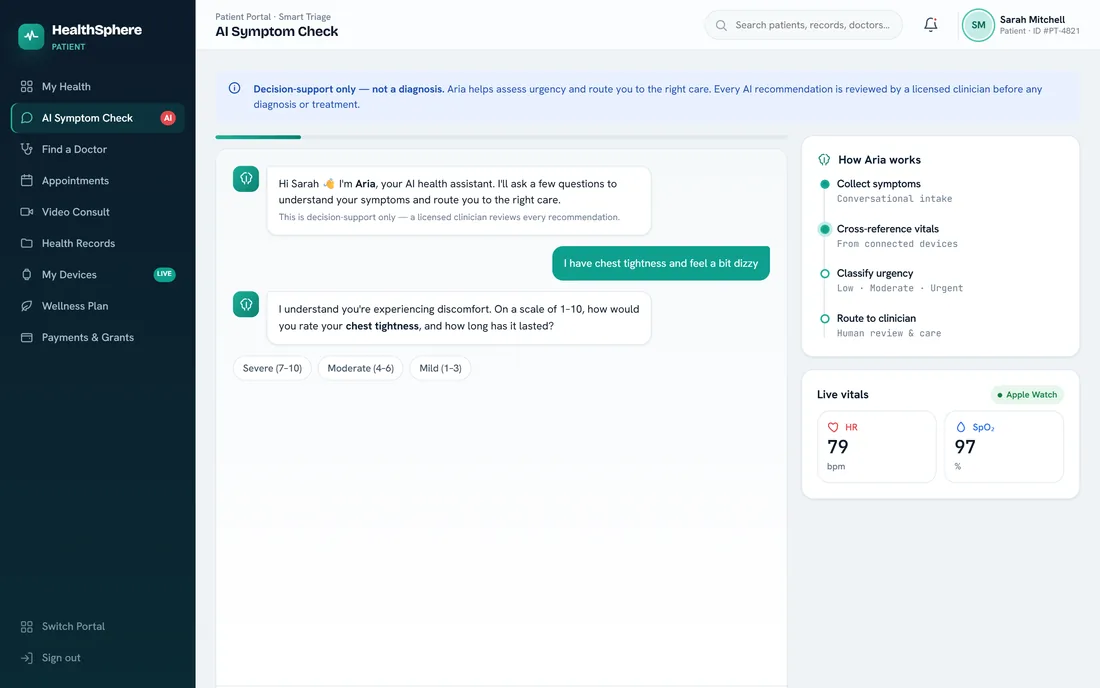
AI triage & governance
Core moduleSymptom capture and urgency classification, framed as decision support with a human in the loop and explicit guardrails.
- Risk scoring
- Human in the loop
Consultations & scheduling
Core moduleBooked and instant visits, virtual waiting rooms and secure video built on WebRTC.
- Waiting rooms
- WebRTC video
Payments, insurance & grants
Core moduleDirect pay and insurance coverage sit next to a grants engine that funds humanitarian cases through anonymised profiles, plus a points and rewards loop for healthy habits.
- Insurance claims
- Donation campaigns
- Points & rewards
Trust & compliance
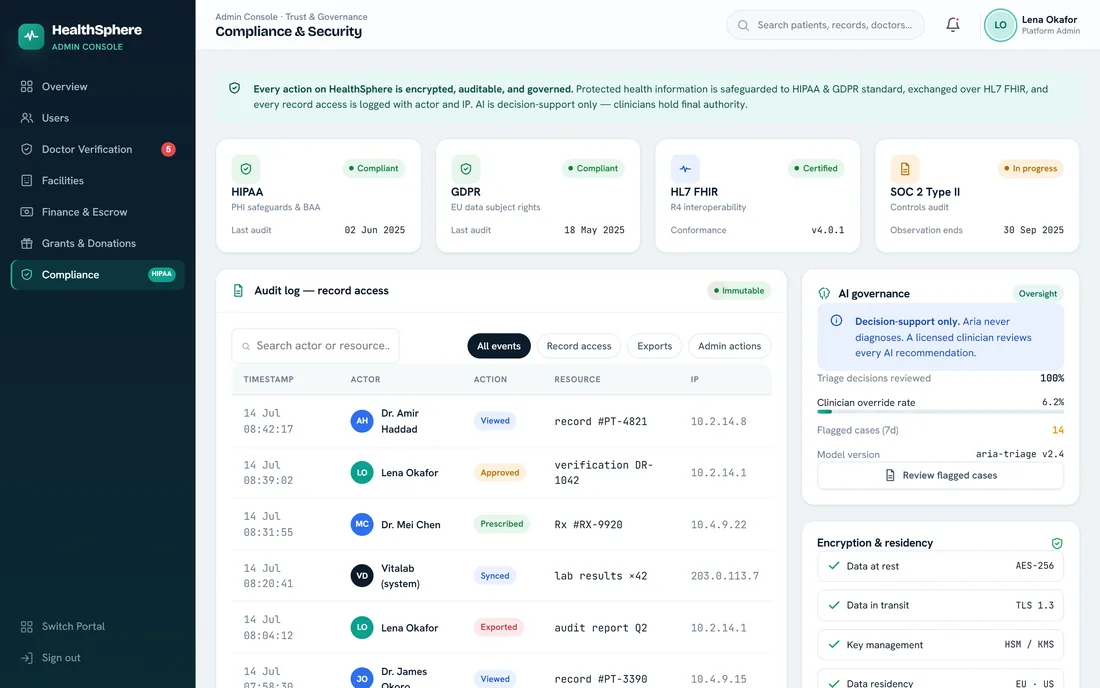
Platform postureHIPAA and GDPR alignment, HL7 FHIR interoperability and encryption at rest and in transit, with a compliance console in the admin portal.
- HIPAA · GDPR
- HL7 FHIR
Connected facilities
3 facility typesPharmacies, laboratories and ambulance dispatch receive work from the platform automatically rather than by phone.
- Pharmacy queue
- Lab orders
- Emergency dispatch
What does each role actually see?
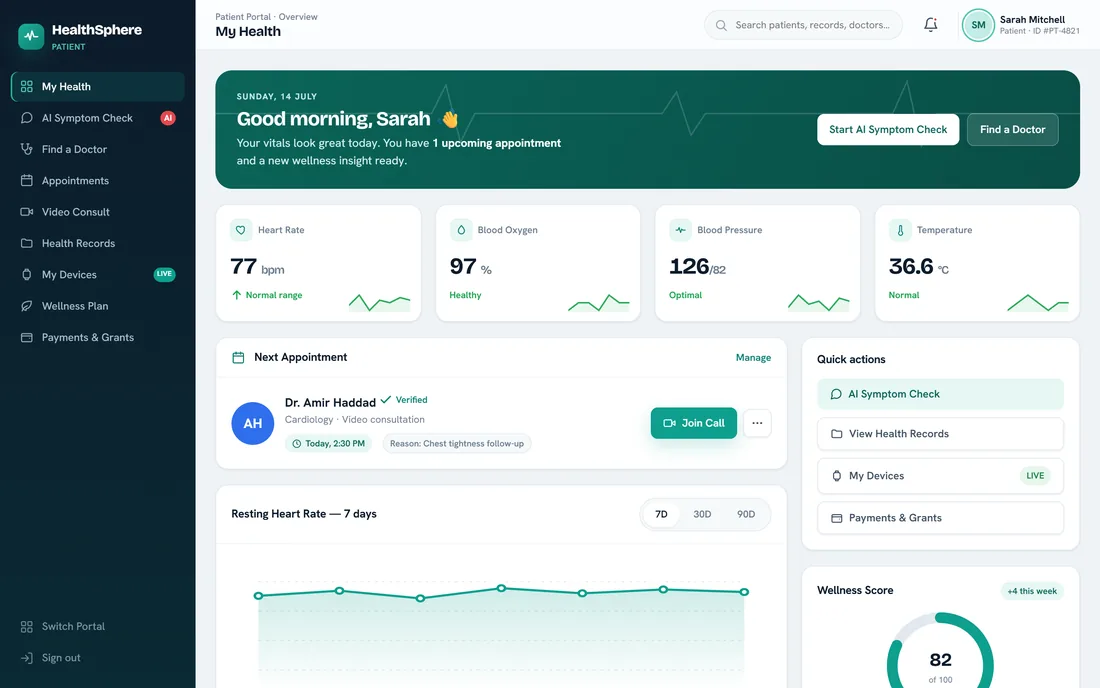
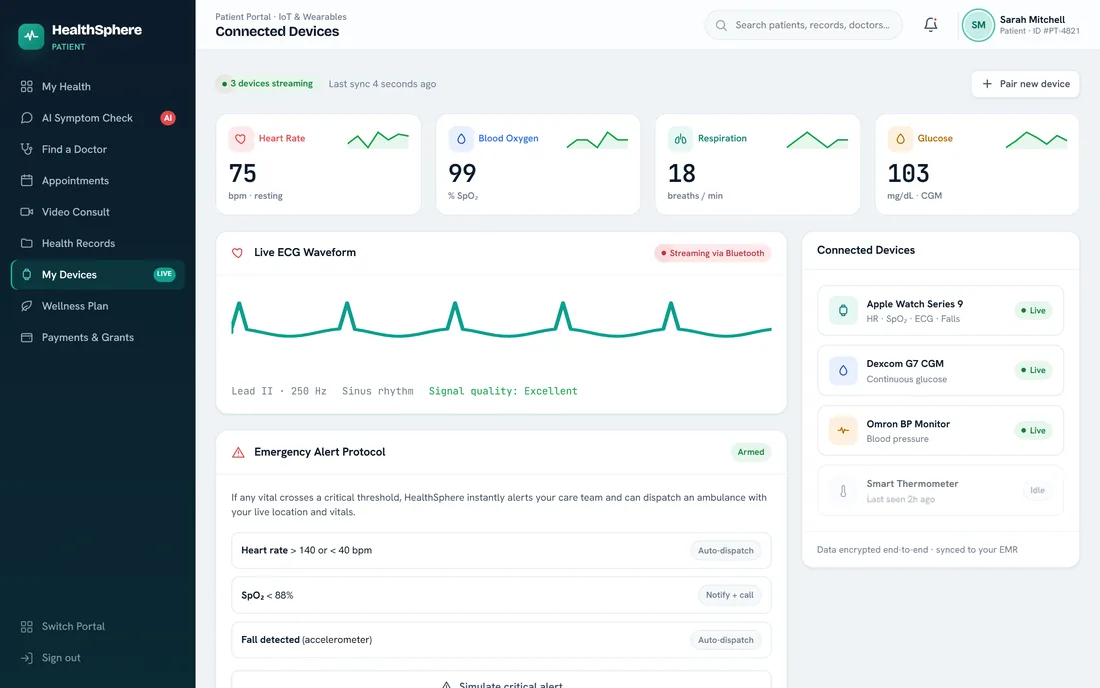
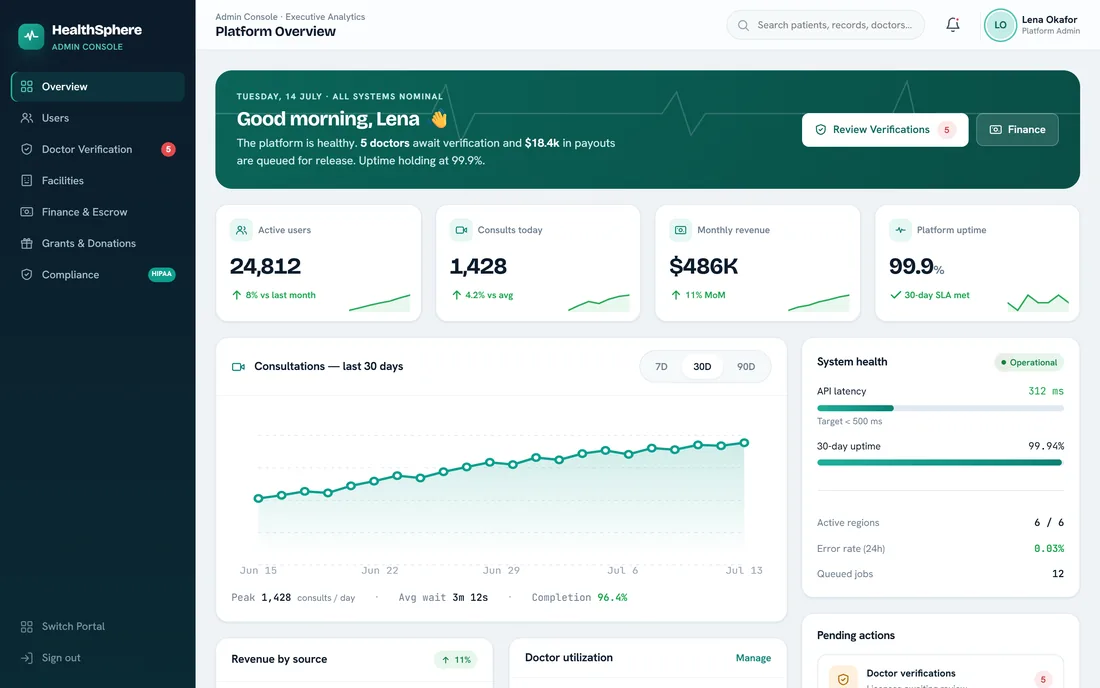
Six portals: five operational roles plus the public marketing site. Pick a persona to swap the screen. The chips under the screen list the patient's own capabilities, the first persona in the list.
- Run an AI symptom check
- Join a video consultation
- Stream vitals from a wearable
- See the care plan and next appointment
- Follow a wellness score and points
What does any multi-role health platform need?
Six things separate a telemedicine platform a health system can actually operate from a video-call app with extra screens. They came out of building this one, and they hold well beyond it.
- One record, many lenses. Model the record once and give each role a view of it. Five separate apps that sync later is how you end up with five versions of a patient's history.
- Triage before the human. If urgency is not scored at intake, the queue orders itself by who typed fastest - and clinical risk hides at the bottom of it.
- AI that is explicitly decision support. Say it in the interface, not just the terms of service. A symptom checker that looks like a diagnosis is a regulatory problem waiting to happen.
- Downstream parties inside the system. Pharmacies, labs and dispatch have to receive work in software, or the last mile falls back to fax and the audit trail stops at the consultation.
- Compliance as structure. Encryption, audit trails, licence verification and standards export are architecture decisions. Retrofitting them costs more than building them first.
- A funding path for patients who cannot pay. Insurance, direct pay and grants are three different money flows over the same care. Pretending there is only one leaves people outside the system.
What does the interface look like, and why?
A deep clinical navy carries the chrome and a single medical teal is reserved for action and for anything reading as healthy. Status colours are kept strictly semantic - green for in range, amber for watch, red for urgent - because in a clinical interface colour is information, not decoration.
Aa
Primary typeface
Hanken Grotesk
A B C D E F G H I J K L M N O P Q R S T U V W X Y Z
a b c d e f g h i j k l m n o p q r s t u v w x y z
0 1 2 3 4 5 6 7 8 9 & ? ! £ $ €
32pxGood morning, SarahH122pxSection headingH218pxCard headingH315pxLead copyLead14pxBody text and table cellsBody11pxPATIENT PORTAL · OVERVIEWEyebrowVitals and record IDs are set in a monospaced face with tabular figures so a column of readings stays legible at a glance, and the type scale stays tight because clinical screens carry a lot of data per row. Hanken Grotesk, Bricolage Grotesque and JetBrains Mono are open-licence typefaces; the specimen above falls back to the nearest available face if they are not installed on your device.
How long does it take to build a telemedicine platform?
A platform of this shape - five roles, a shared medical record, video consultations and downstream facilities - is a multi-month programme, not a few weeks. What moves the date most is not screen count but how much compliance work is in scope and how many external systems have to be integrated. We phase it so one role ships and is used before the next portal is opened.
How much does a telemedicine app cost to develop?
It depends on scope, and nobody can quote it honestly from a feature list alone. The biggest cost drivers are the number of distinct user roles, whether prescribing and claims are in scope, and the level of regulatory assurance you need. Shanti Infosoft scopes it on a short call and returns a fixed quote within 48 hours.
Is a telemedicine platform HIPAA compliant out of the box?
No platform is compliant by itself - compliance is a property of the whole operation. What software can do is make it achievable: encryption at rest and in transit, an audit trail on every record access, role-scoped permissions, verified clinician credentials and standards-based export. HealthSphere treats those as structural, which is the part that is expensive to add later.
Can AI triage replace a doctor?
No, and it should not be presented as if it could. Here AI triage collects symptoms and classifies urgency so the queue is ordered sensibly. A licensed clinician still makes the diagnosis. Building it any other way turns a support tool into a regulated medical device.
Can a platform like this integrate with existing hospital systems?
That is what the FHIR layer is for. HL7 FHIR export means the record can be exchanged with an EMR, a laboratory information system or a payer platform in a standard shape rather than through a bespoke file drop. In practice each integration still needs mapping work, which is why we scope integrations individually rather than promising a universal connector.
Related work
Planning a health platform of your own?
Tell us how your business actually works and we will tell you honestly what it takes to build. See more of our work or what we do.
Book a 15-minute call