


Read, ranked, ready to lodge
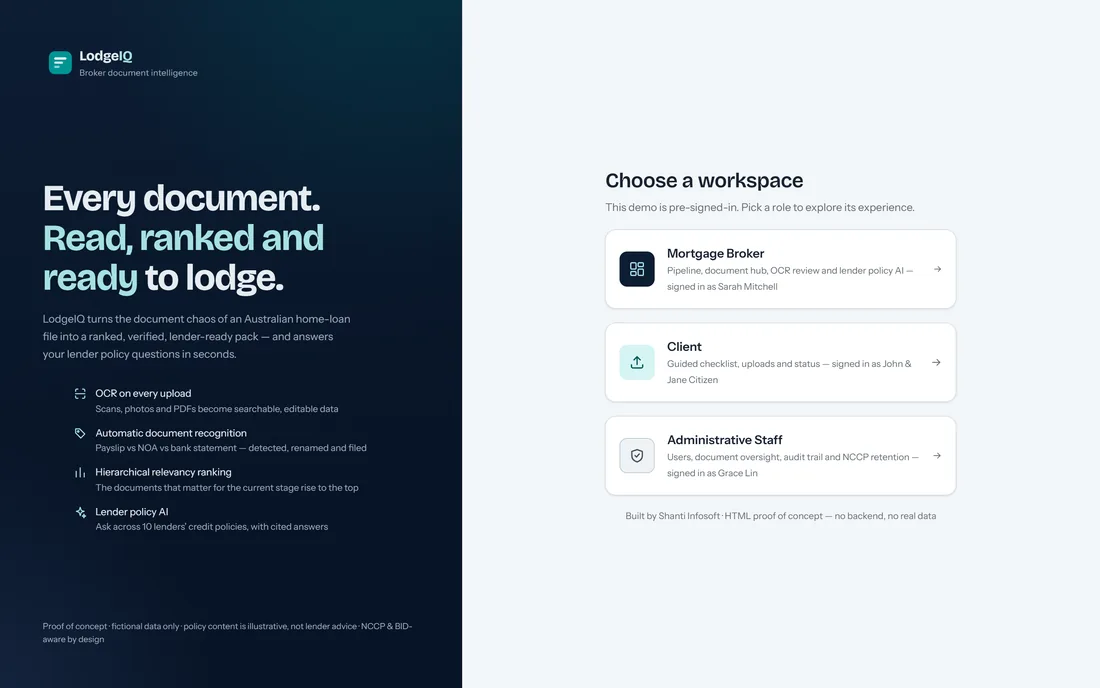
A document platform for Australian mortgage brokers: every upload is OCR'd, recognised by type, renamed, filed and ranked against the file's current stage - and a policy assistant answers credit-policy questions with the source documents attached.
Sector
- Mortgage broking
- Australian home lending
Capability areas
- Document pipeline
- 3 workspaces, 7 screens
What we did
- Workflow modelling
- UX + UI design
- Front-end build
Document engine
- OCR
- Type recognition
- Relevancy ranking
What is LodgeIQ for?
A home-loan file is not one document. It is dozens, arriving as phone photos, scans and PDFs, from two applicants, over weeks - and the broker is the one who has to know which ones are missing and which have gone stale.
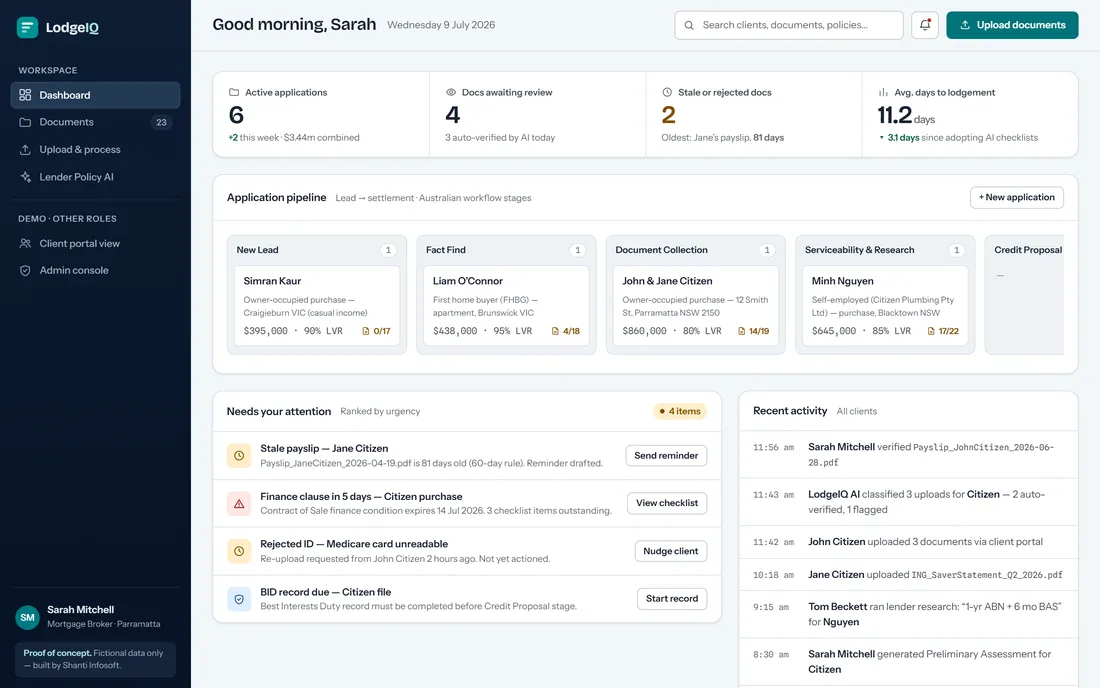
One pipeline, three people looking at it
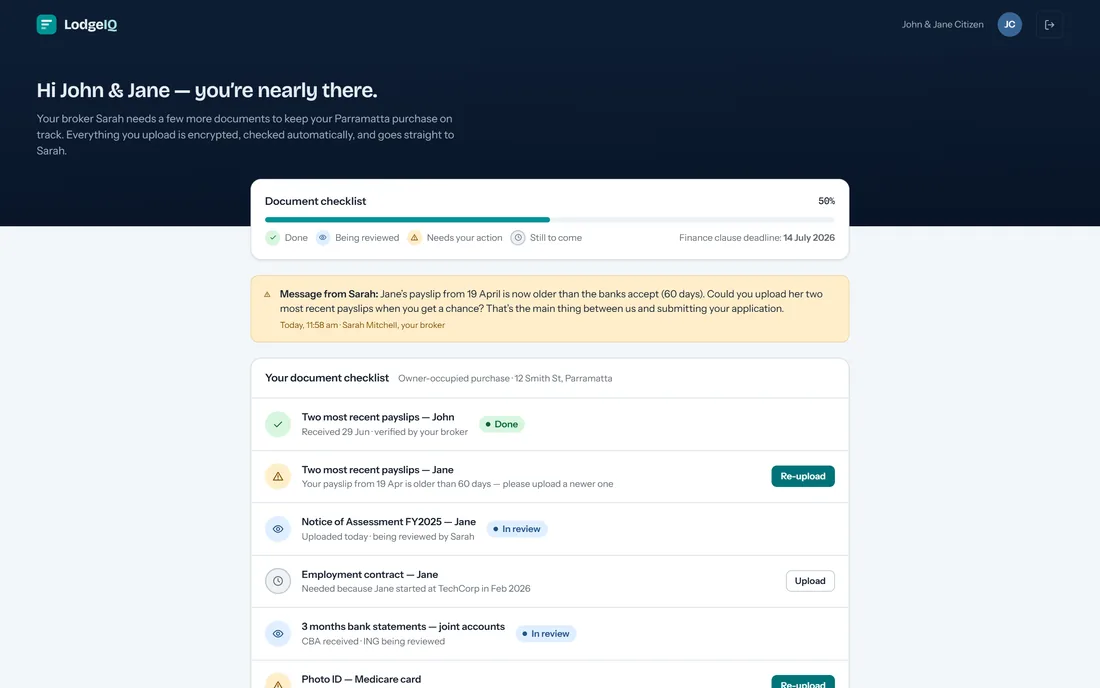
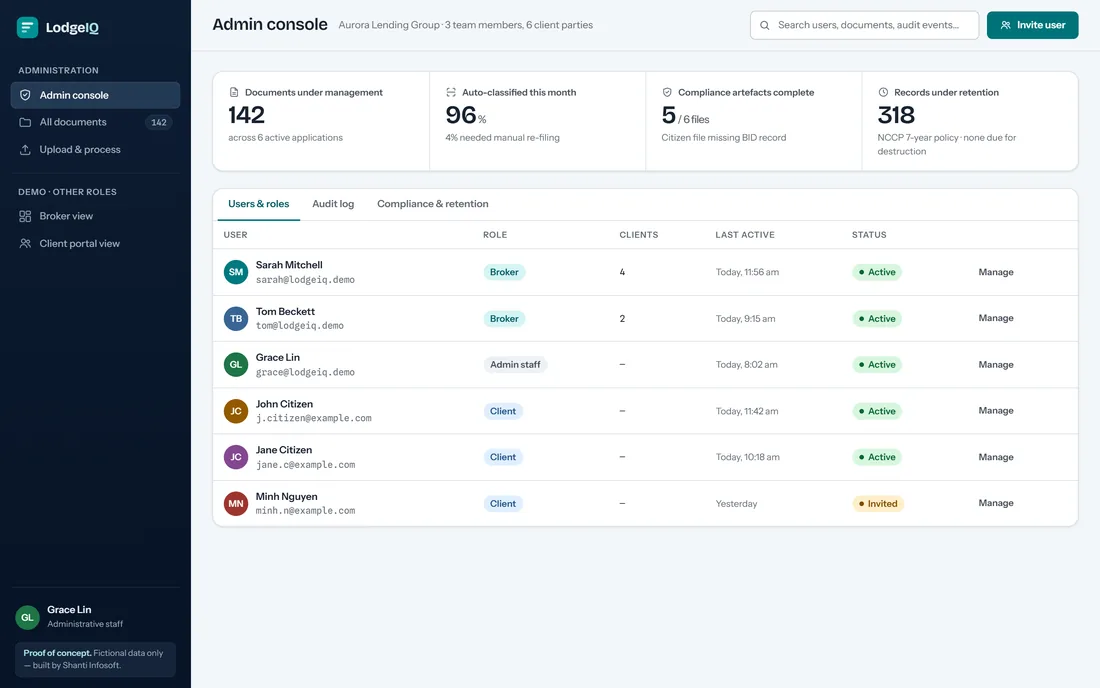
The broker sees a ranked file and a policy assistant. The client sees a plain checklist of what is still needed and why. Administrative staff see who touched what, and how long records must be kept. All three read the same documents, ordered by what the current stage of the application actually requires.
Why does a broker's document pile resist ordinary storage?
Cloud folders and email are not the problem. The problem is that a lending file has rules attached to it, and a folder cannot enforce a rule. Three constraints shape the whole design.
| In a broker's file | Folders, email and memory | In LodgeIQ |
|---|---|---|
| A photo of a payslip | Stored as an image nobody can search | OCR'd to text, including tables, with per-field confidence |
| Naming and filing | Whatever the client called it | Recognised by type, renamed and filed automatically |
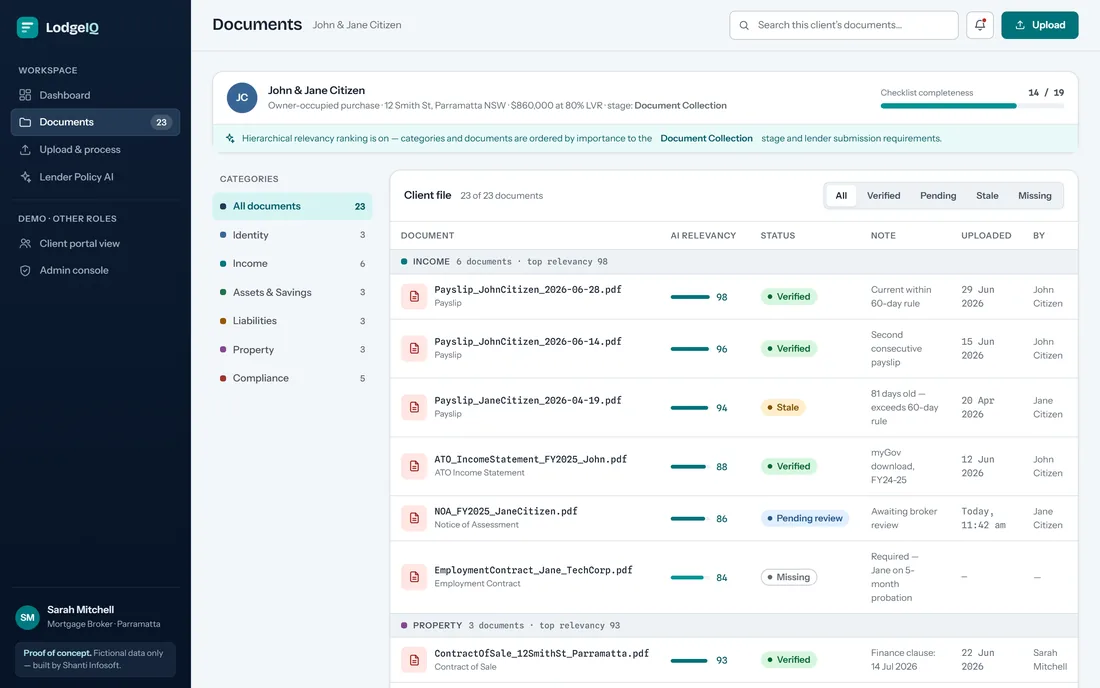
| An ageing document | Discovered at submission | Age rules applied, stale items raised on the dashboard |
| Knowing what is missing | A checklist kept separately | Completeness counted against the stage's requirements |
| Asking the client for more | An email that gets lost | The same item shown in the client's own portal with the reason |
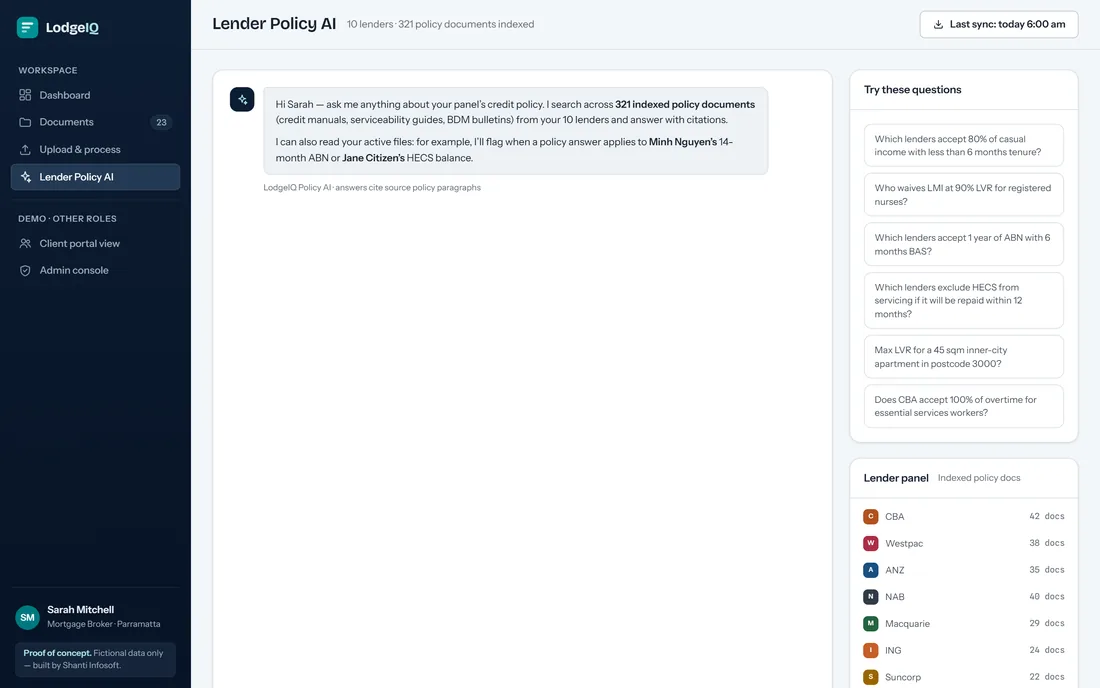
| A lender policy question | Search a PDF, or ring the BDM | Answered across the indexed panel with the sources cited |
What can you actually click?
Three workspaces - broker, client and administrator - each signed in as a different person, so the same lending file can be looked at from all three sides.
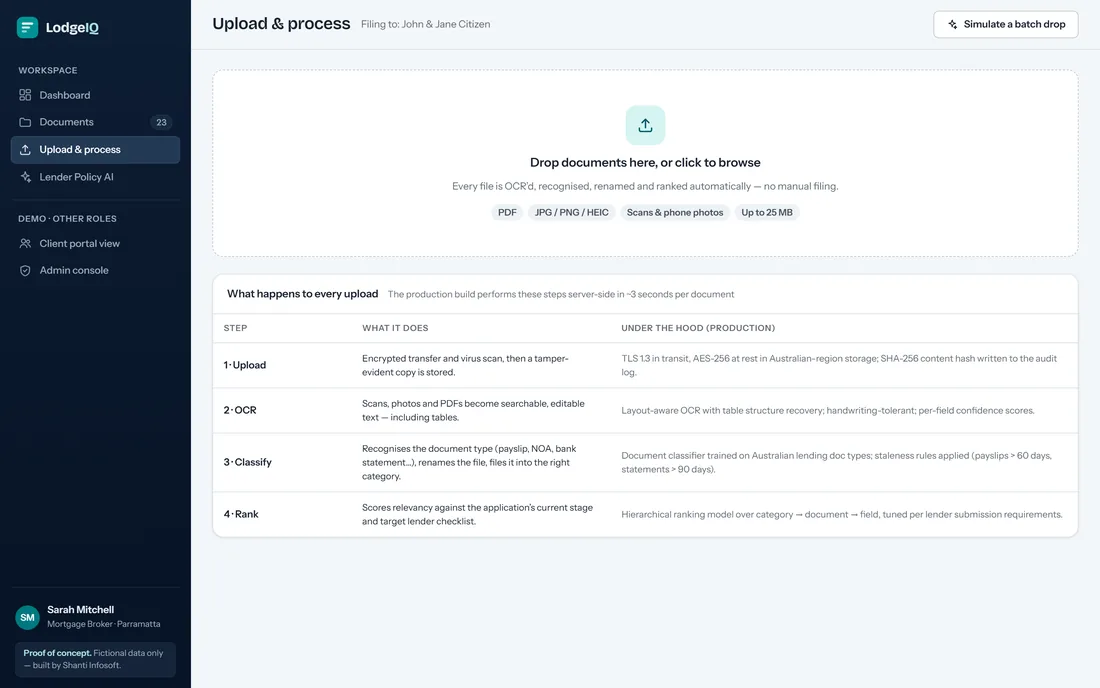
What happens to a document after it is dropped in?
The pipeline runs in four stages, and each one is visible in the interface rather than hidden behind a spinner. This is the part of the product that has to be right, because everything else reads its output.
What does a cited policy answer look like?
This is an exchange from the policy assistant. The point is not the prose - it is that the answer names which lenders it came from, and then relates the rule back to an application already open on the broker's desk.
What does document intelligence have to get right?
Six things came out of building this. They hold for any document-heavy regulated process - lending, insurance, immigration, procurement - not just for mortgages.
- Extraction has to carry a confidence score. A field read from a blurry photo and a field read from a clean PDF are not the same fact, and the interface has to say which is which.
- Classification beats folders. If a person has to choose where a document goes, they will eventually choose wrong - and the rule that depended on it silently stops working.
- Age is part of a document's identity. In a regulated file, a payslip is not valid or invalid - it is valid until a date, so expiry belongs on the record itself.
- Relevance is contextual. Ranking documents by importance only means something once you fix what they are important for: the stage, and the lender being submitted to.
- Give the other party the same list. The fastest way to get a missing document is to show the person who has it exactly which one is missing, and why it came back.
- An audit trail is a feature, not logging. In a regulated practice, being able to show who touched a record and when is part of what the product is for.
Building a document intelligence platform
What brokers and operations teams ask us first, answered plainly.
Ask us yoursHow accurate is OCR on scanned and photographed documents?
Accuracy depends far more on the source than on the engine. Clean digital PDFs extract close to perfectly; phone photos of creased payslips are where the difference between engines shows. So the design answer is not to chase a single number but to attach a per-field confidence score and route low-confidence fields to a human, which is what the review screen does.
Can software recognise a document type automatically?
Yes, and it is one of the higher-value pieces of this kind of system. A classifier trained on the document types of a specific market - payslips, tax assessments, bank statements, identity documents - can identify an upload, rename it and file it without anyone choosing a category. The gain is not the filing itself, it is that every downstream rule can now depend on knowing what the document is.
How long does it take to build a document platform like this?
A first production version of this shape - upload and OCR, classification, a stage-aware checklist and a client portal - is a several-month programme. The variables that move it most are how many document types must be recognised reliably, whether extraction has to reach field level or only page level, and what the record-keeping and audit obligations of the industry require.
Can an AI assistant answer policy questions safely?
Only if it is bounded and cited. An assistant answering from a defined, indexed set of documents and naming the source of every claim is a reference tool. One answering from general knowledge is a liability. LodgeIQ takes the first approach, and still puts a verify-before-advising notice under every answer - which is the right posture for regulated advice.
Does the client see the same file as the broker?
They see the same documents, presented differently. The broker's view ranks everything by relevance to the current stage; the client's portal shows a plain checklist of what is done, what is in review, what is needed now and what is still to come - with the reason an item came back written in ordinary language. Administrative staff get a third view: who touched which record, and how long it has to be kept.
Related work
Drowning in documents somebody has to read?
Tell us how your business actually works and we will tell you honestly what it takes to build. See more of our work or what we do.
Book a 15-minute call