


Underwritten on cash flow
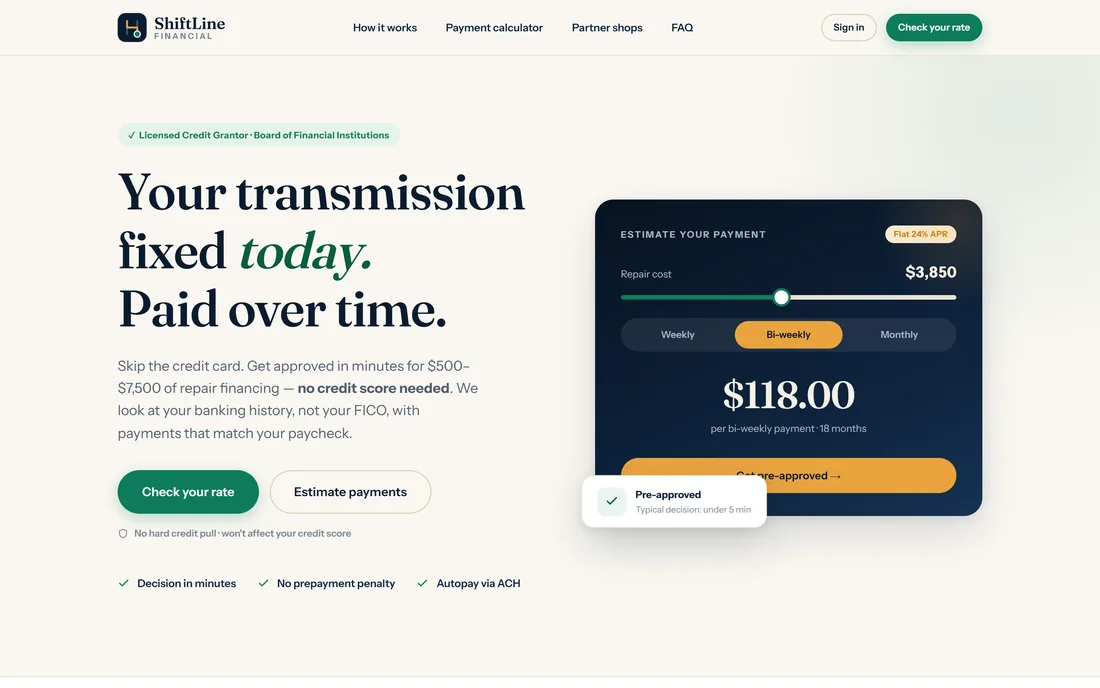
A small-ticket consumer lending platform for automotive repair: a six-step application that links a bank account instead of pulling a credit file, a rules-driven pre-qualification decision, a borrower repayment portal and a loan-officer console.
Sector
- Consumer lending
- Automotive repair finance
Capability areas
- Application + decisioning
- 15 screens across 3 surfaces
What we did
- Scope modelling
- Brand + UI system
- Front-end build
Surfaces
- Public site + application
- Borrower portal
- Loan console
What is ShiftLine for?
A transmission fails on a Tuesday and the repair costs more than the card limit. The borrower is not a credit-file problem - they are a cash-flow question that a credit score answers badly.
Three products sharing one loan record
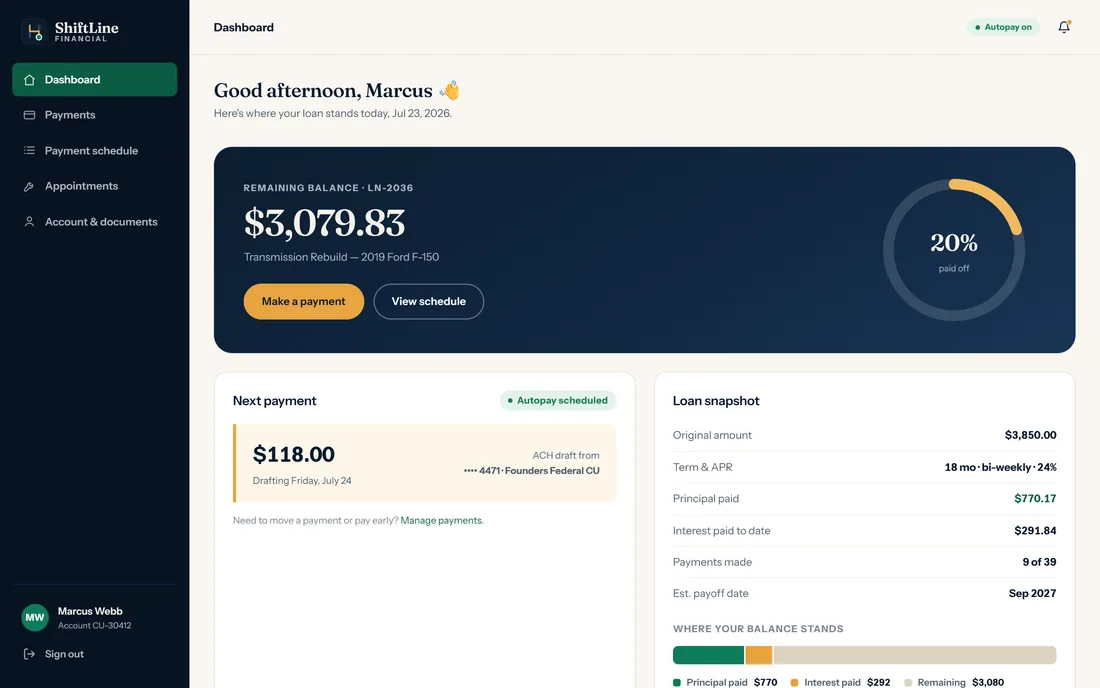
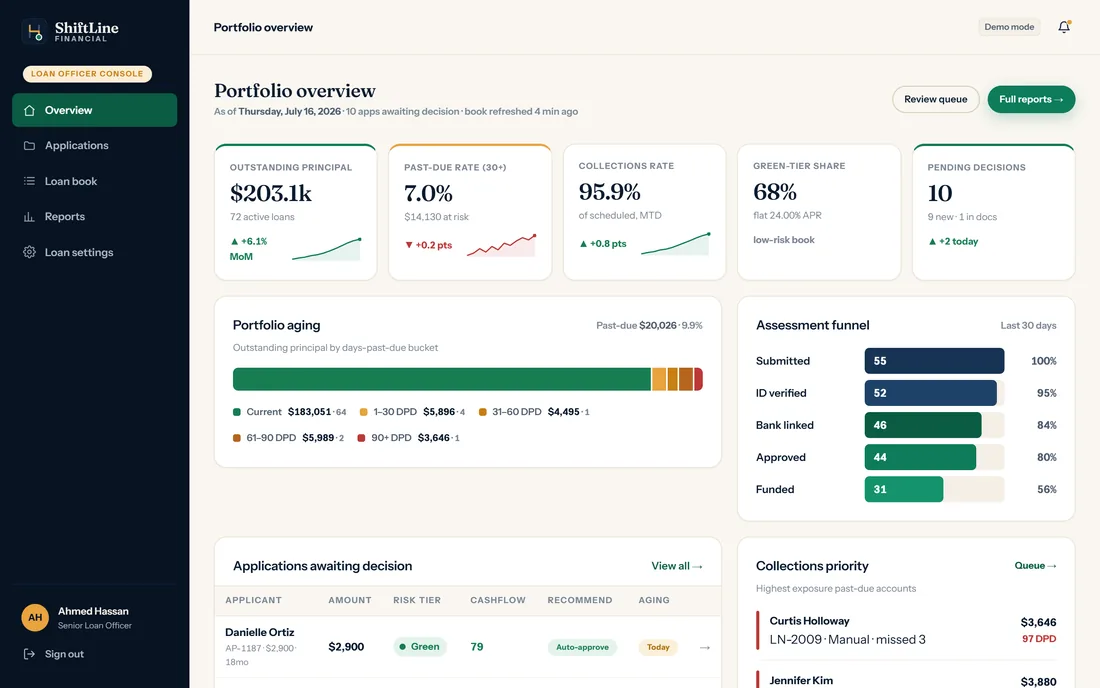
ShiftLine is a lender as three surfaces over one loan record: a public site whose only job is to get an honest payment number in front of somebody in five minutes, a borrower portal that runs the repayment, and a console where an officer works the queue the rules could not close.
Why is small-ticket repair lending its own product?
It is not a mortgage with smaller numbers. Three constraints shape everything about the interface, and a platform that ignores any one of them fails in a specific and predictable way.
| Borrower moment | A card or a store finance form | In ShiftLine |
|---|---|---|
| Finding out if you qualify | A hard credit pull before you know the answer | Bank-data pre-qualification with no hard inquiry |
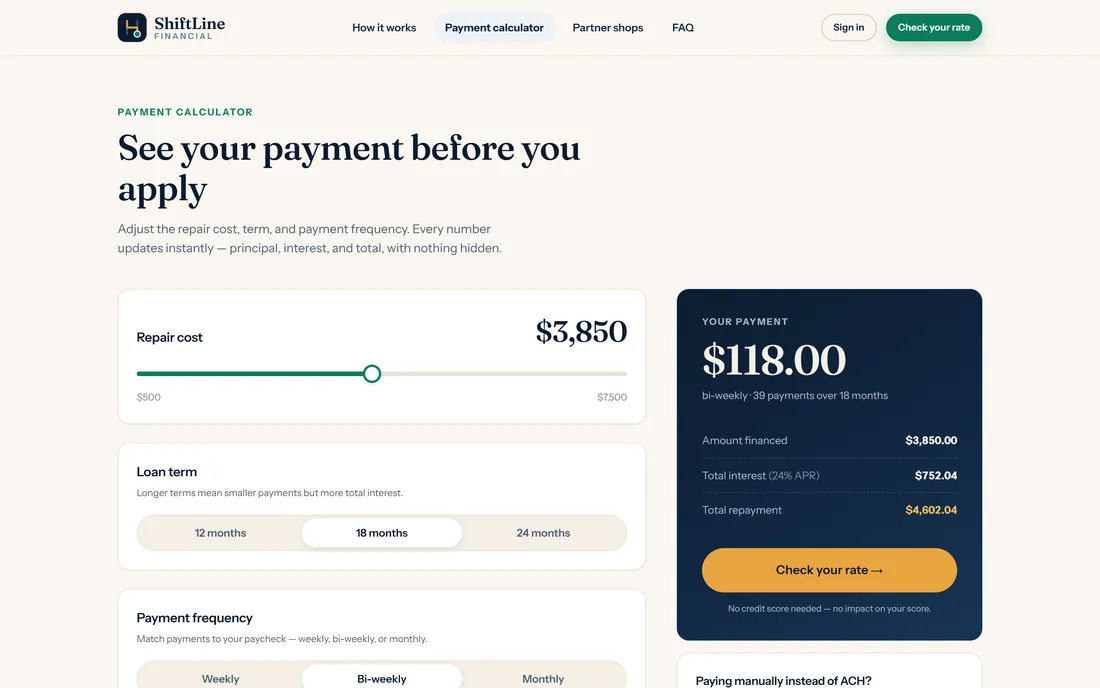
| Seeing what it costs | APR quoted, payment worked out later | Live payment figure on every screen that offers a term |
| Choosing a term | One take-it-or-leave-it schedule | 12, 18 or 24 months at weekly, fortnightly or monthly |
| Getting the repair booked | A separate call to the shop | Partner shop chosen in the application, paid direct |
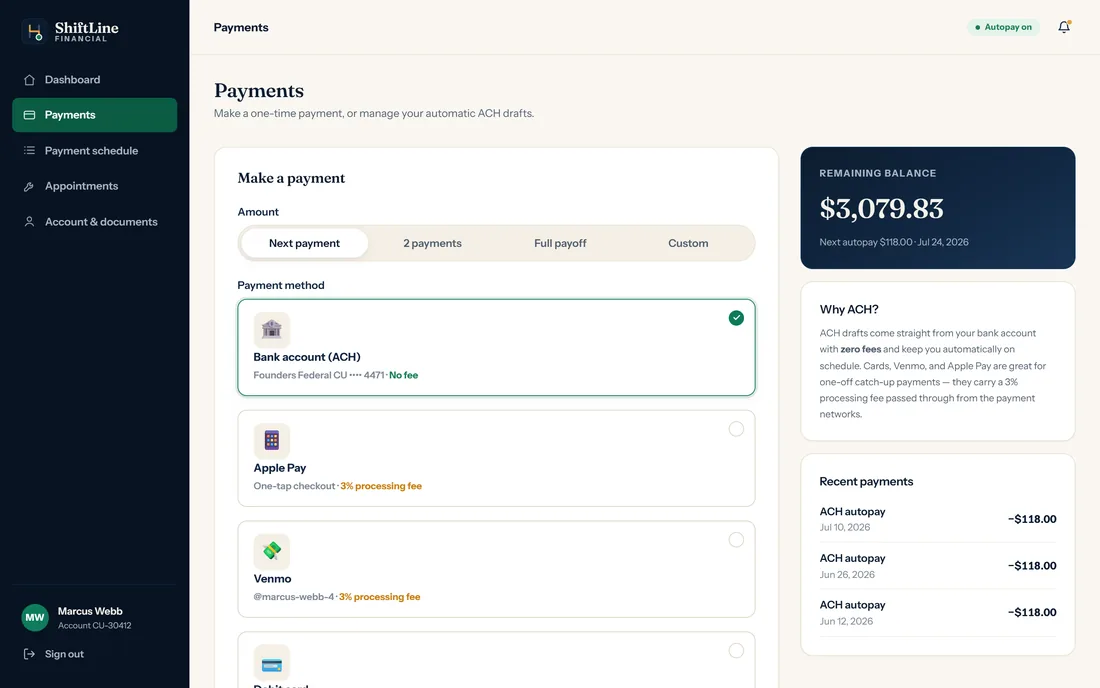
| Making a payment | A portal that only accepts one method | Free ACH autopay, with card and wallet options disclosed as fee-bearing |
| Being declined | A dead end with no reason | A decision path that carries an adverse-action notice |
What can you actually click?
Fifteen screens across three surfaces. The path worth walking runs from the public payment estimator through the six-step application into the borrower's own repayment portal.
Module A - Application flow
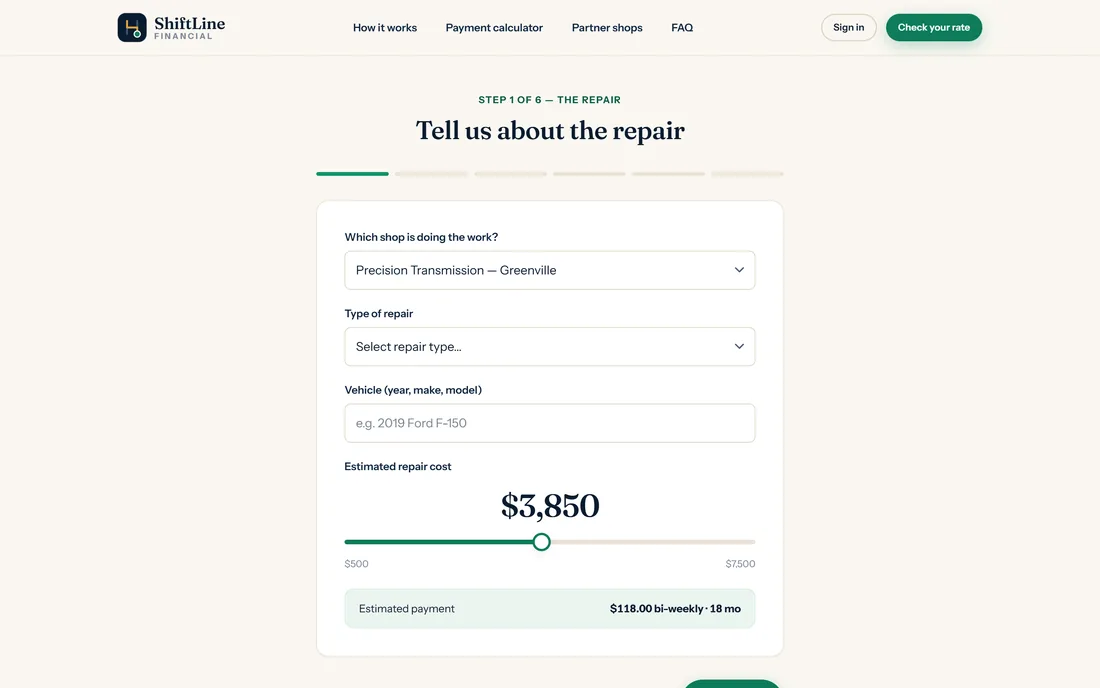
6 stepsRepair and cost, applicant details, bank linking, address and housing, identity and consent, then the decision - with a live payment estimate carried through every step.
- Repair + cost
- Bank linking
- Identity
- E-sign consent
Module B - Decisioning
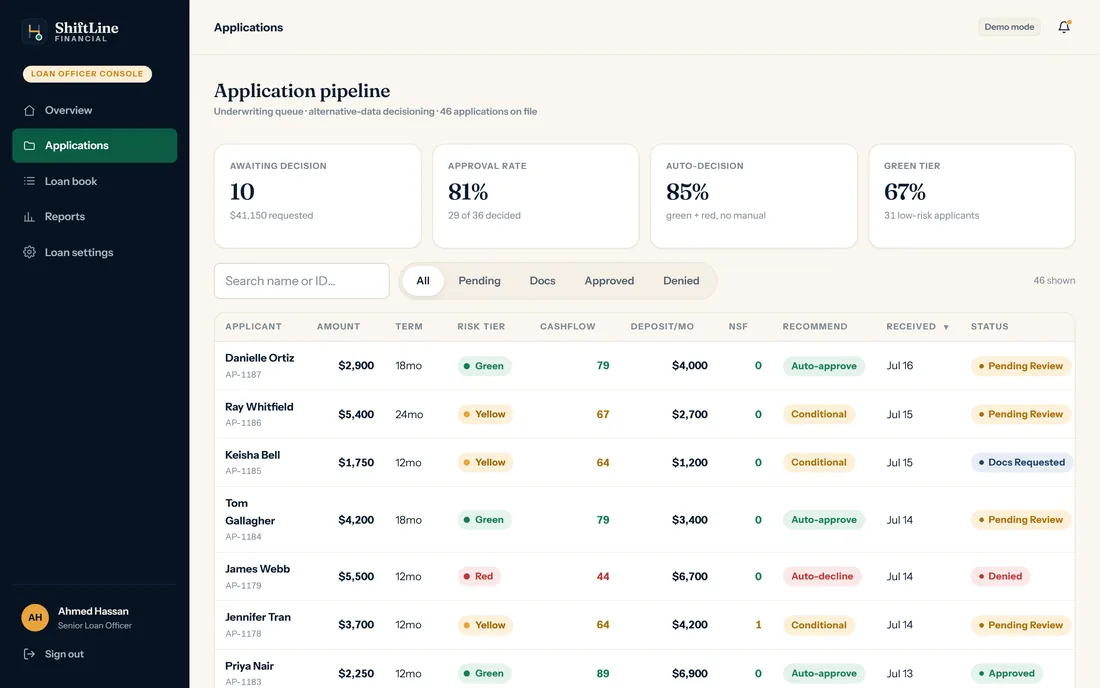
3 outcomesApprove, conditional or decline, driven by a risk tier and a cash-flow score derived from linked bank data rather than a credit score.
- Approve
- Conditional
- Decline
Module C - Terms & pricing
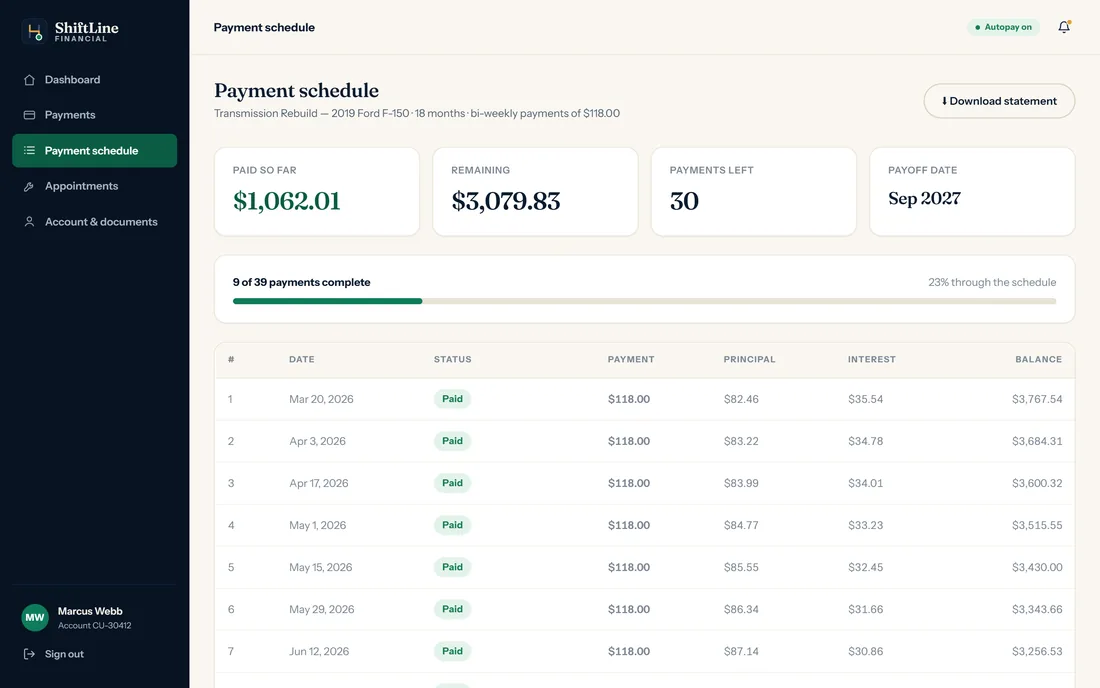
3 termsTwelve, eighteen or twenty-four months at weekly, fortnightly or monthly frequency, with total repayment and early-settlement saving shown throughout.
- 12 / 18 / 24 mo
- 3 frequencies
- Early payoff
Module D - Borrower portal
5 screensBalance and next draft, payment methods with their fees stated, the full amortisation schedule, service booking at a partner shop, and account settings including the repayment bank account.
- Make a payment
- Schedule
- Book service
- Change bank
Module E - Loan console
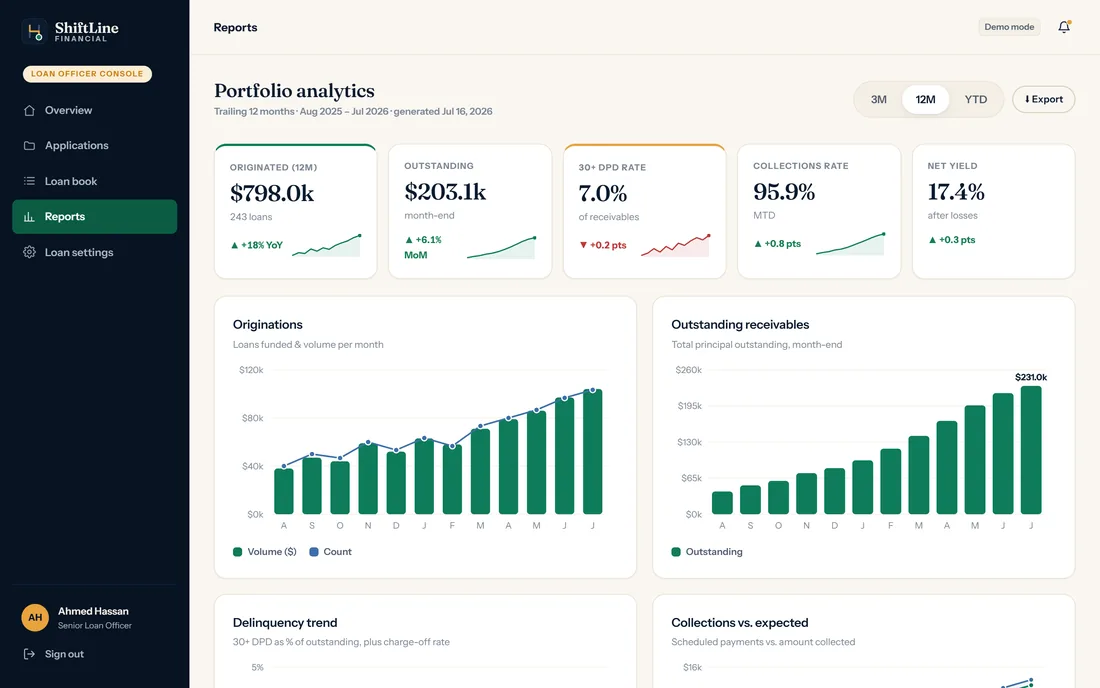
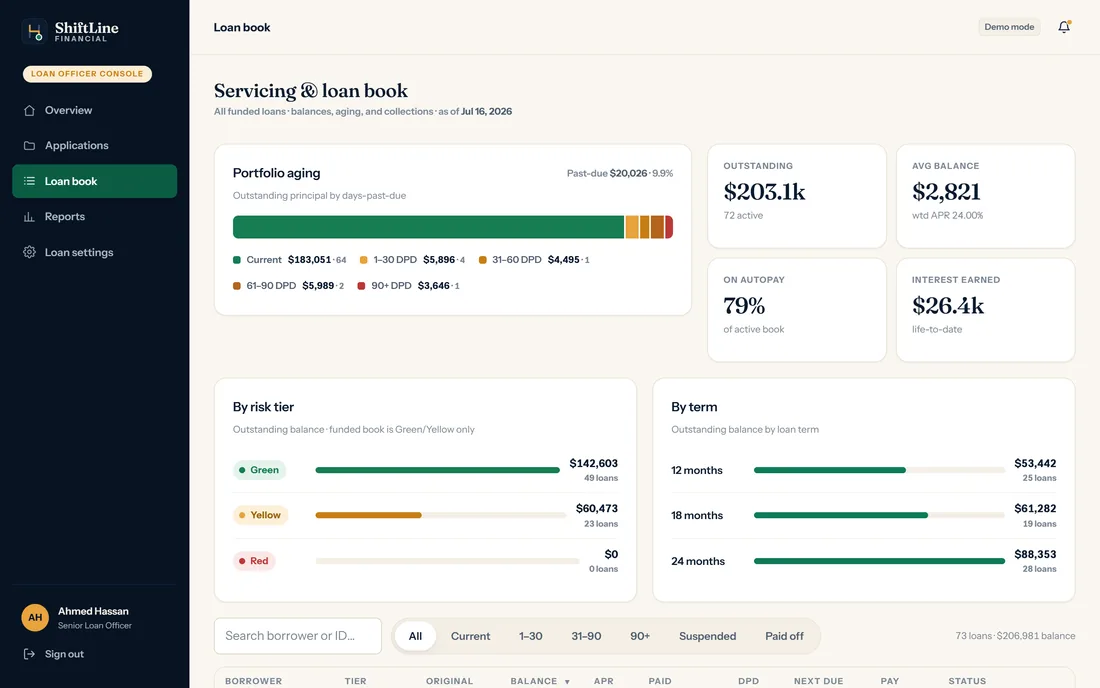
5 screensPortfolio overview, the underwriting queue, loan servicing, reporting and settings - the internal side of the same loan record.
- Review queue
- Servicing
- Reports
Module F - Compliance surface
Built inElectronic-signature consent, an explicit authorisation to review bank and alternative-credit data, adverse-action handling on a decline, and fee disclosure wherever a fee applies.
- E-SIGN consent
- Adverse action
- Data authorisation
How did we build it?
The aim was a lending platform a lender's own operations people could argue with. That meant building the decision path and the servicing screens first, and treating the marketing site as the last thing rather than the first.
What does the interface look like, and why?
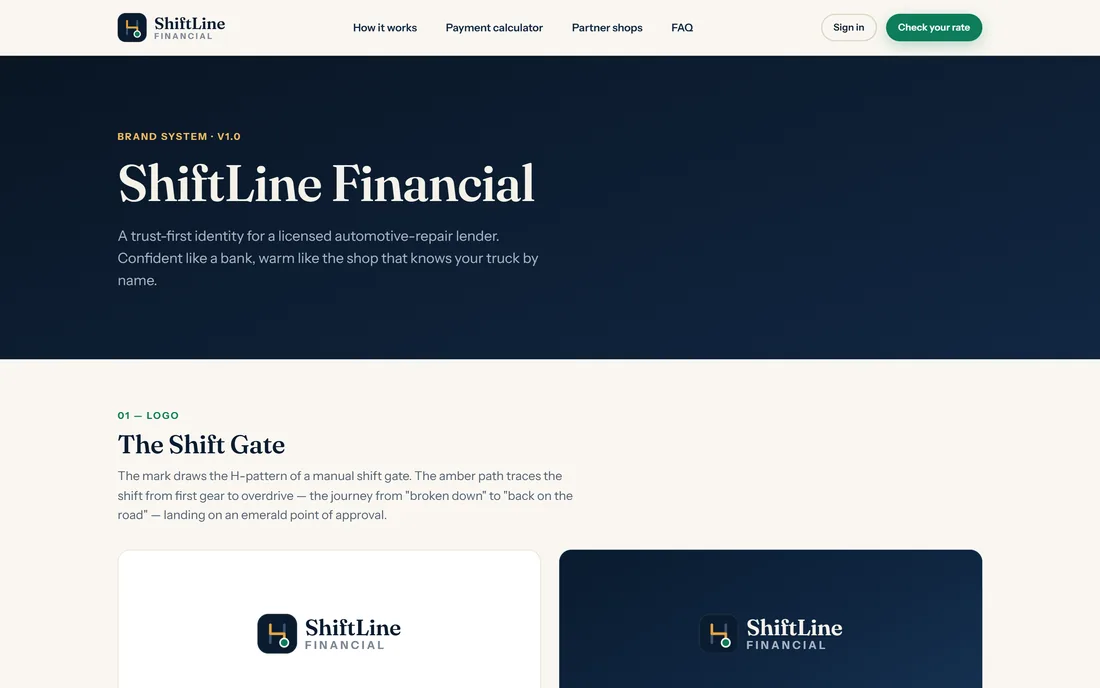
ShiftLine carries its own published brand system. Deep navy carries authority, a single emerald is reserved for approval and primary action, amber marks momentum, and a warm cream keeps a lending interface from feeling clinical at the worst moment of somebody's week.
Aa
Primary typeface
Fraunces
A B C D E F G H I J K L M N O P Q R S T U V W X Y Z
a b c d e f g h i j k l m n o p q r s t u v w x y z
0 1 2 3 4 5 6 7 8 9 & ? ! £ $ €
40pxFix it today. Pay over time.Display28pxYour repair, approved in minutesH220pxCard and section headingsH316pxBody copy, forms and table cellsBody16px$3,850.00 - $104.62 / bi-weeklyMoney12pxLICENSED CREDIT GRANTOREyebrowMoney is always set in tabular numerals so a column of instalments lines up on the decimal - the detail that makes a repayment schedule readable at a glance. Fraunces and Instrument Sans are open-licence typefaces; the specimen above falls back to the nearest available face if they are not installed on your device.
Building a lending platform
What lenders and fintech founders ask us first, answered plainly.
Ask us yoursHow long does it take to build a loan origination platform?
A scope at roughly this size - a public application, a decisioning layer, a borrower portal and an internal console - is a several-month programme rather than a few weeks. The date is driven less by screen count than by how many external providers have to be integrated for bank data, identity and payments, and how much of the regulatory surface has to be enforced in software rather than in policy.
What is alternative credit assessment, and how does it work?
It means underwriting from evidence other than a credit bureau score - most commonly the applicant's own bank transaction history, read with their permission. Instead of asking what a file says about the past, it asks whether the income arriving each month can carry the instalment. ShiftLine surfaces deposit regularity, overdraft events and a derived cash-flow score next to every recommendation.
Can a borrower be pre-qualified without a hard credit pull?
Yes - that is the pattern ShiftLine is built on. Pre-qualification runs on bank-transaction and alternative-credit data with the applicant's explicit authorisation, which is a soft process and does not create a hard inquiry on the file. A hard pull, where one is used at all, belongs at the point of formal offer rather than at the point of curiosity.
How do you handle compliance in a lending product?
By treating it as part of the flow rather than a legal appendix. In ShiftLine that means electronic-signature consent, a separate explicit authorisation to review bank and alternative-credit data, fee disclosure at the moment a fee-bearing option is offered, and an adverse-action path on a decline. The specific obligations vary by jurisdiction and product, so the rules a build enforces are scoped with the lender's own counsel.
Can one platform run both the borrower side and the internal side?
It should, and ShiftLine is built that way deliberately. Borrower and officer look at the same loan record from opposite sides, so an arrears case is worked from the same numbers the borrower can see in their own portal. Splitting them across two systems produces the classic failure: a customer told one balance on the phone and shown another on screen.
Related work
Scoping a lending or decisioning platform?
Tell us how your business actually works and we will tell you honestly what it takes to build. See more of our work or what we do.
Book a 15-minute call