


The right list, fast
The website for a Swedish B2B data house that sells business address, email and phone databases plus lead lists, across more than 100 countries, and turns a fuzzy buyer request into the exact targeted list.

Industry
- B2B data & direct marketing
Coverage
- 100+ countries
- Swedish + English
What we did
- Marketing site UX
- Catalogue structure
- Lead capture
Catalogue
- Company & consumer data
- Email, phone & leads
What does BizWell sell?
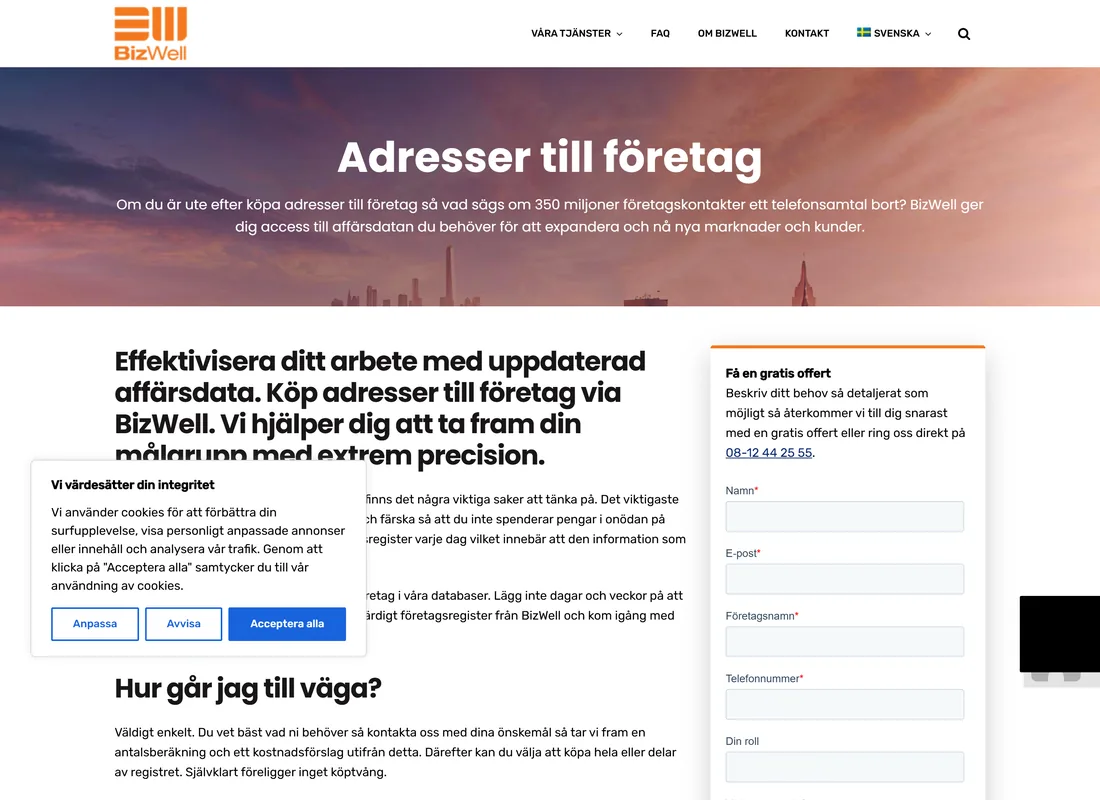
Targeted business data. The site is a catalogue of database types, company addresses, consumer addresses, email lists, phone lists and ready-made leads, each with its own page, so a buyer lands directly on the exact product they came for.
A catalogue, not a contact form
Every data product the company advertises is a first-class page rather than a line in a brochure. The site is organised the way a buyer actually shops, by who they want to reach and how they want to reach them, and every page ends in a free-quote request.
Why is buying business data harder than it should be?
A buyer rarely wants "data". They want decision-makers in a sector, in a region, reachable a specific way. A generic site buries that under one contact form; this one lets the request resolve itself before a human is involved.
| Buying business data | A generic data site | The BizWell catalogue |
|---|---|---|
| Finding the right product | One page, one enquiry form | A page per data type, phrased how buyers shop |
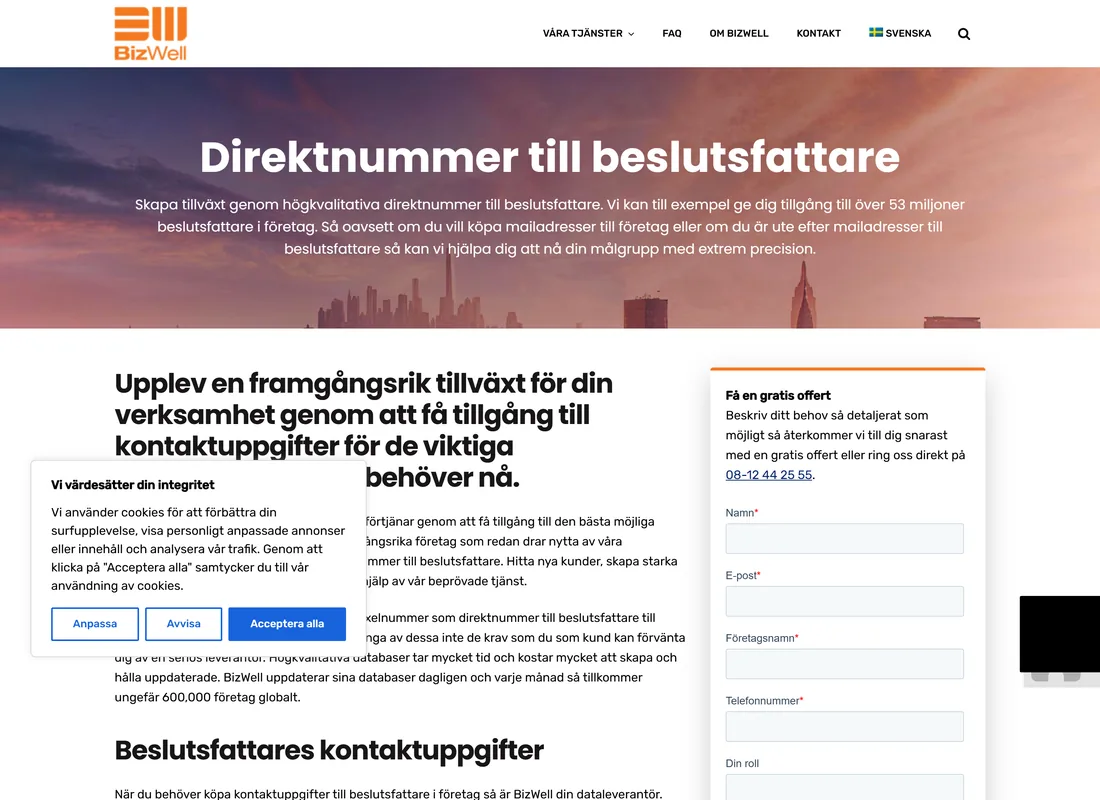
| Reaching decision-makers | Buried in a feature list | A named offering with direct numbers |
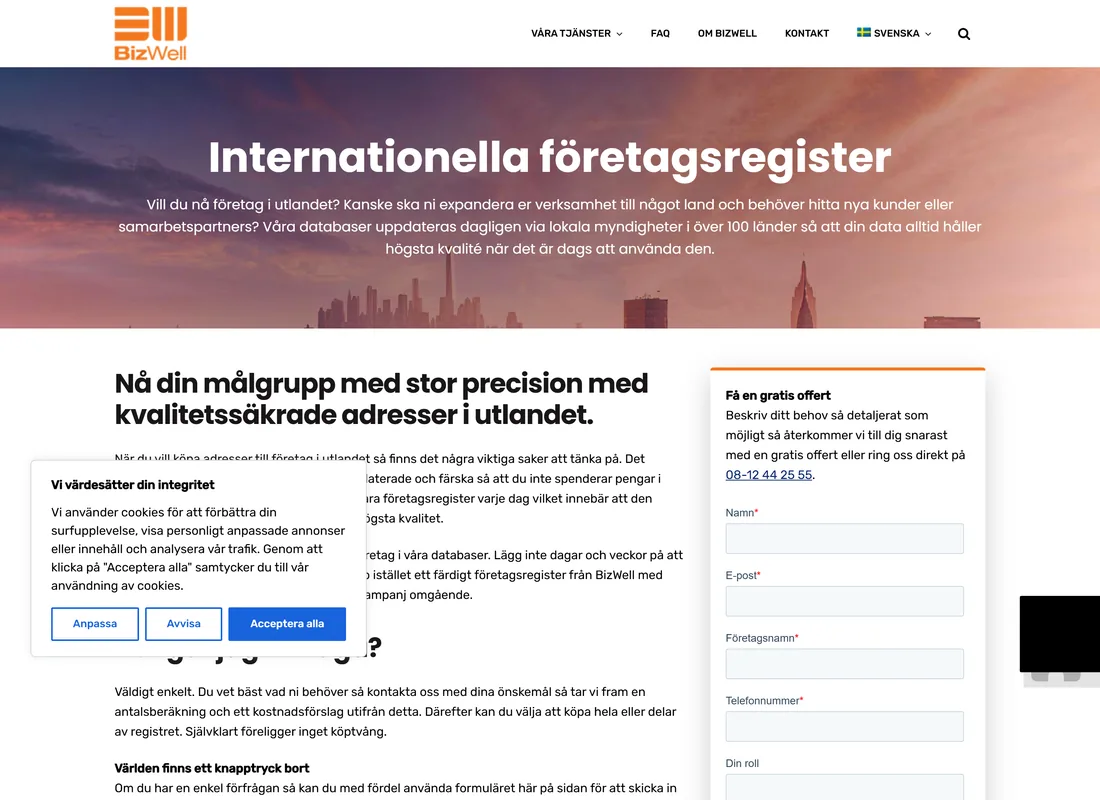
| Cross-border coverage | "Contact us for details" | A dedicated international-registers page |
| Acting on a list | Left to the buyer | Direct-mail distribution sold alongside |
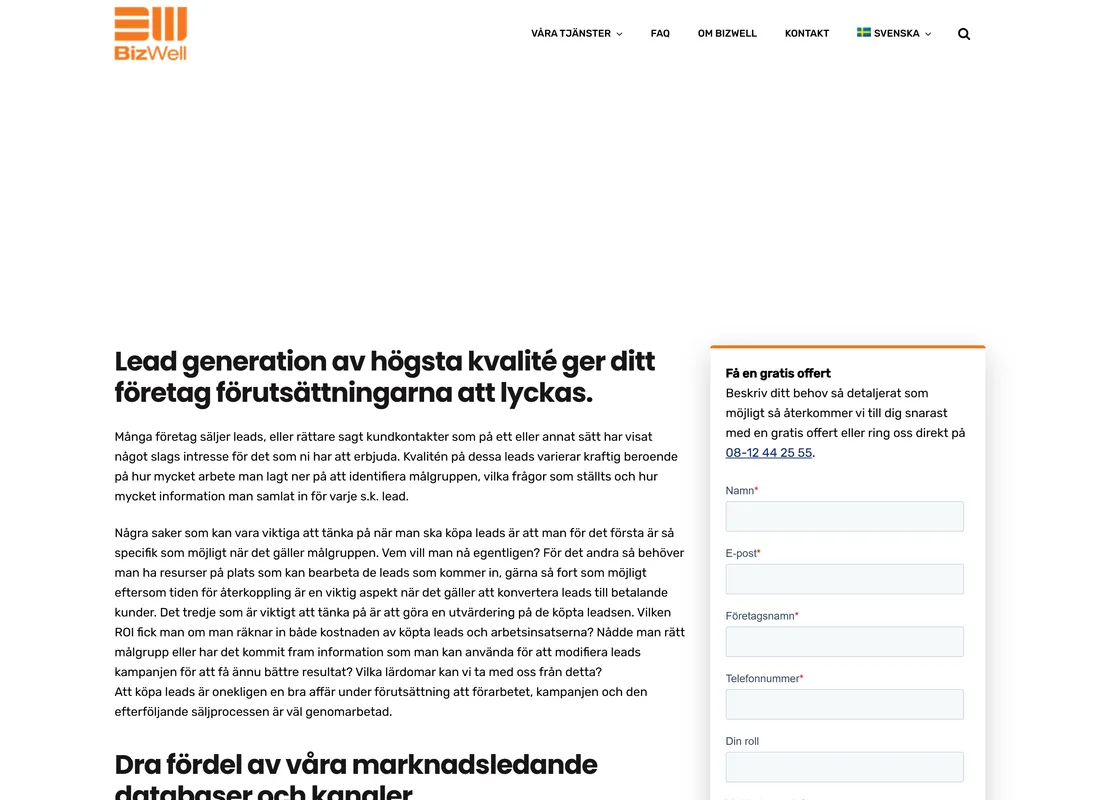
| Getting a price | A quote you chase | A free-quote request on every page |
How is the catalogue laid out?
Each product line is a page a buyer can land on cold from search and understand in seconds, then request a quote from without a detour.
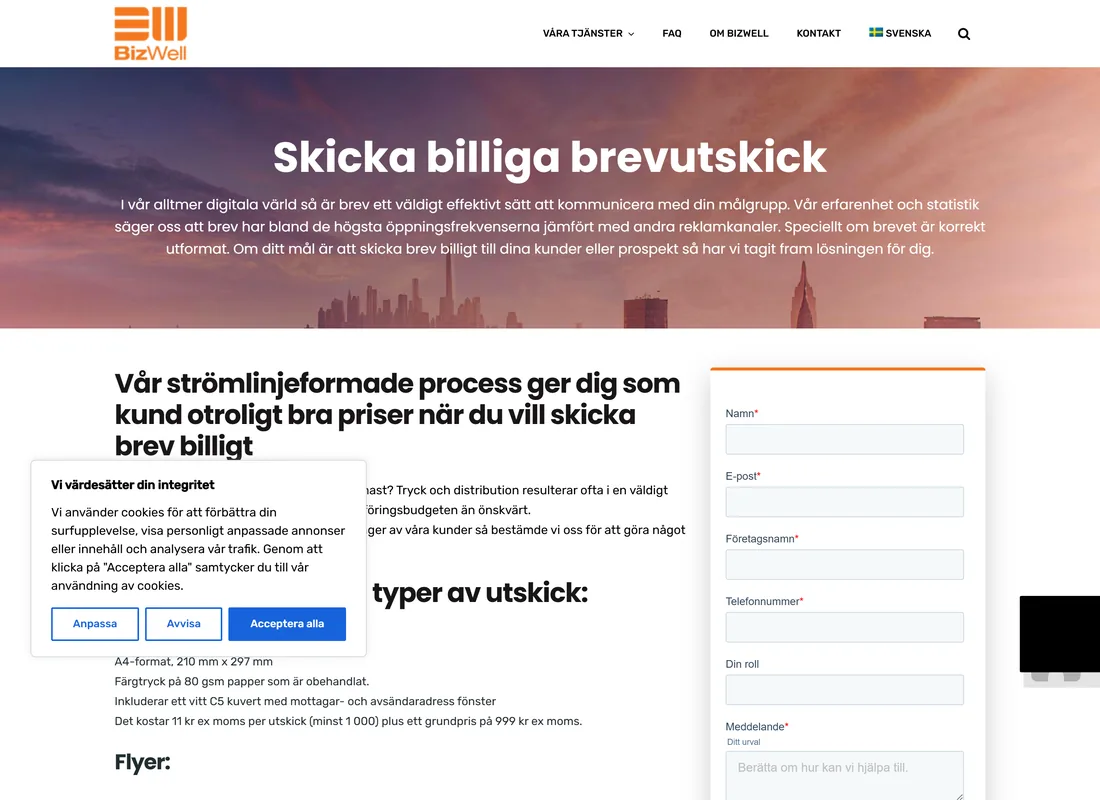
Company data
Core catalogueBusiness address, email and phone databases, filterable by the sector, region and role a buyer actually targets.
- Address
- Phone
Consumer data
HouseholdsConsumer address lists, including family and guardian segments, kept separate from the business catalogue.
- Addresses
- Segments
Leads
Ready listsProspect-ready lead lists for teams that want to start reaching out immediately.
- Decision-makers
- Direct numbers
International
100+ countriesCross-border business registers, treated as their own product because coverage and compliance vary by market.
- Registers
- GDPR-aware
Direct mail
DistributionPostcards, flyers and letter mailings, sold so a purchased list can be acted on without changing vendor.
- Mailings
- Bulk / unaddressed
Quote on every page
Lead captureEach catalogue page ends in a free-quote request, so interest is captured at the point of intent.
- Free quote
- Fast reply
What does a data-marketplace website need to get right?
Selling data online is not selling a widget. These are the things that separate a catalogue a buyer trusts from a brochure they bounce off, and they came out of structuring this one.
- A page per product, not per brochure. A buyer searching for "email lists" should land on that exact page, not a homepage that lists everything.
- Organise by how buyers shop. Who they want to reach and how, not by internal database names.
- Separate the raw data from the ready lists. A prospecting team and a mailing team want different products and should not have to untangle one page.
- Answer coverage first for cross-border buyers. "Which markets?" is the question that decides whether they read on.
- Sell the action, not just the asset. Distribution sold alongside the list keeps the campaign, and the buyer, in one place.
- Capture intent on every page. A free-quote request at the end of each product page beats a single buried contact form.
What does the site look like, and why?
A confident data-house identity: a warm signal orange reserved for every action and the brand mark, a trust blue for links and secondary emphasis, and a near-black ink for dense catalogue copy. It is set in Rubik for headings and Poppins for body, a friendly geometric pairing that keeps a data catalogue from feeling clinical.
Aa
Primary typeface
Rubik
A B C D E F G H I J K L M N O P Q R S T U V W X Y Z
a b c d e f g h i j k l m n o p q r s t u v w x y z
0 1 2 3 4 5 6 7 8 9 & ? ! £ $ €
34pxHero headlineH124pxSection headingH218pxProduct titleH315pxLead copyLead14pxBody copy and listsBodyThe palette and type are read from the live site's own computed styles. Orange is used sparingly, only for the logo, primary buttons and the data-driven statement band, so it always reads as "do this next". Rubik and Poppins are open-licence typefaces; the specimen falls back to the nearest available face if they are not installed.
Building a data-marketplace website
What data businesses ask before commissioning a catalogue site.
Ask us yoursHow long does it take to build a data-marketplace website?
A catalogue site of this shape, a page per data product, multilingual, with quote capture on each page, is a matter of weeks rather than months, because the complexity is in the information architecture, not heavy application logic. What moves the date is how many product lines and languages are in scope and whether pricing is shown or quoted. We structure the catalogue first, then build outward from it.
Should data products each get their own page?
Yes. A buyer searching for a specific list, email addresses, decision-maker contacts, an international register, should land on that exact page from search and be able to request a quote without hunting. One catch-all page forces every buyer through the same funnel and loses the ones with a specific need, which is most of them.
How do you handle multiple languages on a catalogue site?
The catalogue structure is built once and the content layered per language, with a visible language switch, so a Swedish and an English buyer see the same products framed in their own language. The important part is that URLs and page structure stay consistent across languages so search treats them as one coherent site.
How is lead capture handled without a shopping cart?
Every product page ends in a free-quote request rather than a checkout, because data is quoted on volume, selection and use. Capturing the request at the point of intent, on the product page the buyer is already reading, converts far better than a single site-wide contact form.
Related work
Selling something that deserves a page of its own?
Tell us how your business actually works and we will tell you honestly what it takes to build. See more of our work or what we do.
Book a 15-minute call