01
Model the cellar as an asset
We started from the data a valuation actually needs - collection, bottle, tags, storage state - rather than from a generic product list, so every screen supports the number at the end.
Valuation-first→



A web platform for wine collectors that turns a cellar of bottles into a tracked, re-priceable asset - build collections, import them in bulk, run market valuations, and compare how each one moves over time.
The collector builds named cellars, fills them by hand or by importing a whole inventory at once, then runs a valuation that returns a market figure per collection - with the documents, notes and history a real asset needs kept alongside it.
Bottles are organised into separate cellars - a premium selection, an investment portfolio, everyday drinking - each carrying its own bottle count, value and storage status.
A cellar can be flagged as bonded, and individual bottles carry tags such as rare, investment or bonded, so provenance and storage state travel with the record.
Every valuation records a figure and how far it has risen or fallen since the last one, so a collection reads as a position rather than a static inventory.
Why is a wine collection so hard to value?
A cellar of a few hundred bottles is a five- or six-figure asset, yet it is almost always tracked the way a shopping list is. Three things break that habit, and the platform is built around all three.
Nobody re-prices it: a bottle's market value drifts constantly, but a spreadsheet records the purchase price and never revisits it. Bottles arrive faster than they get entered, in batches - a case here, an auction lot there - which is exactly the friction that leaves records perpetually out of date. And one number hides the movement: a single current value says nothing about whether a collection is climbing or sliding, which is the only thing a collector deciding to hold or sell actually needs to know.
core modules built around one loop - catalogue a cellar, value it against the market, and track how that value moves.
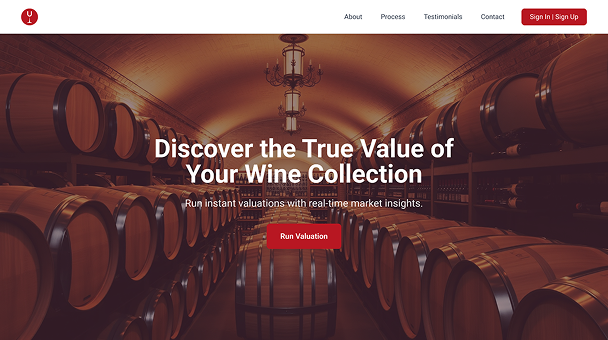
As published on the live product page.
The platform had to make an unfamiliar idea - a wine cellar as a re-priceable asset - feel obvious, from the first bottle entered to the tenth valuation compared.
We started from the data a valuation actually needs - collection, bottle, tags, storage state - rather than from a generic product list, so every screen supports the number at the end.
Manual entry and CSV import were designed as first-class equals, because a collector with three hundred bottles will never type them and one with three will never build a spreadsheet.
In-progress, accepted and declined states, movement percentages and the wines-documents-notes detail were built so the figure is always explainable, never a black box.
Historical valuations and the side-by-side compare view were the last piece, turning a single current price into a line a collector can read a decision off.
keep scrolling — the deal glides left →
This is the core loop of the platform: catalogue a cellar, value it against the market, then keep re-running the valuation so the collection reads as a position that moves.
The collector creates a named cellar for a collection - investment, everyday, special occasion.
Bottles go in one at a time by hand, or a whole inventory arrives at once via CSV import.
A valuation is launched against the collection and returns a market figure per cellar.
The run moves through an in-progress state and lands as pending, accepted or declined.
The valuation opens onto its wines, documents, notes and error logs - the reasoning behind the number.
Each valuation joins the history, where movement is charted and any two can be compared.
A deep claret carries the identity - the colour of the asset itself - against a warm, quiet neutral built to keep dense valuation tables and long histories legible.
Tell us how your inventory actually works and we'll tell you honestly what it takes to build - the catalogue, the valuation engine, the history. No deck, no pitch.