01
Shipper posts the job
Category, budget, pickup and drop-off, and photos — the load, fully described, posted to the marketplace in a minute.
Post→



A road-freight marketplace where shippers post a job and verified drivers nearby make a firm offer — collection to delivery, no phone calls. A load finds its truck by distance, not by luck.
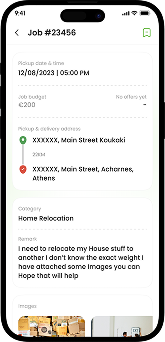
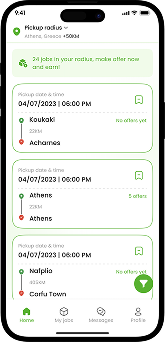
A shipper describes the job — what, where from, where to, when, with photos — and it surfaces to verified drivers whose pickup radius covers the collection point. Drivers bid, the shipper picks, and the app carries the rest.
A driver sets a radius around where they are, and only jobs whose collection sits inside it appear — the feed is jobs they could actually take.
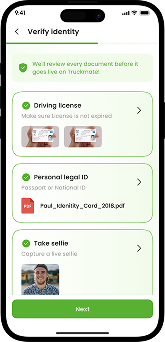
Licence, legal ID and a live selfie, each reviewed before a driver goes live on the marketplace.
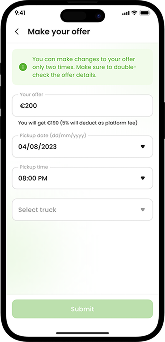
Bidding sets a price, a pickup date and time and the truck, with the platform fee taken from the accepted offer.
Arranging road freight still means ringing round for quotes and hoping someone is free and nearby.
Moving a load is a matching problem — the right truck, near enough, free at the right time — and the phone-and-quotes way of solving it loses on all three. It's slow, it's opaque, and the "deal" lives in a call nobody can hold to account.
TruckMate turns that into a marketplace: the shipper posts once, and the drivers who can actually do it come to them. Distance does the matching; verification builds the trust; a structured offer replaces the handshake.
constraints a chat app can't solve — distance, trust, and a deal with structure. Each one shaped the product.
Framing from the project brief — no market metric implied.
Turning phone-call freight into a marketplace meant designing four things in from the start — and beating the three constraints a chat app can't solve.
A two-sided marketplace with 2 roles — the shipper who posts the load, and the driver who carries it.
Posts a haulage or moving job — category, budget, pickup and drop-off addresses and photos — then compares the offers that come in.
Discovers jobs inside their pickup radius, clears identity checks, bids a firm offer, and carries it from collection to delivery.
Category, budget, pickup and drop-off, and photos — the load, fully described, posted to the marketplace in a minute.
The job surfaces only to verified drivers whose pickup radius covers the collection point, ranked by distance.
Bids a price, a pickup date and time and the truck they'll use, with the platform fee shown. A firm commitment, not an enquiry.
Compares the offers on their job and accepts one — turning the bid into a booked deal both sides are held to.
Collects at the pickup point and confirms the job is under way, in the app — everyone can see the state.
Photos at handover and an OTP, then the load is marked delivered — closing out the job on the record.
Both sides rate each other and the driver's earnings settle to their payout, minus the platform fee. The loop closes.
keep scrolling — the deal glides left →
The obvious build was a listings feed plus a chat to haggle in. Drag to see what we shipped instead.
No date. No named truck. No fee. Nothing to hold either side to.
Chat-first freight is the phone call, moved onto a screen. It hides price, invites no-shows, and leaves disputes with no source of truth.
Bidding writes a structured offer — price, pickup date & time, the exact truck, and the fee. Accepting it is the booking.
Every feature solves one of the constraints. Scroll — the screen follows the story.
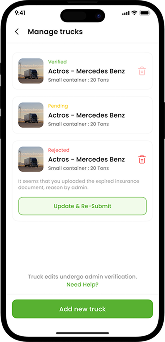
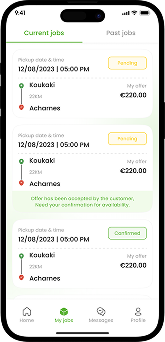
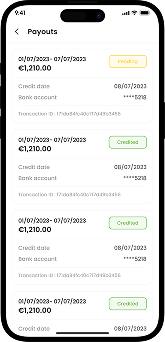
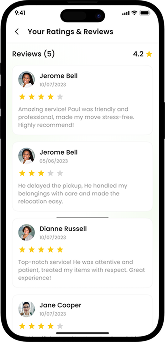
A driver sets a radius; only jobs whose collection sits inside it appear — the feed is jobs they could actually take.
Category, budget, pickup and drop-off addresses and photos — the load fully described, so a driver bids on what's really there.
Driving licence, legal ID and a live selfie — every document reviewed before a driver goes live on the marketplace.
Price, pickup date & time and the truck, with the fee shown and revisions limited. A booking, not a chat.
Trucks added and edited with details and images, so the right vehicle is named on every offer.
Driver and shipper message inside the job rather than swapping numbers — the deal stays on-platform.
Completed jobs settle to the driver's earnings, net of the platform fee, with payout details held in-app.
Driver and shipper rate each other after a job, building the reputation a marketplace runs on.
A crisp, operational system — a confident green carries the marketplace, status colours mark verified and pending, and a geometric sans keeps the load board legible at a glance.
Every job ends the same way — collected, carried, delivered, rated and paid, all on the record. No cash in an envelope, no number in a chat.
The site publishes no performance metrics, so none are invented here — this is delivered scope, not results.
TruckMate lives on a phone at the wheel — the job feed, the deal, the fleet and the money, one tap apart.
The driver's console. Verify identity, manage the fleet, confirm delivery, settle the payout.
Even the edges are designed. Radius search, delivery-photo proof, payouts and chat — down to the empty and error states.
Screens are the delivered TruckMate UI, supplied by the project team.
"A price agreed in a message is not a booking."
— the one constraint that shaped the entire product
Six things separate a marketplace drivers and shippers actually use from an app that never reaches liquidity — they hold for any local matching marketplace.
For physical work, nearness is the constraint, so discovery has to be built on radius from the job, not a global list.
When strangers carry belongings, identity and documents have to be checked before anyone can trade.
A price in a chat binds no one; the bid has to carry the amount, the vehicle, the times and the fee.
Category, addresses and photos on the job mean a driver bids on what is really there, cutting disputes on arrival.
Messaging, money and ratings tied to the job stop the marketplace leaking to cash and phone numbers.
Two-way ratings turn good work into more work, which is what keeps both sides coming back.
The questions operators ask us first, answered plainly.
Tell us how your business actually works and we'll tell you honestly what it takes — the trust layer, the payments, the path to liquidity. No deck, no pitch.