01
Choose the direction
A to B or B to A on a fixed route, with a preferred pickup point saved to the profile.
Direction→



A fixed-route shared transport platform for Peru. Passengers pick a direction, choose an exact seat on a sedan, SUV or van, pay before boarding, and get on against a QR the driver scans into an electronic manifest.
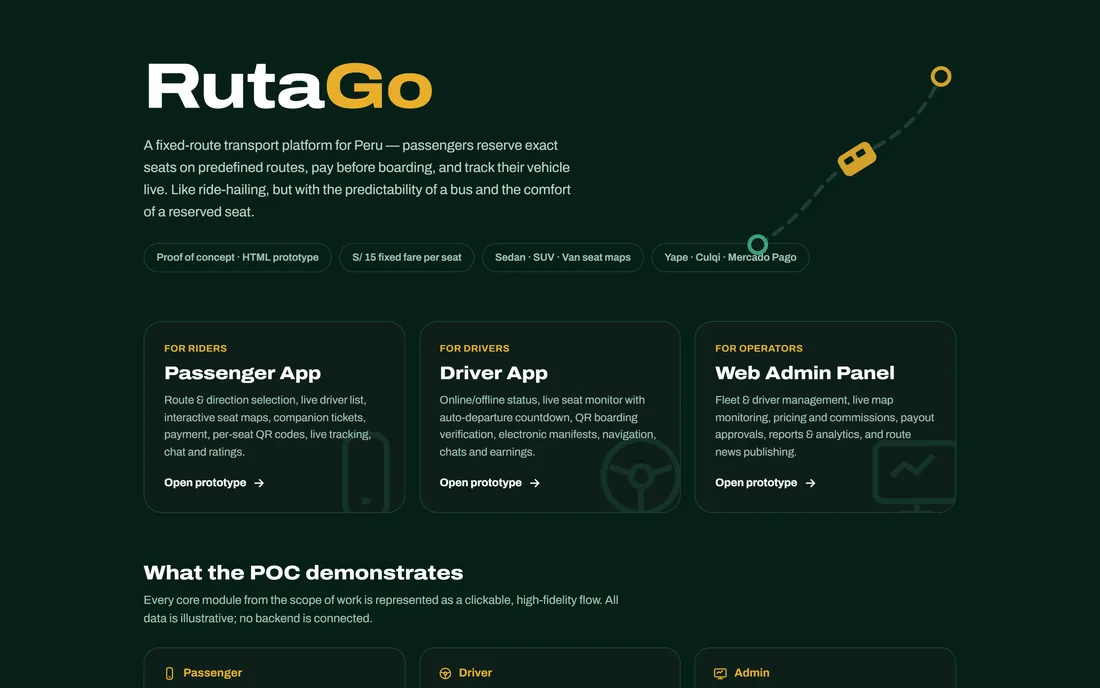
RutaGo keeps the economics of a shared van - one fixed route, one fixed fare, many passengers - and adds what ride-hailing taught people to expect: a named driver, a reserved place, a price agreed before boarding, and a vehicle on a map.
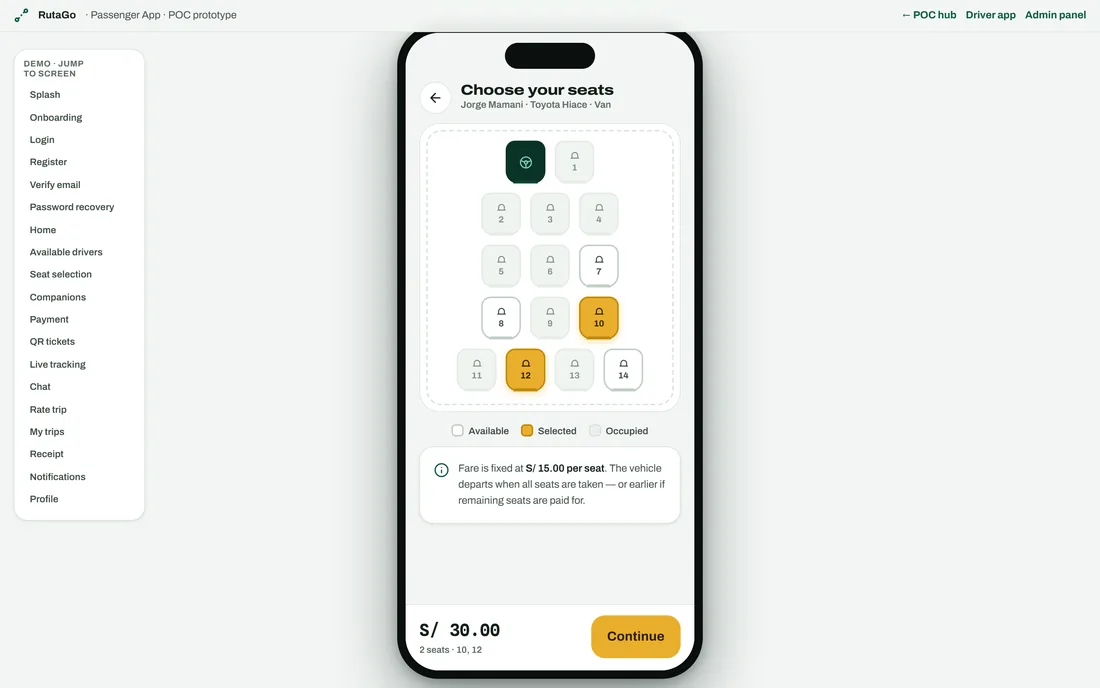
Sedan, SUV and van each get their own interactive seat map - 4, 7 and 14 places - and occupied seats are locked out rather than merely counted down.
Cards, Yape and Mercado Pago are selected in the app, so the driver never handles a fare and the manifest is settled before the doors close.
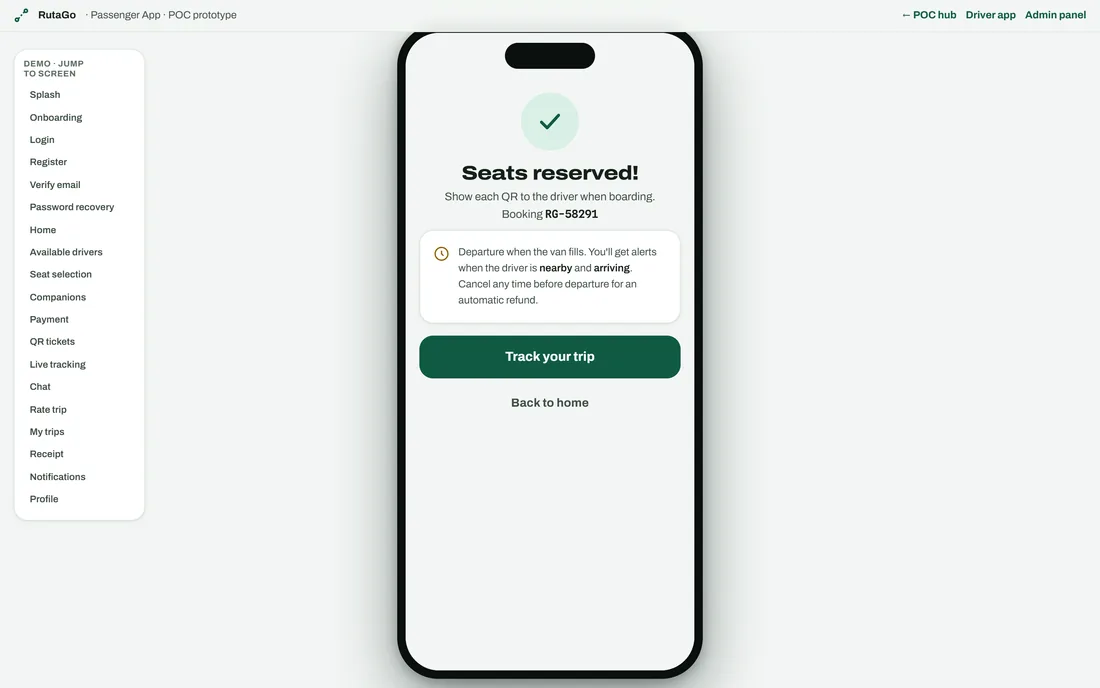
Every reserved place issues its own QR, companions included, and the driver scans each one into an electronic manifest at boarding.
Why is a shared fixed-route van harder to build than ride-hailing?
A private ride is one passenger, one price, one decision. A shared van is many strangers competing for the same fourteen places, on a fare nobody is allowed to change, in a vehicle that must not leave half-empty.
Three rules follow from that, and all three are enforced in the interface rather than written in a policy nobody reads: two people cannot take the same seat, a van that leaves half-full loses money, and the fare is not the driver's to set.
screens across three surfaces — passenger, driver and operations — designed as one connected system.
The rules that make a shared, fixed-fare van work are only real if the interface enforces them — not a policy nobody reads.
Three surfaces, one system — passenger, driver and ops — reading the same route, seat and fare language.
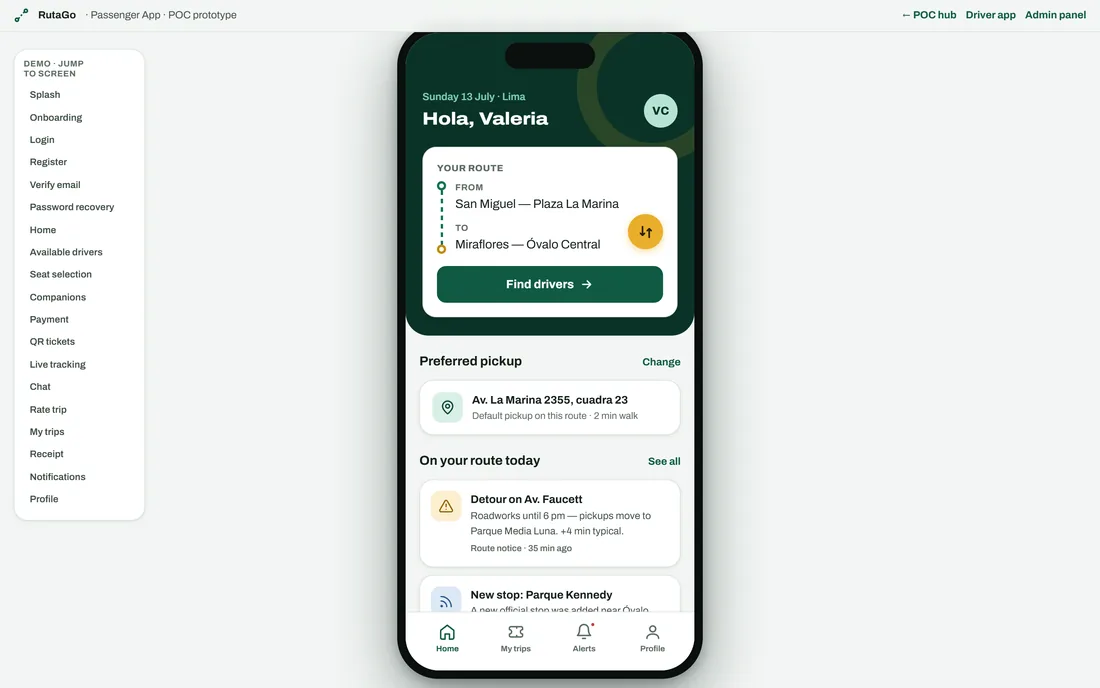
Picks a direction, chooses an exact seat, pays before boarding and tracks the van live with Wait-for-Me and driver chat.
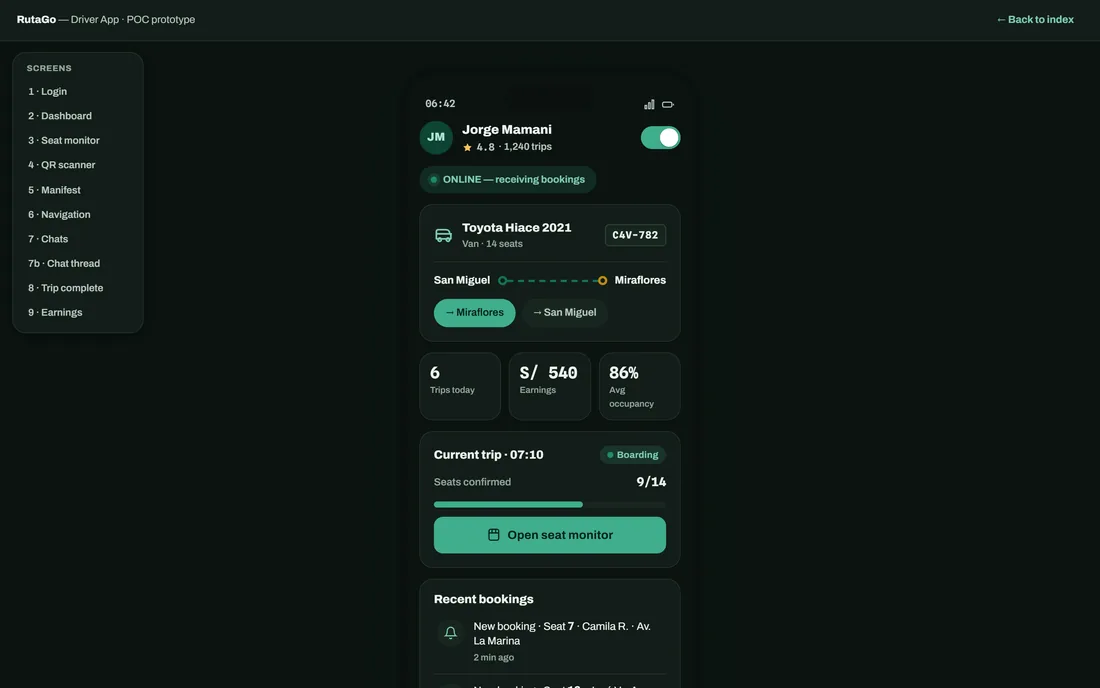
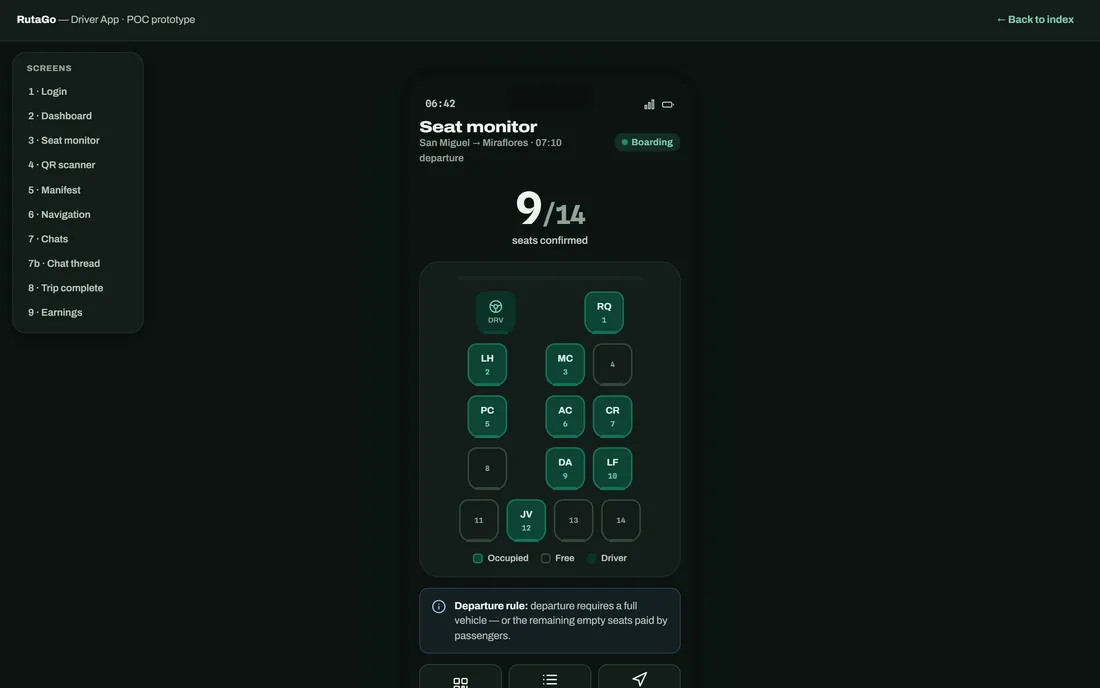
Watches seats confirm in real time, scans each QR at boarding, and works the departure gate and payout requests from the same app.
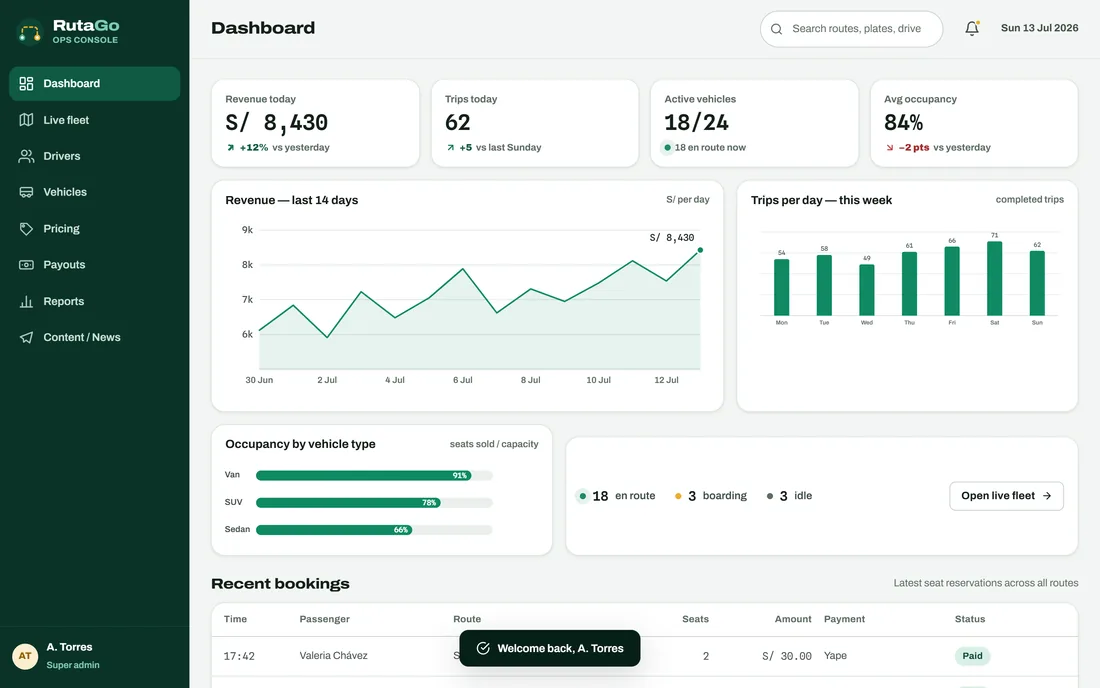
Watches the live fleet map, validates fares and commission, and approves the payouts that settle to drivers.
A to B or B to A on a fixed route, with a preferred pickup point saved to the profile.
Vans running that route list rating, vehicle type, seats left and minutes to departure.
Sedan 4, SUV 7 or van 14. Occupied places are locked; each selection prices at the fixed fare.
Travelling companions are named at booking so each one gets a place and a ticket of their own.
Card, Yape or Mercado Pago. The trip is prepaid, so nothing is settled with the driver.
One QR per reserved seat, companions included, held in the passenger app.
The driver scans each QR and the boarding lands on the electronic manifest.
Departure stays blocked until every seat is taken or the empty ones are paid for; then a three-minute countdown runs.
Live tracking and driver chat during the trip, a rating and a digital receipt after it.
keep scrolling — the deal glides left →
Thirty-seven screens across three surfaces, designed as one system: the same route, seat and fare language reads consistently whether you are the passenger choosing a chair, the driver holding the door, or the operator approving the payout.
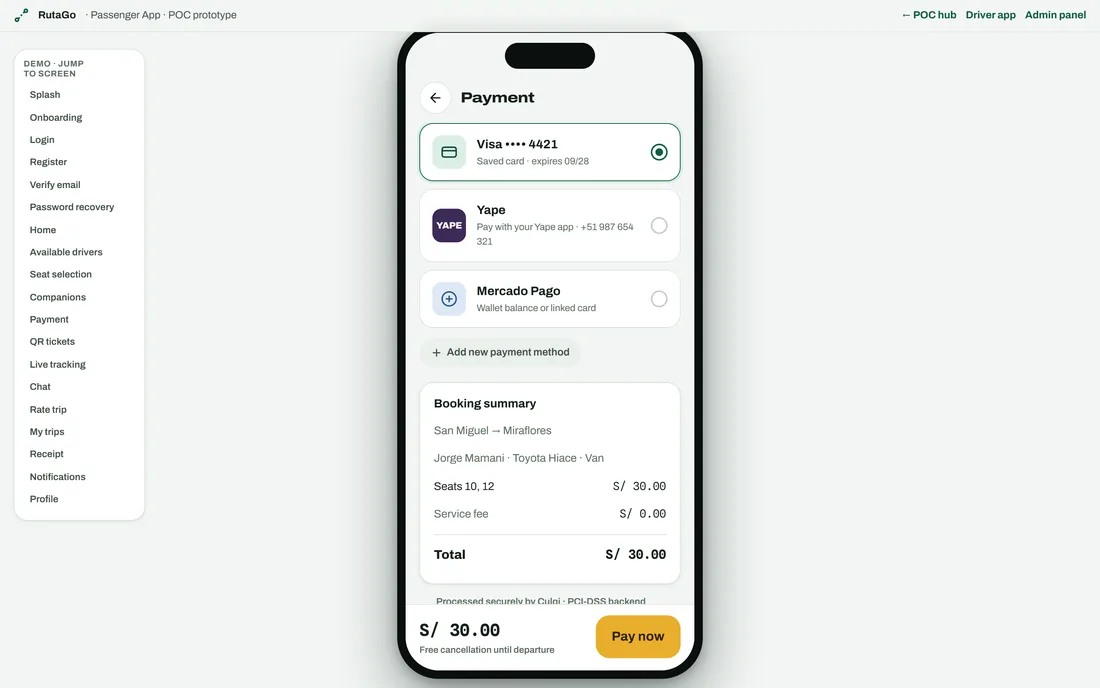
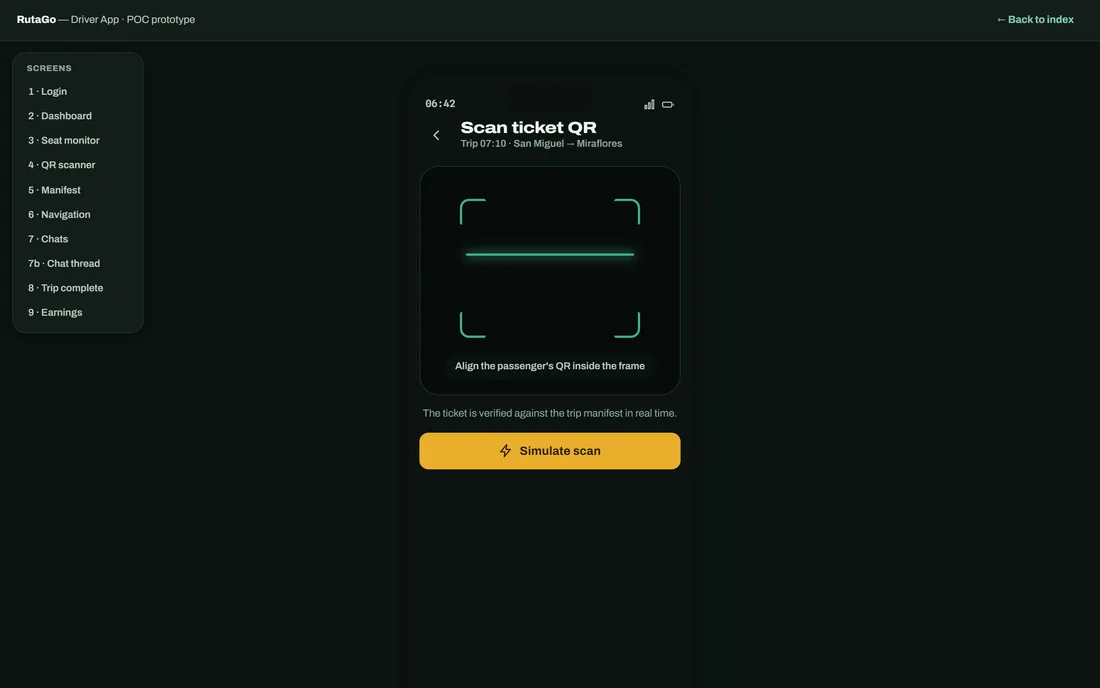
Card, Yape and Mercado Pago sit side by side with a booking summary and a service fee, because on this route a card-only flow would exclude most riders.
Reserved seats issue individual QR codes, with the refund rule stated at the exact step where it stops applying.
The driver watches seats confirm in real time; the departure rule and the auto-departure countdown live on this screen, not in a policy document.
The QR scanner checks a ticket against the manifest and confirms the passenger, seat and stop in one glance.
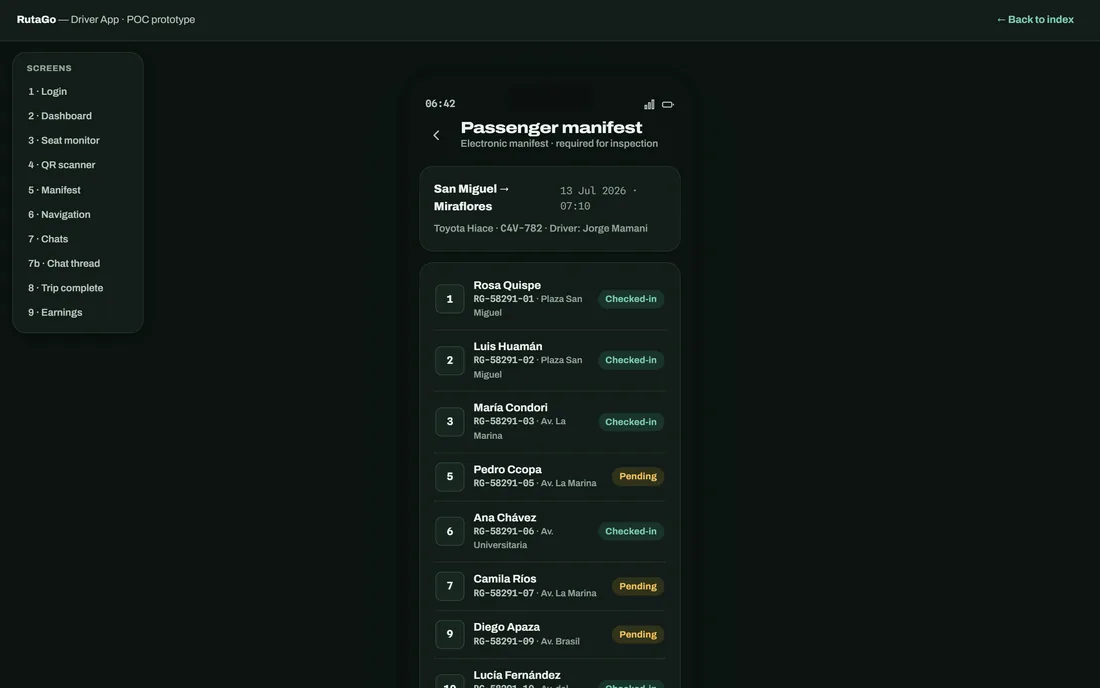
The electronic manifest lists every passenger, seat and boarding state, and exports to PDF for inspection.
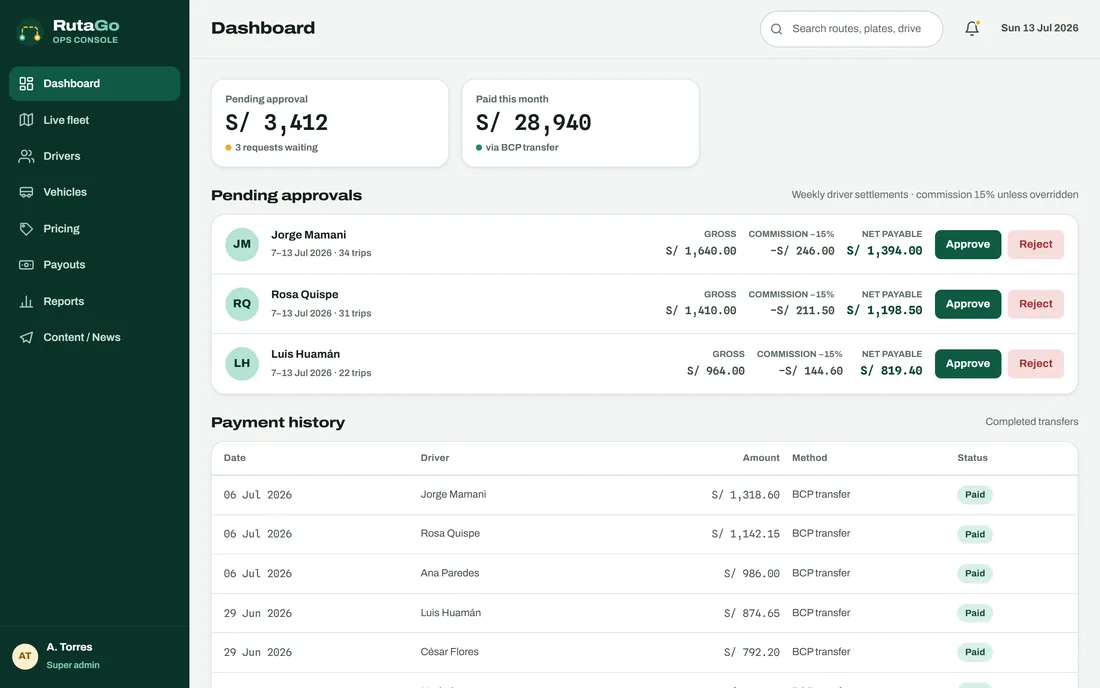
Driver settlements arrive as approvals with gross, commission and net payable spelled out, and a payment history behind them.
Live tracking runs alongside an in-trip chat, so a question about the pickup doesn't need a phone call.
Six things separate a booking platform whose rules actually hold from one that just displays them. They came out of designing and prototyping RutaGo and hold for any capacity-constrained, fixed-fare booking system.
Availability has to be a specific chair held under concurrency, not a number inferred from a stale screen.
If the rule against leaving half-empty lives in a policy document instead of the driver app, it doesn't hold.
Prices validated by operations, not set by whoever is driving, are what make a shared fare fair.
On a route where card ownership is not universal, wallets alongside cards are what make checkout actually work.
Proof of boarding has to be individual and auditable, not a driver's memory.
Directions, vehicle classes, seat layouts, fares and commission all change per city; the seat-locking and payout logic underneath should not.
Tell us how your business actually works and we'll tell you honestly what it takes to build — the seat map, the departure gate, the payouts. No deck, no pitch.