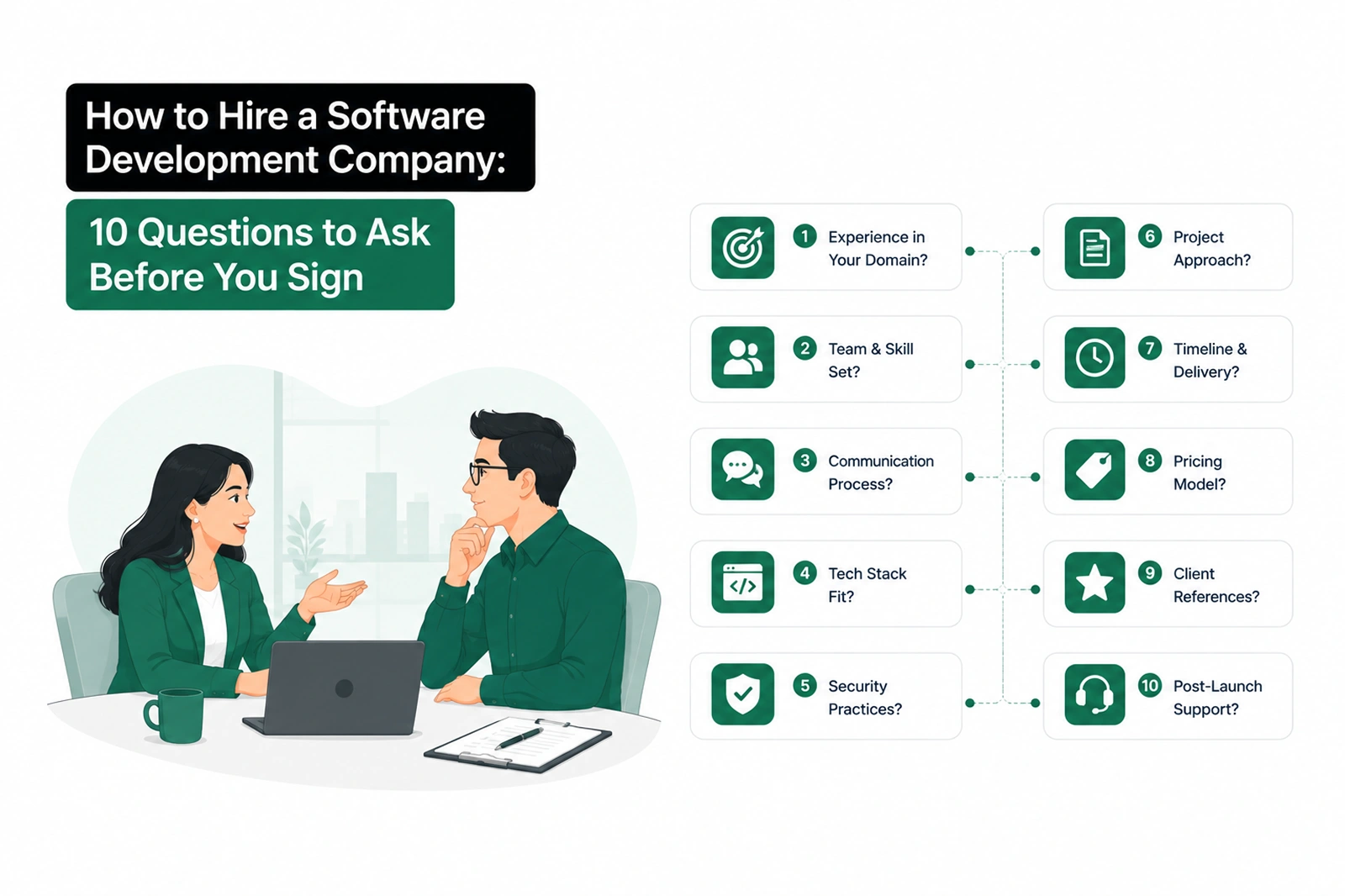
You don't need to write code to hire the right software development company. But you do need to ask the right questions - because the wrong hire will cost you months of wasted time and tens of thousands of dollars with nothing to show for it.
This guide is written for founders and business owners who are not engineers. No jargon. No technical theory. Just 10 honest questions that separate serious software teams from expensive disappointments - plus a pre-contract checklist you can use before you sign.
Plain-English questions every buyer should ask before hiring a software company
Typical timeline for a well-scoped custom build from contract to launch
Projects delivered by Shanti Infosoft across the UK, US, UAE, and Australia
Why Non-Technical Buyers Need a Different Checklist
Most advice on choosing a software development company is written by engineers for engineers - architecture, frameworks, CI/CD. That is not what you need to make a good hiring decision.
What you need is simpler: Will this company solve my actual business problem? Will it cost what they say? Will it still work in six months? And what happens when something breaks? Those are business questions, not technical ones - and any vendor worth hiring should answer every one of them in plain English.
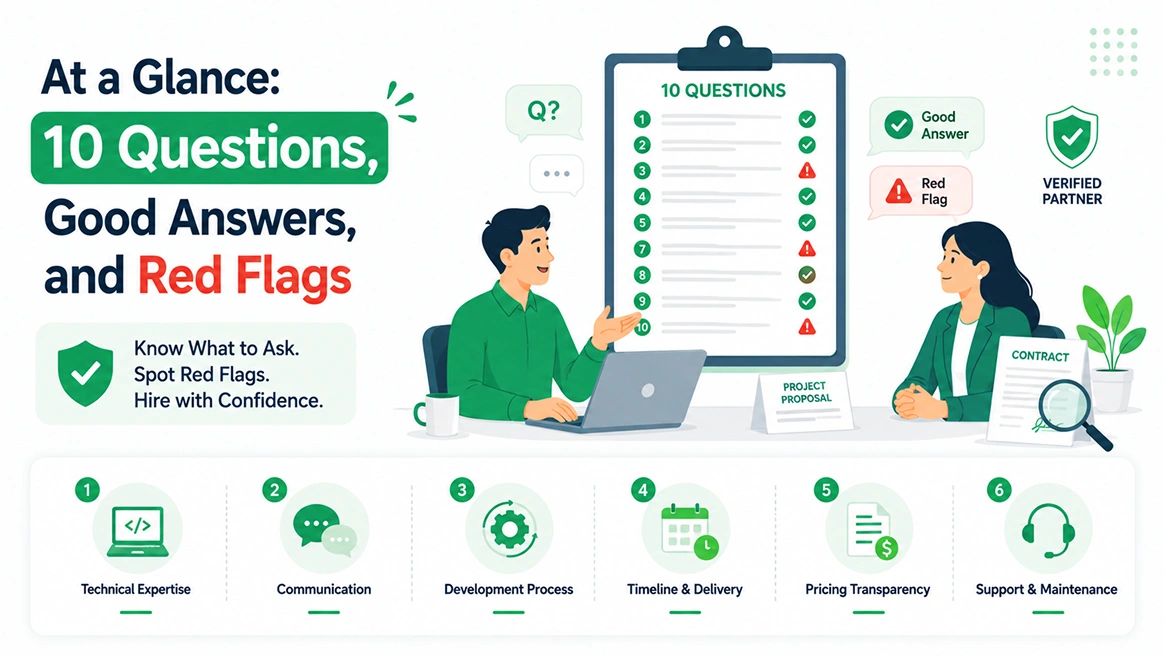
At a Glance: 10 Questions, Good Answers, and Red Flags
| # | Question | Good Answer | Walk Away If |
|---|---|---|---|
| 1 | Can you show me live software + a reference? | Live product, real client, offers a reference call | Only demos or screenshots, no references |
| 2 | What business problem will this solve? | Specific outcome with a measurable impact | Technology talk with no outcome |
| 3 | How do you define "done"? | Written scope and acceptance criteria | "We'll figure it out as we go" |
| 4 | Who owns the code and IP? | Full ownership transfers to you, in a repo you own | "It runs on our platform" |
| 5 | What happens after launch? | Defined support, warranty, and maintenance plan | Launch treated as the finish line |
| 6 | How do you handle bugs and delays? | Escalation process and a clear defect policy | "Our code rarely has bugs" |
| 7 | What will this cost now and later? | Full breakdown including hosting and change requests | Build price only, nothing beyond |
| 8 | Who will actually build it? | Named team you can meet before signing | "Our experienced engineers" |
| 9 | Can you explain your process? | Clear milestones, weekly updates, your sign-off | "We're agile and flexible" with no plan |
| 10 | What similar work have you done? | Projects at your scale, verifiable references | Broad portfolio, no depth anywhere |
Question 1
Can You Show Me Live Software - and a Client I Can Call?
Any team can build a polished demo or a good-looking portfolio page. Real business software is noisier and less predictable. Ask to see a live product running for a real client right now - and, better still, ask to speak with that client. If you are weighing an in-house team against a vendor, our guide on in-house vs outsourced vs dedicated teams breaks the trade-offs down.
Question 2
What Business Problem Will This Solve?
Before discussing technology, discuss outcomes. Ask the vendor to describe, in plain language, what your business will be able to do after the project that it can't do today - what task gets faster, what cost drops, and by roughly how much. A serious custom software partner translates their work into your business outcome, not the other way round.
Question 3
How Do You Define "Done"?
If neither of you can define what "done" looks like, the project never feels finished - and you keep paying for it. Push for written scope and acceptance criteria before work starts, tied to your contract.
Question 4
Who Owns the Code, IP, and Infrastructure?
This protects you from a common trap: the project ends and you discover the vendor owns the code, the repo, or the hosting - and you're locked into paying them indefinitely to keep using what you already paid to build. Ask directly, and get it in the contract.
Question 5
What Happens After Launch?
Most software doesn't fail during the build. It fails months after launch, when nobody maintains it. Ask what support, warranty, and maintenance look like - and what they cost - before you sign.
Question 6
How Do You Handle Bugs, Delays, and Things Going Wrong?
Every project hits problems. The difference between a strong and a weak partner isn't whether things go wrong - it's whether they have an honest plan for when they do.
Question 7
What Will This Cost - Now and Later?
The build price is only part of what you'll spend. Hosting, licenses, third-party APIs, and change requests add up. Ask for a full breakdown, and whether it's fixed-price or time-and-materials - and what happens to cost if usage doubles.
Question 8
Who Will Actually Build It - and Can I Meet Them?
The team you meet in the sales process is often not the team that builds your software. Ask who specifically will work on it, whether they're employees or subcontractors, and to meet them first. If you need to scale a team, a dedicated development team model makes this transparent.
Question 9
Can You Explain Your Process - and How I Stay in Control?
You don't need to understand the code. You do need to understand how the project runs, how you stay informed, and how problems get escalated before they get expensive.
Question 10
What Similar Work Have You Delivered?
Experience in software isn't the same as experience with your problem, industry, or scale. Ask for two or three projects close to what you need, with real business results and references you can verify. You can review work we've delivered across industries in our client portfolio.
Final Checklist Before You Sign
Use this before committing to any software development company. If two or more boxes stay empty, slow down before you sign.
- They showed you live, working software - not just a demo or portfolio page
- They described your business outcome in specific, measurable terms
- Scope and acceptance criteria are defined and confirmed in writing
- Code, IP, and repo ownership is clearly stated in your contract
- Post-launch warranty, support, and maintenance are agreed and costed
- You have met the actual project team by name
- You understand the milestones, cadence, and your approval rights
- Total cost, including hosting and change requests, is estimated in writing
- You spoke to at least one reference from a similar project
- Nothing felt rushed and no question was avoided or deflected
Frequently Asked Questions
Do I need to be technical to hire a software development company?
No. You need to understand your business problem, ask the right questions, and insist on plain-English answers. A good vendor makes their work understandable to you. If someone makes you feel foolish for asking basic questions, that tells you how they'll communicate for the whole project.
How much does it cost to hire a software development company?
It depends on scope and complexity. Budget for design, development, testing, integration, and at least a few months of post-launch support. Be cautious of unusually low quotes - they almost always omit ongoing costs. Contact us for a written estimate with no obligation.
Is fixed-price or time-and-materials safer for a software project?
Fixed-price suits small, well-defined scopes; time-and-materials suits evolving products. The safest arrangement is a fixed-price discovery phase that produces a written spec, then a transparent build with milestones and your sign-off at each stage.
How long does a custom software project take?
A well-scoped MVP or internal tool typically takes 2 to 4 months from signed contract to launch. Be skeptical of timelines under 6 weeks for anything genuinely custom, and of open-ended timelines with no milestones.
How do I protect my source code and IP?
Put IP ownership in the contract: all source code, designs, and data transfer to you at completion, in a repository you own. Insist on a signed NDA and a Data Processing Agreement (DPA) if they handle personal data (required under GDPR). Vague answers here are a legal risk, not just a business one.
Talk to a Software Team That Answers Every Question
We work with founders and business owners who are not technical. You get a named team, written cost estimates, full code and IP ownership, and 48-hour response times. CMMI Level 5 certified. 700+ projects delivered.