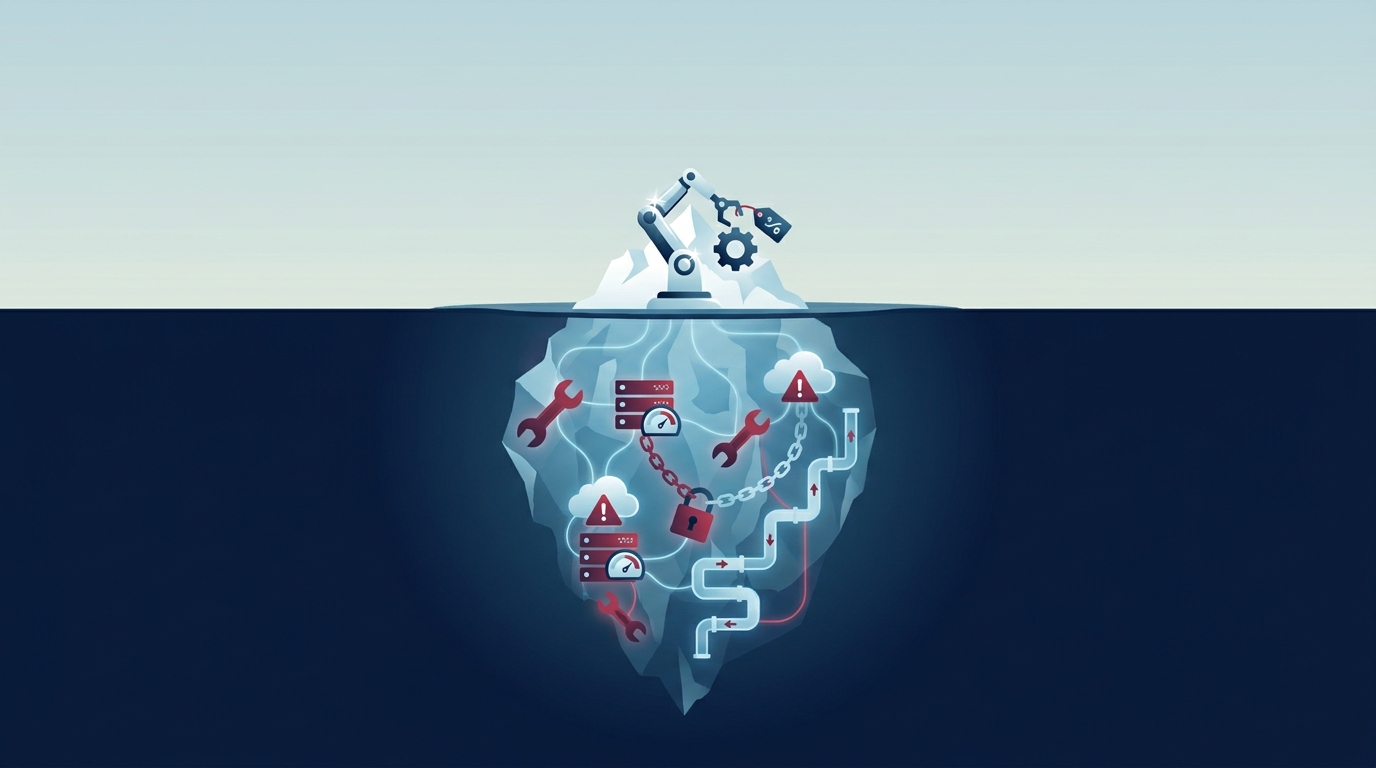
Nobody ever quotes you the most expensive part of an automation: the years you spend keeping it alive.
"Just automate it" has become the reflex answer to every repetitive task, and most of the time it is good advice. Automation is one of the highest-leverage things a business can do. But there is a sentence that almost never gets said in the same breath, and it is the one that separates people who get rich on automation from people who get slowly buried by it: every automation you build is a permanent liability you have taken onto your books. You did not just save time. You acquired a small, fragile machine that now has to be fed, watched, and repaired for as long as you depend on it.
This is not an argument against automating. It is an argument for automating with your eyes open — for seeing the whole bill before you sign up for it, and for having the discipline to say "not this one" when the math does not work. Because the build cost, the part everyone quotes, is the tip of the iceberg. The rest is below the waterline, and it is where automation projects quietly go from asset to anchor.
The Pitch Everyone Hears vs the Bill Everyone Pays
The pitch is clean and compelling: this task takes someone two hours a week; we automate it once; now it takes zero hours forever. Framed that way, the decision is obvious — of course you build it. And if automations were "build once, run free," it would be obvious. The problem is that an automation is not a finished object. It is a piece of software that makes a standing assumption: that the world it runs in will stay exactly as it is. The same spreadsheet format. The same website layout. The same API. The same business rule it encoded. The same edge cases — and no new ones.
The world does not cooperate. The vendor changes their UI. The API deprecates a field. Someone adds a new product category the automation never anticipated. A regulation shifts the rule. And every one of those changes lands as a broken automation that someone now has to notice, diagnose, and fix — often urgently, because by the time you automated it, the manual fallback skill quietly atrophied. The pitch quoted you the build. The bill includes the entire lifetime of keeping a brittle thing working in a world that keeps moving. That gap between the pitch and the bill is the whole subject of this article.
The Four Line Items Nobody Puts in the Quote
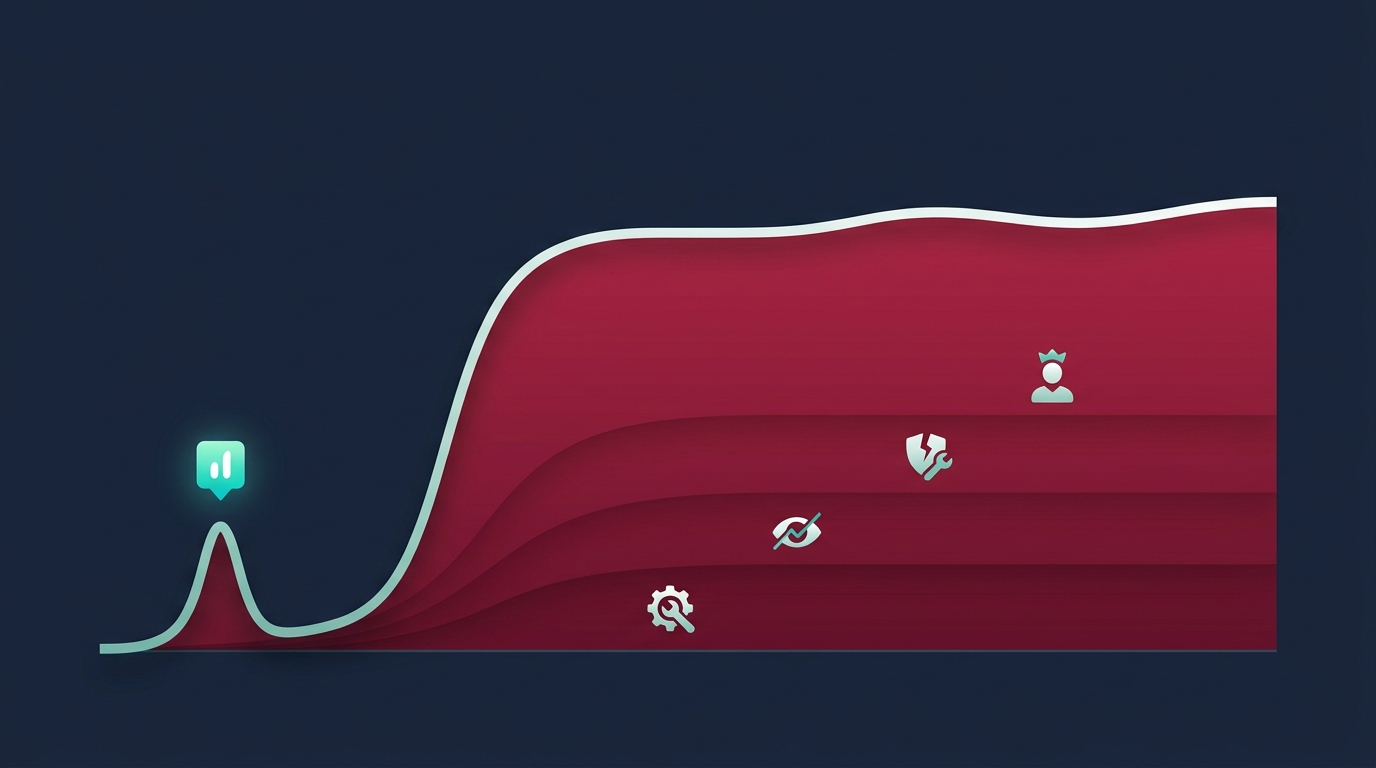
When we audit an automation that has become a burden, the cost always breaks into the same four buckets. Three of them are invisible at quoting time, which is exactly why they blow up budgets later. Here is the real bill.
| Line item | What it actually costs you |
|---|---|
| 1. Build (the quoted part) | The visible, one-time cost everyone budgets for — and usually the smallest number on the page over the automation's life. |
| 2. Maintenance | Ongoing repairs every time something it depends on changes — a UI, an API, a data format, a rule. Recurs forever, unpredictably, often urgently. |
| 3. Monitoring & silent failure | Automations fail quietly. Without monitoring you find out from an angry customer, not an alert. The cost is both the watching and the damage when watching is absent. |
| 4. Edge cases & fragility | The first version handles the common path. Every exception you later bolt on adds complexity, and the institutional knowledge of the manual process decays — so the fallback is gone when you need it. |
Two of these deserve special attention because they are the ones that genuinely surprise people. Silent failure is uniquely nasty: a human doing a task by hand notices when something looks wrong, but an automation will happily process garbage at full speed and never raise its hand. A misconfigured rule can corrupt months of data before anyone spots it, precisely because the automation was working "fine" — it was doing exactly what it was told, just wrongly. The fix is monitoring and alerting, which is itself more software to build and maintain. The bill compounds.
And institutional fragility is the subtle one. When you automate a process completely, the people who used to do it forget how. That is fine until the day the automation breaks and you discover that nobody remembers — or was ever taught — the manual version. Now a routine outage is a crisis, because there is no human fallback and the one system that understood the process is the one that is down. Automation does not just add a maintenance cost; it can remove your safety net.
The Total-Cost-of-Ownership View That Changes the Decision
The fix for over-automation is not cynicism; it is a better unit of measure. Stop comparing "build cost" against "time saved" and start comparing lifetime cost against lifetime savings. The moment you do that subtraction honestly, the right answer often flips — in both directions, which is the point.
Lifetime cost is build plus expected maintenance plus monitoring plus a fair estimate of what a silent failure will cost you, summed over the realistic lifespan of the task. Lifetime savings is the time and money the automation frees up over that same period. A high-volume, stable task — invoices that arrive in the same format ten thousand times a year — has enormous savings and modest maintenance, so it is an obvious, decisive win. A rare, fiddly, frequently-changing task has small savings and large, recurring maintenance, and the honest math often says: leave it manual, or keep a human in the loop.
This is exactly the analysis we run before we build anything for a client. The most valuable thing a good engineering partner does is sometimes talk you out of an automation — or steer you to semi-automation, where the software does the heavy lifting and a human handles the exceptions, which frequently captures most of the savings for a fraction of the lifetime cost and fragility. The goal was never "automate everything." It was "spend your maintenance budget where it earns the most."
When NOT to Automate
Here is the practical filter. Before you build, run the task through these. If it trips several of them, that is your signal to leave it manual, semi-automate it, or wait until it is more stable — and to feel good about the decision rather than guilty.
- It's rare. A task you do a handful of times a year rarely saves enough to justify a lifetime of maintenance. Do it by hand and spend the engineering elsewhere.
- It changes often. If the process, the inputs, or the systems it touches keep shifting, the automation will break constantly. You'll spend more time fixing it than the manual task ever took.
- It needs judgement. Tasks full of exceptions and "it depends" are a poor fit for full automation. Encode the routine part and route the judgement calls to a human.
- Silent failure is expensive. If a quiet error could corrupt data, mislead a customer, or break compliance, the cost of getting it wrong unattended can dwarf the time saved. Keep a human checkpoint.
- It would erase a critical skill. If fully automating means no one can do it manually in an outage, you have traded efficiency for fragility. Keep the fallback alive.
- The lifetime math is negative. If build plus maintenance plus failure risk outweighs the realistic lifetime savings, the spreadsheet has already answered. Trust it.
How to Be in the Winning Minority
Most teams automate on instinct and discover the bill later, one broken script and one silent-failure incident at a time. The minority who compound value from automation, rather than accumulate fragile liabilities, do a small set of things differently — and none of them are hard, they are just disciplined.
They price automations on lifetime cost, not build cost, and they are willing to walk away when the math is negative. They reach for semi-automation by default — software does the volume, a human owns the exceptions — because it captures most of the savings without most of the fragility. They build monitoring and alerting in from the start, so failures announce themselves instead of festering. They deliberately preserve the manual fallback for anything critical, so an outage is an inconvenience and not a crisis. And they revisit their automations periodically and retire the ones whose world has changed so much that they cost more to maintain than they save — pruning, not just planting.
The honest punchline is that automation is still one of the best investments you can make. It is just an investment, with an ongoing cost of capital, not free money. Treat each automation as something you will own and feed for years, do the subtraction before you build, and you end up in the minority who get the leverage without the slow burial. The trade-off was always there. The winners are simply the ones who priced it.
We Quote You the Whole Bill — Then Build Only What Pays
Shanti Infosoft is a CMMI Level 5 software engineering firm. We help you decide what's worth automating, build it to last with monitoring and graceful failure, and tell you honestly when manual or semi-automation is the smarter call. You get a named senior team, written fixed-scope estimates, and full IP and source ownership.
Frequently Asked Questions
What is the hidden cost of automation?
The build cost is the small, visible part. The hidden cost is everything after: maintenance when the things it depends on change, monitoring so you know when it silently breaks, handling the edge cases the first version skipped, and the institutional fragility of a process only the automation understands. Every automation you build is a permanent liability on your books, and that ongoing bill is almost never in the original quote.
When should you NOT automate a task?
Don't automate when the task is rare, when it changes often, when it needs judgement and exceptions are common, or when the cost of a silent failure is high relative to the time saved. A good test is the total-cost-of-ownership view: if the lifetime maintenance burden plus the risk of failure outweighs the hours saved, doing it manually — or semi-automating with a human in the loop — is the smarter, cheaper choice.
Why does automation create technical debt?
Because an automation is code that depends on the world staying the same — the same UI, API, data format, and business rules. The world doesn't. Every upstream change can break it, and someone has to notice, diagnose, and fix it. Automations also tend to encode a process so completely that the human knowledge of how to do it manually atrophies, so when the automation breaks, the fallback is gone. That accumulating maintenance and fragility is real technical debt.
How do you calculate the real ROI of an automation?
Compare the time and money saved against the full lifetime cost, not just the build. Add up build cost, expected ongoing maintenance, monitoring and incident handling, and a fair estimate of the cost when it fails silently. Then weigh that against hours saved over the realistic lifespan of the task. Many automations are clear wins on this math; a surprising number are not, especially for rare or frequently-changing tasks.
Is semi-automation better than full automation?
Often, yes. Semi-automation lets software do the high-volume, mechanical part while a human handles the exceptions and judgement calls. It typically captures most of the time savings while avoiding the worst of the fragility, silent-failure risk, and edge-case maintenance that make full automation expensive to own. For tasks with frequent exceptions or high stakes, it is usually the smarter design.
Written by
Rishabh Jain
AI Consultant & Founder, Shanti Infosoft LLP
Shanti Infosoft is a CMMI Level 5 software engineering firm. We deliver every project with written, fixed-scope estimates, full IP and source-code ownership for the client, and a named team of senior engineers. We specialise in taking AI from prototype to production: 700+ projects delivered across web and mobile development, AI integration, and offshore engineering.
700+ Projects Delivered | CMMI Level 5 | 4.9★ on Clutch | 38,000+ hrs on Upwork