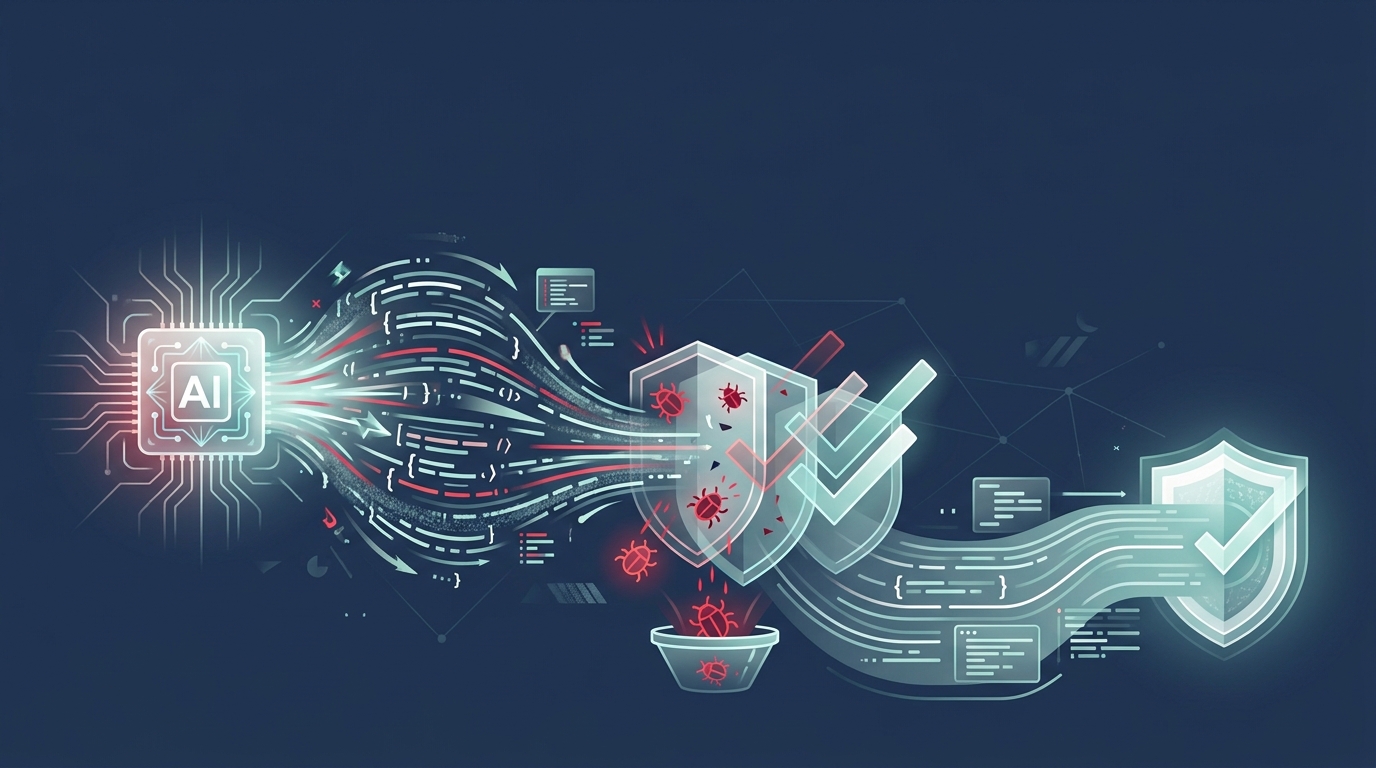
Your developers are shipping more code than they ever have. So are their mistakes.
The story everyone tells about AI coding tools is a story about speed: features that took a week now take an afternoon, a junior can scaffold what used to need a senior, the backlog finally moves. All of that is real. But there is a second half to the sentence that rarely makes the slide deck. When you multiply how fast code is written, you multiply how fast code is shipped — and "code" includes the broken parts. The bottleneck did not disappear. It moved downstream, from writing to verifying, and most teams have not moved their defenses to match.
This is the quiet crisis inside the AI productivity boom. The bug that an AI introduces costs exactly the same to fix in production as a human-written one — except now there is four times as much code arriving four times as fast for a review process that did not get four times bigger. The teams pulling genuinely ahead are not the ones generating the most code. They are the ones who built a QA layer that scales with the output. This article is the playbook for that layer.
The Bottleneck Just Moved — and Most Teams Didn't
For decades the constraint on software delivery was typing speed in the loosest sense: how fast skilled people could turn intent into working code. Every methodology, every tool, every hiring plan was tuned to relieve that constraint. AI relieved it almost overnight. And the moment it did, the real constraint underneath was exposed: not how fast you can produce code, but how fast you can be confident it is correct, safe, and maintainable.
Confidence does not come from generation. It comes from review, testing, and verification — and those are still bounded by human attention and by whatever automated checks you have in place. So when output quadruples and verification stays flat, something has to give. Usually what gives is the review itself: pull requests get rubber-stamped because there are too many, tests get skipped because the feature "obviously works," and the team quietly trades rigor for throughput without ever deciding to. The bill arrives later, in production, with interest.
The fix is not to slow the AI down. It is to build verification that scales the way generation now does — mostly automated, layered, and fast, with human judgement spent only where it actually counts. That is what the rest of this guide lays out.
Why AI-Generated Code Bites Differently
AI code is not worse than human code line by line. In many cases it is cleaner. The danger is different in kind, and understanding that is what tells you where to aim your QA. Three properties make AI output uniquely risky if you review it the way you review a human's.
It is plausible. AI writes code that looks right. It compiles, it follows conventions, the variable names are sensible, the structure is familiar. That surface correctness disarms reviewers — a human pull request that looks this tidy usually is fine. But AI optimises for plausible, not correct, so the errors hide in the gaps the eye glides over: an off-by-one in a boundary, a misunderstood requirement, a security check that looks present but does nothing.
It is confident about things it should not be. AI rarely signals doubt. A junior developer who is unsure says so, flags the risky bit, asks a question. AI hands you the uncertain part with the same calm fluency as the trivial part. So the signal a reviewer normally relies on — "the author seemed nervous about this function" — is gone. Everything reads as finished.
It arrives in volume. One developer with an AI assistant can open more pull requests, touching more files, than a reviewer can carefully read. Volume is itself a defect vector: the more there is to review, the less attention each line gets, and the more a real bug slides through on the strength of looking like all the others around it. A meaningful share of AI-generated code still needs debugging once it is live — Lightrun's 2026 developer survey found roughly 43% of respondents reported AI-written code that required production debugging. That is not an argument against AI; it is an argument for catching those defects before they ship.
The 5-Layer QA Stack for AI-Generated Code
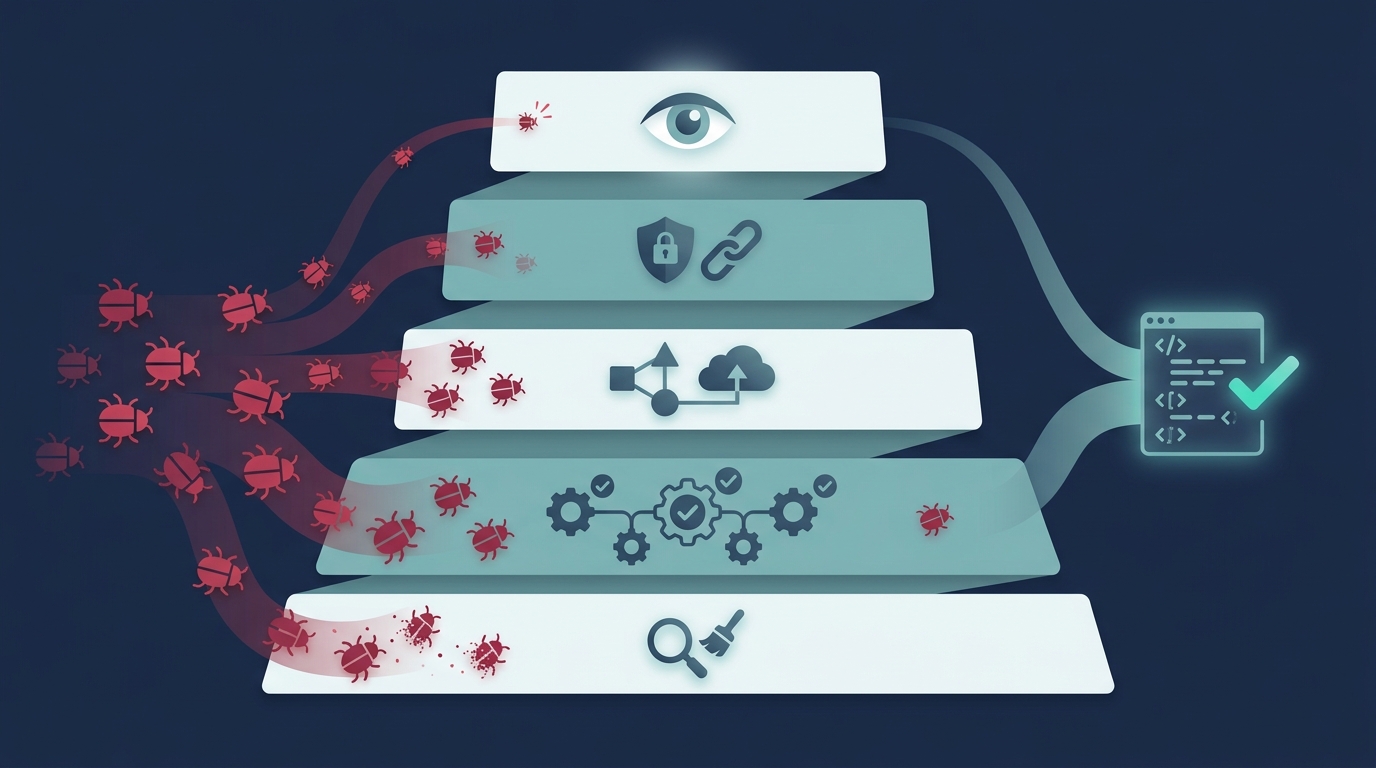
The answer to "more code, faster" is not "review harder." It is a stack of checks, each catching a different class of defect, most of them automated so they scale with output instead of with headcount. Think of it as a series of filters: AI code enters at the top, and only code that survives every layer reaches your users. Here is the stack we run, top to bottom.
| Layer | What it catches | Automated? |
|---|---|---|
| 1. Static analysis & linting | Style violations, obvious bugs, unused code, type errors, risky patterns — instantly, on every commit | Fully |
| 2. Automated tests (the wide base) | Logic errors and regressions via unit and property tests; this is the layer that must grow with the code, not lag it | Fully |
| 3. Integration & end-to-end tests | Failures at the seams — where AI-written modules meet each other and your existing systems | Fully |
| 4. Security & dependency scanning | Injection flaws, secrets in code, vulnerable or hallucinated dependencies, insecure defaults | Fully |
| 5. Human code review | Business-intent mismatches, architectural drift, and the subtle, plausible-looking errors machines miss | Human |
A few things about how to run this stack, because the order and emphasis matter as much as the list. Push detection as early (as far up) as possible. A bug caught by a linter costs seconds; the same bug caught in production costs an incident. Every layer you can catch a defect at, instead of the one below it, saves real money.
Make the test layer non-negotiable and let AI help build it. The single biggest failure mode is letting code volume outpace test coverage. Use AI to write tests too — it is genuinely good at generating cases — but with a sharp caveat covered below. Tests are the layer that turns "looks right" into "provably does what we asserted."
Treat the AI tool's own settings as part of the stack. Constrain what the assistant is allowed to touch, pin and review its dependency suggestions, and never let it merge its own output unreviewed. The tool is a powerful junior on the team, not an autonomous committer.
The One Layer AI Can't Replace
It is tempting to believe that if you automate enough layers, you can remove the human one. You cannot — and the reason is precise. Every automated check verifies that the code does what the code says. None of them verify that the code does what the business needs, because the machine has no access to that intent. The linter does not know your refund policy. The test suite does not know that this customer tier is supposed to be exempt. The security scanner does not know which data is sensitive in your domain.
That gap — between "the code is internally correct" and "the code is the right code" — is where the human reviewer lives, and AI has, if anything, made that role more important. When code was expensive to write, the writer thought hard about intent along the way. When code is cheap to generate, the intent check has to be deliberate, and it lands on the reviewer. The skill that appreciates in an AI-heavy team is not typing faster; it is reading critically — holding the business requirement in one hand and the plausible-looking diff in the other, and catching where they quietly disagree.
This is exactly the discipline we bring to AI integration and delivery work: AI accelerates the generation, and a named senior engineer owns the verification. The output is ours to defend, not the model's — and that is the only basis on which code is safe to ship.
How to Be in the Winning Minority
The teams getting compounding value from AI coding tools, rather than a slow accumulation of hidden defects, share a small set of habits. None of them are exotic. They are simply the discipline that the speed of AI makes mandatory instead of optional.
They invest in the test and CI layer first, before scaling up AI usage, so that the safety net grows ahead of the code rather than behind it. They make code review a hard gate that no AI output skips, and they staff it with engineers who understand the business, not just the syntax. They run security and dependency scanning on every change, because AI confidently suggests vulnerable and even non-existent packages. They use AI to generate tests but design the critical ones independently, so the checks are not graded by the same hand that wrote the answer. And they measure the thing that actually matters — defects reaching production, mean time to detect, escaped-bug rate — rather than vanity metrics like lines generated or pull requests merged, which reward exactly the wrong behaviour.
Put simply: the winners let AI write at full speed and refuse to let it ship at full speed. The gap between those two is the QA layer, and it is the entire game. If you are accelerating generation without a matching investment in verification, you are not faster yet — you are just closer to the incident.
Ship AI-Generated Code at Speed, Without Shipping the Bugs
Shanti Infosoft is a CMMI Level 5 software engineering firm. We build the QA layer that lets AI-assisted teams move fast safely — automated testing, CI pipelines, security scanning, and senior human review on every change. You get a named senior team, written fixed-scope estimates, and full IP and source ownership.
Frequently Asked Questions
Does AI-generated code really need more QA than human-written code?
Yes — not because each line is worse, but because there is far more of it, it arrives faster than a human can carefully read, and it looks more finished than it is. AI optimises for plausible output, which disarms reviewers and hides subtle logic, security, and edge-case errors. The volume and the false confidence are the risk, so your QA layer has to scale with output rather than depend on someone eyeballing every line.
What does a QA layer for AI-generated code actually look like?
A stack of automated and human checks: fast static analysis and linting, a strong base of automated unit and property tests, integration and end-to-end tests, security and dependency scanning, and a mandatory human code review. Each layer catches a different class of defect. Together they let you accept code at AI speed without shipping bugs at AI speed.
Can't AI just write its own tests to cover the bugs?
AI can write tests, and it should — it is good at generating cases. But tests written by the same model that wrote the code tend to assert what the code already does, including its mistakes. AI-written tests are a useful first layer, not the safety net. You still need independently designed tests for critical paths, security scanning, and a human reviewer who understands the business intent the code is meant to serve.
How much does production debugging of AI code actually cost?
A meaningful share of AI-generated code still needs debugging once it reaches production — Lightrun's 2026 developer survey put it at roughly 43% of respondents reporting AI code that required production debugging. A bug caught by a linter or a test costs minutes; the same bug caught in production costs incident response, customer impact, and engineering time. That gap is exactly why moving detection earlier in the QA stack pays for itself.
Will a strong QA layer slow my team down and cancel out the AI speed-up?
The opposite, when it is built well. Most QA layers are automated and run in seconds to minutes on every change, so they add almost no human time — they simply catch defects before they become expensive. What slows teams down is the alternative: shipping fast, accumulating hidden bugs, and paying for them in production incidents and rework. A good QA layer is what makes AI speed sustainable rather than a debt you repay later.
Written by
Rishabh Jain
AI Consultant & Founder, Shanti Infosoft LLP
Shanti Infosoft is a CMMI Level 5 software engineering firm. We deliver every project with written, fixed-scope estimates, full IP and source-code ownership for the client, and a named team of senior engineers. We specialise in taking AI from prototype to production: 700+ projects delivered across web and mobile development, AI integration, and offshore engineering.
700+ Projects Delivered | CMMI Level 5 | 4.9★ on Clutch | 38,000+ hrs on Upwork