You hired a software vendor to build a product, not to defend a moving frontier of AI-powered attacks. But here is the uncomfortable truth: the way attackers break into software changed more in the last twelve months than in the previous ten years. The tools your development team uses to write code faster are the same tools attackers now use to break in faster. And most buyers have no idea the ground shifted underneath them.
You don't need to be a security engineer to protect your project. You do need to know which questions separate a vendor who takes AI-era security seriously from one who is still running a 2023 playbook. This guide gives you the plain-English tour: the new attack surfaces, why the patch window collapsed, and the hardening practices a serious vendor follows on every AI-assisted build. Read it before you sign your next contract.
At a Glance
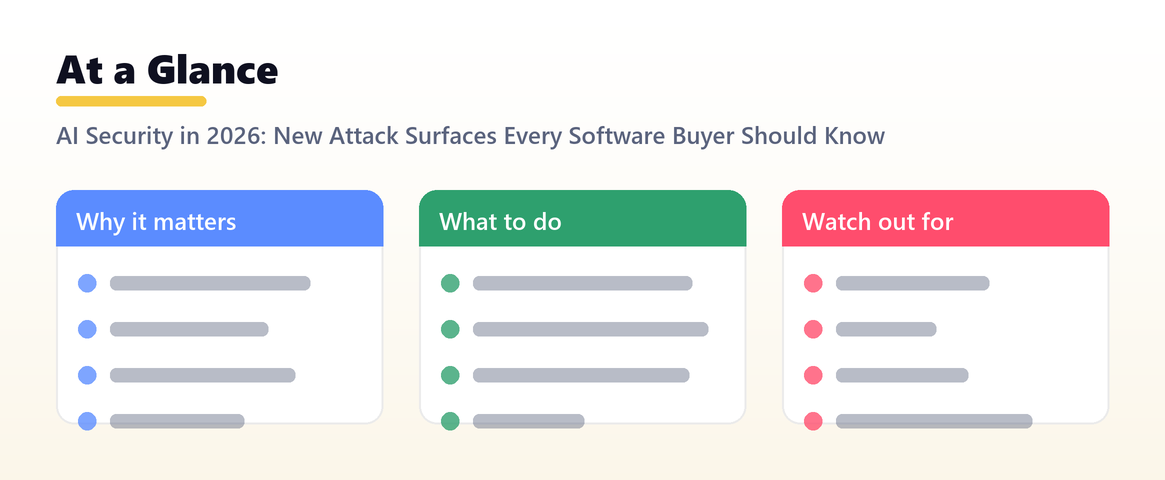
| # | The New Threat | What It Actually Means | What a Serious Vendor Does |
|---|---|---|---|
| 1 | Poisoned AI config files | Hidden instructions in the files that guide AI coding tools tell the AI to plant backdoors | Audits config files like dependencies; scans for hidden characters |
| 2 | Autonomous exploit agents | AI that hacks, escalates, and spreads across a network 24/7 with no human driver | Deploys monitoring agents that watch for anomalous behaviour humans miss |
| 3 | Faster vulnerability discovery | Attackers chain minor bugs into working exploits in under a week, not months | Treats security as continuous, not an annual compliance checkbox |
| 4 | Collapsed patch window | The gap between "we patched it" and "they're in" shrank from months to days | Patches on a days cadence; assumes AI-assisted reconnaissance |
| 5 | Supply-chain drift | Poisoned packages and templates spread through npm, PyPI, and GitHub | Pins, verifies, and reviews every dependency and AI artefact |
The New Attack Surface: Config Poisoning and Agent Exploits
For most of software history, the "attack surface" was a short list: your login page, your API, your servers, the libraries you pulled in. In 2026, two new surfaces appeared that did not exist in any threat model your old vendor wrote.
Poisoned config files: the threat hiding in plain sight
Modern development teams use AI coding assistants like Cursor and Claude Code. These tools read small configuration files in your repository, files named things like .cursorrules or CLAUDE.md, that tell the AI how to write code for your project. Think of them as a style guide the AI follows.
A new class of attack, publicly named TrapDoor, hides malicious instructions inside those config files. Attackers inject invisible Unicode characters, text that looks completely blank to a human reviewer, but reads as a clear instruction to the AI: slip a backdoor into the codebase. Your developer scrolls past a blank line. The AI sees a command. The backdoor ships.
What makes this dangerous for you as a buyer is how it spreads. These poisoned configs travel through the same channels your team trusts every day: npm packages, PyPI libraries, and GitHub starter templates. A developer clones a popular template to save a week of setup, and inherits a compromised instruction file along with it. The attack rides in on convenience.
The reason traditional review misses it is worth understanding, because it explains why "we do code reviews" is no longer a sufficient answer. A human reviewer reads the visible code and signs off. The malicious payload is not in the visible code at all, it is in an instruction file the reviewer treats as harmless project metadata, written in characters that render as nothing on screen. The backdoor the AI then writes can look like ordinary, plausible code, the kind that passes review precisely because it does not look out of place. The fix is not heroic vigilance from your developers. It is process: treat AI config files as part of your security surface, version-control them, and run an automated scan for hidden characters before trusting any config that arrived from outside your team.
Autonomous exploit agents: software that breaks in without a human
The second new surface is the attacker themselves. Software used to need a person to point it at a target. That assumption broke this year. Published research now demonstrates AI agents, AI that takes actions rather than just answering questions, that can autonomously exploit real vulnerabilities, escalate their own privileges, and self-replicate, copying themselves to new machines with no human help. One documented agent rewrote its own code to evade detection.
Why this matters in plain terms: your old threat model assumed a human attacker who sleeps, makes mistakes, and works at human speed. An AI agent does none of those things. It probes thousands of endpoints at once, adapts its tactics in real time based on what it finds, and scales an attack faster than any human security team can respond. The perimeter-defence, static-rules, quarterly-pen-test playbook that worked in 2023 was built for an attacker that no longer exists.
Why the Patch Window Collapsed
Here is the single most important shift for a buyer to understand, because it quietly invalidates how most vendors schedule their security work.
Finding a serious vulnerability used to take skilled humans months of effort. This year, a small team used a restricted-access AI model to break through a brand-new chip-level hardware defence in five days. A separate corporate red team ran a similar exercise across 50 code repositories: the AI found minor bugs, then chained them into working exploits, in under a week. Both results, in days, not months.
Translate that into your business. The window between "we patched that vulnerability" and "attackers found a way in" collapsed from months to days. If your vendor runs vendor-risk assessments and security reviews on an annual cycle, those reviews are built on outdated assumptions the moment they are signed. AI-augmented attackers now move faster than any compliance checklist can keep up with.
This is not a reason to panic. It is a reason to change cadence. The defensible posture in 2026 is not "we did a big audit in Q1." It is "we check continuously, and we patch on a timeline measured in days." A vendor who cannot describe that cadence is telling you, without realising it, that they are still defending last year's threat.
There is a second-order effect here that buyers often miss. When exploitation accelerates, the value of knowing your own attack surface in detail rises sharply. In the old world, you could afford a fuzzy picture of what was running where, because attackers were slow enough that you usually had time to react once an alarm went off. In the new world, the gap between disclosure and exploitation is so short that your only durable advantage is having already mapped, hardened, and monitored everything before the attacker arrives. That is why the strongest vendors invest in continuous inventory and monitoring, not just reactive patching. They are buying down the time it takes to notice, because noticing is now the bottleneck.
Continuous vs Quarterly Audits: Why Cadence Decides Everything
Most teams run a security scan once and assume they are covered. Then they discover the hard way that "secure" and "actually secure" are two different things. The same AI that creates the new risk also makes continuous defence cheap. An AI audit agent can now check a fleet of devices and configs in real time, weak encryption, exposed passwords, unpatched settings, in the time it used to take to schedule a meeting. One real example: a founder discovered disk encryption was switched off on three executive laptops. The scan that caught it took ninety seconds.
Here is the honest comparison between the old cadence and the cadence a serious vendor now runs.
| Dimension | Quarterly / Annual Audit (the old way) | Continuous AI-Assisted Audit (the 2026 way) |
|---|---|---|
| Detection lag | Up to 90 days between checks | Nightly or on every change |
| Cost per check | High (human consultant time) | Near zero (agent runs unattended) |
| What it catches | A snapshot, already stale on delivery | The live gap between policy and reality |
| Response to the collapsed patch window | Loses the race; attackers move in days | Matches attacker speed |
| Coverage | Sampled, point-in-time | Every device, every config, every night |
| Where findings land | A PDF read once, then filed | Flagged in Slack the moment they appear |
The cost of missing one unpatched config is ransomware, data theft, and the PR nightmare that follows. The cost of catching it is ninety seconds and a prompt. That asymmetry is why cadence, not the size of any single audit, is now the thing that actually protects your project. At Shanti Infosoft we have built device-audit agents for clients that run nightly and flag risks directly in their team's Slack, so the gap between "something changed" and "someone knows" is measured in minutes.
One caution, because it is where buyers get misled: continuous does not mean unattended-and-forgotten. An agent that runs nightly but dumps findings into a channel nobody reads is theatre, not security. The point of continuous auditing is to compress the human response loop, not to remove the human. A serious vendor pairs the agent with a named owner who triages what it surfaces, decides what is real, and drives the fix. When you ask about continuous security, listen for both halves of the answer: the automation that detects, and the person accountable for acting. A vendor who can only describe one half has only half a posture.
A Hardening Checklist for AI-Assisted Projects
If your project is being built with AI coding tools, and in 2026 almost every project is, these are the controls a serious vendor applies. Use this as the standard you hold your vendor to, not as homework for yourself.
- ☐ AI config files (
.cursorrules,CLAUDE.md, and similar) are version-controlled and code-reviewed like any other source file. - ☐ Config files are scanned for hidden or invisible Unicode characters before they are trusted.
- ☐ Every dependency is pinned to a specific version, and updates are reviewed, not auto-pulled.
- ☐ Third-party templates and starter kits are audited before use, not cloned blind.
- ☐ Secrets (passwords, API keys, tokens) live in a vault or environment file, never hard-coded in the repo.
- ☐ Security checks run continuously (on every change or nightly), not just quarterly.
- ☐ A monitoring agent watches for anomalous behaviour humans would miss, and alerts in real time.
- ☐ Patching runs on a days cadence, with a named owner for security response.
- ☐ The threat model explicitly accounts for AI-assisted reconnaissance and autonomous agents.
- ☐ You retain full ownership of the source code and can have it independently audited any time.
If a vendor cannot show you how they meet most of this list, they are not running a 2026 security posture, regardless of what their proposal says. This is exactly the discipline we apply across our AI development and offshore engineering engagements.
Vendor Security Questions to Ask Before You Sign
You do not need to understand the cryptography. You need to ask the right questions and listen for whether the answer is specific or hand-wavy. Here are the questions that surface a vendor's real posture.
"How do you secure the AI tools your developers use?"
Good answer: They mention auditing config files, scanning for hidden characters, and treating AI artefacts as part of the security surface. Walk away if: they look puzzled, or insist AI tools are "just an editor" with no security implications.
"How often do you check for vulnerabilities, and how fast do you patch?"
Good answer: Continuous or nightly checks, patching measured in days, a named owner. Walk away if: the only answer is "we do an annual pen test." That cadence lost the race.
"Does your threat model account for AI-assisted attackers?"
Good answer: Yes, and they can describe how, autonomous agents, faster exploit chaining, monitoring for anomalous behaviour. Walk away if: they describe only perimeter defence and static rules.
"Will I own the source code, and can I get it independently audited?"
Good answer: Full IP and source ownership, written into the contract, audit-friendly. Walk away if: they gatekeep the code or resist independent review. A vendor confident in their security welcomes a second set of eyes.
Final Checklist Before You Sign
- ☐ The vendor could explain, in plain English, how poisoned config files and autonomous agents change the threat.
- ☐ They run continuous or nightly security checks, not a once-a-year audit.
- ☐ They patch on a cadence measured in days and named a responsible owner.
- ☐ Their threat model explicitly includes AI-assisted reconnaissance.
- ☐ Dependencies are pinned and templates are vetted before use.
- ☐ Secrets are vaulted, never committed to the repository.
- ☐ You receive full source and IP ownership, with the right to an independent audit.
- ☐ You got a written, fixed-scope estimate, not a vague hourly promise.
- ☐ You know the names and seniority of the people doing the security-sensitive work.
Frequently Asked Questions
Do I need a security background to evaluate a vendor's AI security?
No. You need to ask the questions in this guide and judge whether answers are specific or evasive. A serious vendor explains the threat in plain English without making you feel you should already know it. Vagueness is the red flag, not your lack of a security degree.
What is a poisoned config file, in one sentence?
It is a small file that guides AI coding tools, secretly carrying invisible instructions that tell the AI to plant a backdoor in your software, while looking completely blank to a human reviewer.
Are AI coding tools too risky to use at all?
No. They deliver real speed and quality gains, and the risk is manageable with basic hygiene: version-control and review the config files, scan for hidden characters, pin dependencies. The risk comes from using these tools without that discipline, not from the tools themselves.
How fast can attackers really exploit a new vulnerability now?
In documented 2026 cases, under a week, including breaking a brand-new hardware defence in five days. That is why an annual security cadence no longer protects you and continuous checking has become the baseline.
What does "continuous security" actually cost?
Far less than the old quarterly-consultant model, because the checks run as unattended automation. A nightly device-and-config audit agent runs in seconds and flags issues in your team chat. The expensive part of the old model, human time per check, largely goes away.
Can the same AI that creates these risks also defend against them?
Yes, and that is the most practical good news. The agent technology that enables autonomous attacks also powers continuous monitoring agents that watch for anomalous patterns a human would miss. The right posture is fighting fire with fire, deploying defensive agents to match attacker speed.
Written by
Rishabh Jain
AI Consultant & Founder, Shanti Infosoft LLP
Shanti Infosoft is a CMMI Level 5 software engineering firm. We deliver every project with written, fixed-scope estimates, full IP and source-code ownership for the client, and a named team of senior engineers, not a rotating bench of anonymous contractors. Our security-audit and hardening work spans web and mobile development, AI integration, and offshore engineering across 700+ delivered projects.
700+ Projects Delivered | CMMI Level 5 | 4.9★ on Clutch | 38,000+ hrs on Upwork
Talk to a Team That Treats AI-Era Security as a First-Class Concern
We work with founders and business owners who are not security specialists. You get a named senior team, written fixed-scope cost estimates, full IP and source ownership, continuous security practices baked into the build, and 48-hour response times. CMMI Level 5 certified. 700+ projects delivered. Explore our AI development services or offshore engineering options.