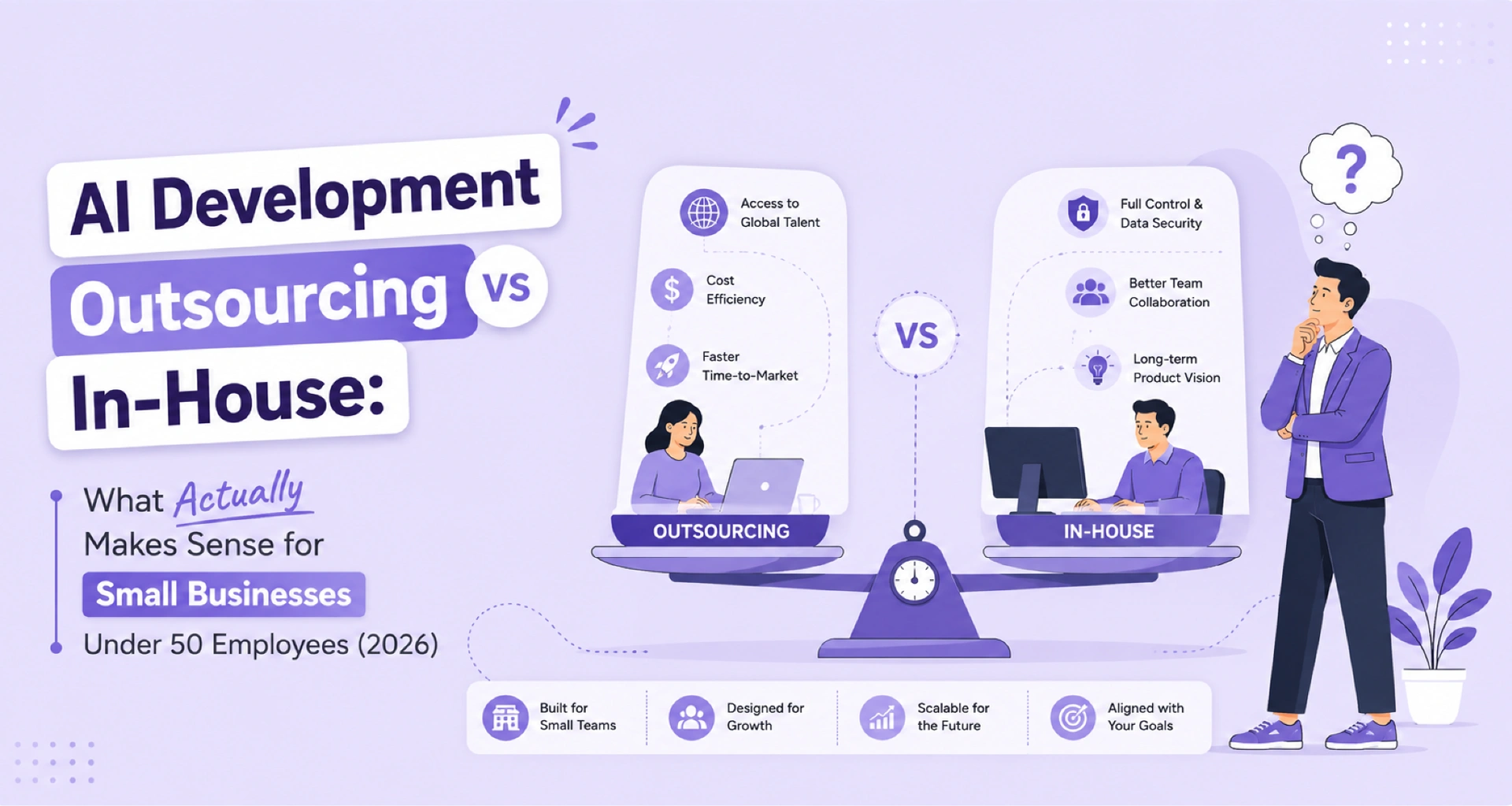
When weighing AI outsourcing vs in-house for small business, here is the honest financial reality most consultants won't give you upfront: for teams under 50 employees, outsourcing AI development is 60–70% cheaper than building in-house. Most small businesses — especially those under $2M in revenue — should start by outsourcing to an offshore team ($3K–$8K/month) and only consider hiring in-house AI engineers once AI becomes the core product, not just a feature.
The short answer is: outsource first, hire later. But the right choice shifts based on your budget, runway, and what you're actually building. Before choosing which route to take, it helps to understand what a serious AI development company actually does — this guide gives you a real decision framework so you can make the call confidently.
Cheaper to outsource vs. build in-house for small businesses
Typical outsourcing MVP timeline vs. 5–7 months in-house
Average savings for small businesses that validate via outsourcing first
Quick Answer: Outsourcing vs In-House for Small Businesses
| Factor | Outsourcing | In-House |
|---|---|---|
| Monthly cost | $3K–$8K (offshore) | $12K–$25K+ |
| Time to start | 2–4 weeks | 3–6 months |
| Best for | MVP, feature builds | Core product, proprietary models |
| Risk | Low — switch vendors freely | High — fixed salaries |
| IP Control | Medium (with proper DPA) | High |
| Hidden costs | Vendor mgmt, handoffs | Benefits, tools, compute |
What Is AI Development Outsourcing?
AI development outsourcing means hiring an external team — a freelancer, an offshore agency, or a specialist firm — to build AI features or models for your business without adding to your permanent headcount.
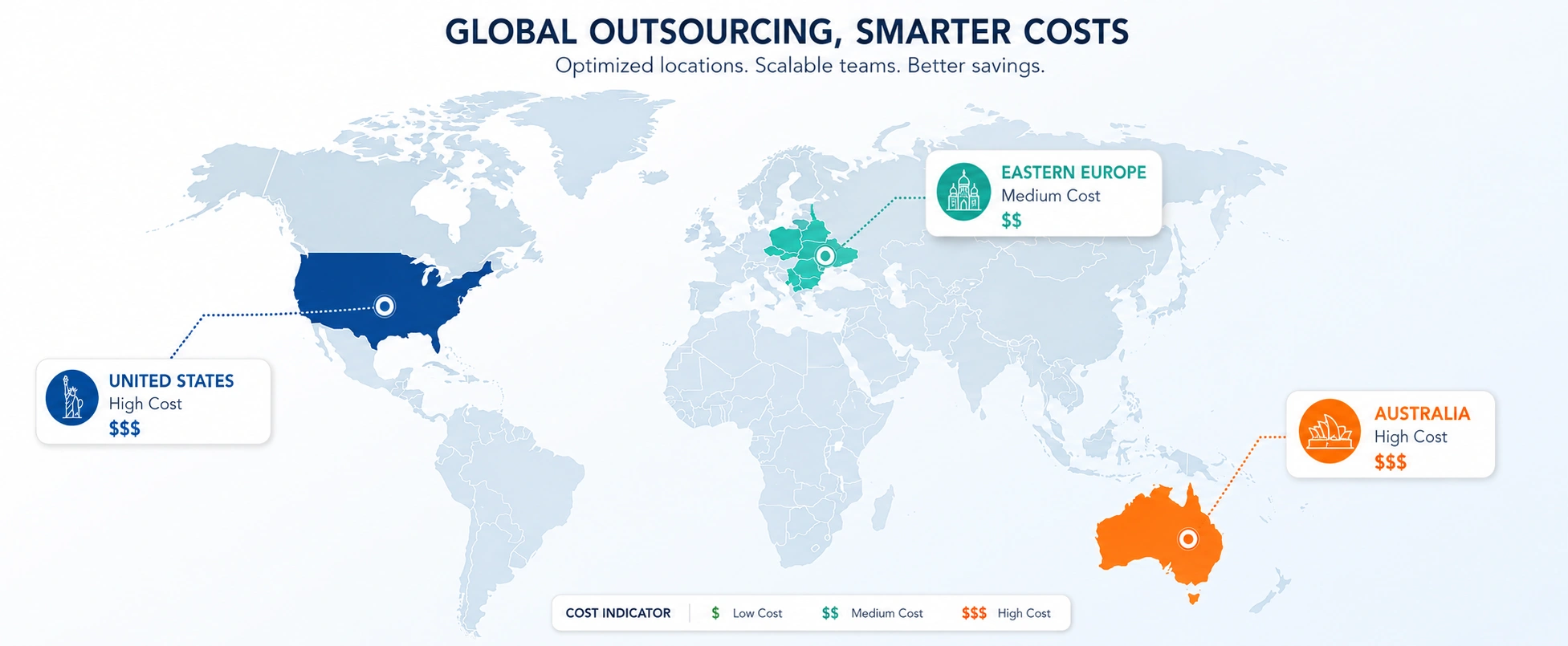
The most popular options for small businesses in 2026 are offshore teams from India and Eastern Europe, and boutique AI development agencies. AI development outsourcing in India in 2026 remains the most cost-competitive option, but Eastern Europe has gained ground for teams that want time zone overlap with the US or EU.
You agree on scope, deliverables, and timeline. They build. You keep full rights to the output through a proper IP assignment clause. No long-term commitment unless you want one.
What Is In-House AI Development?
In-house means hiring full-time AI engineers, ML engineers, or data scientists directly onto your payroll. They work exclusively for you, learn your product deeply over time, and have full context on every decision.
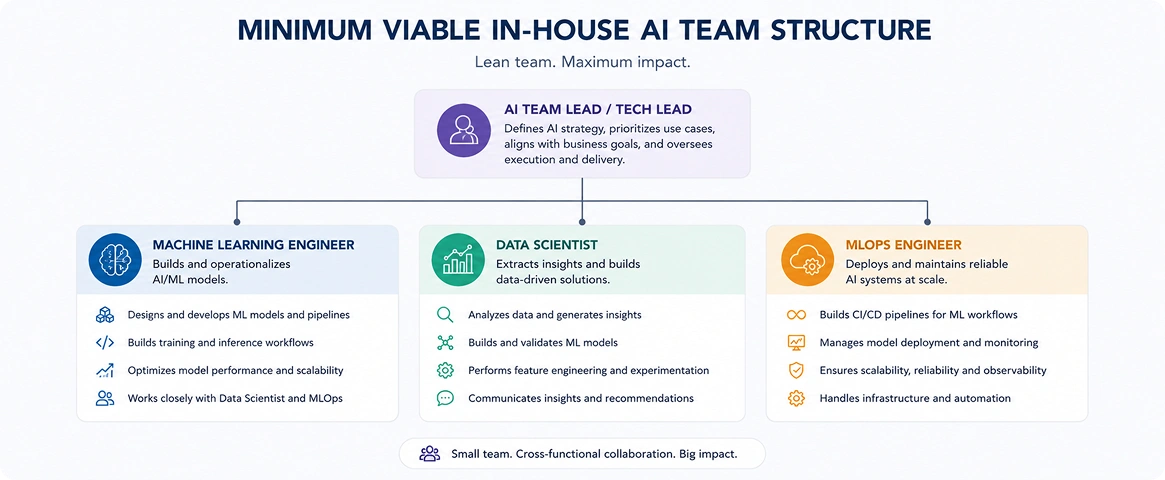
The tradeoff: speed and cost. A functional in-house AI team needs at minimum one ML engineer and one data scientist before a single feature ships. In the US, that's already $250K–$380K per year in base salaries before benefits, tooling, or cloud computing.
For most small businesses still finding product-market fit, that's a significant bet to make early.
AI Development Outsourcing Cost Breakdown (Hourly & Monthly Rates)
This is the section most small business owners bookmark. Here's the clearest breakdown — including the numbers most guides quietly leave out.
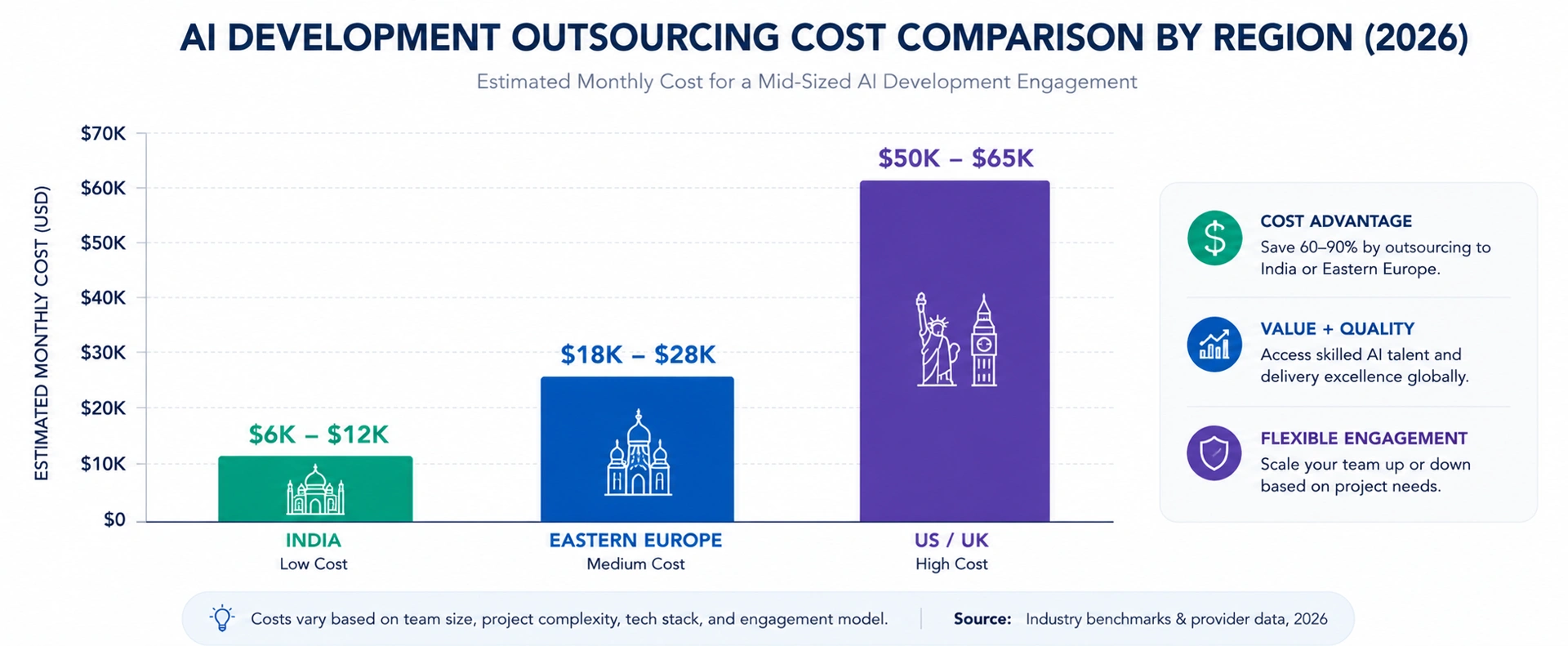
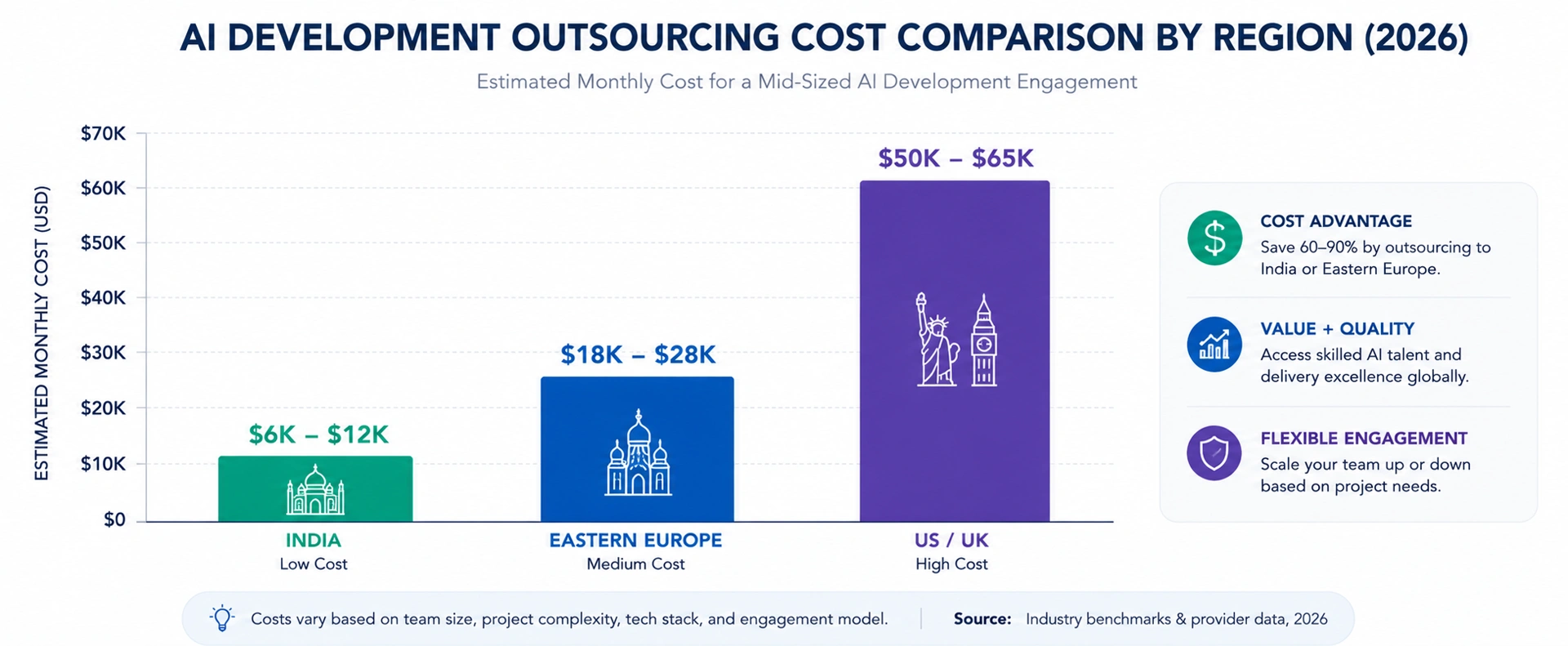
Outsourcing Cost by Region
| Region | Hourly Rate | Monthly (Full-Time Equivalent) |
|---|---|---|
| India / Offshore | $25–$50/hr | $3K–$8K |
| Eastern Europe | $40–$70/hr | $6K–$12K |
| US / UK Agency | $100–$200/hr | $16K–$32K |
Offshore teams in 2026 are no longer a quality compromise. Many have delivered AI projects for funded startups, mid-market SaaS companies, and enterprise clients. For small business AI development cost, offshore outsourcing is consistently the lowest-risk starting point — especially for teams building on generative AI, where pre-trained foundation models dramatically reduce build time compared to training custom models from scratch. If you're specifically evaluating generative AI options, the cost gap is even wider because offshore teams can move quickly with existing LLM infrastructure.
In-House Cost Breakdown
| Role | India Salary | US Salary |
|---|---|---|
| AI Engineer (Junior) | ₹6–12L/year | $120K–$160K |
| ML Engineer (Mid-Level) | ₹12–25L/year | $140K–$190K |
| Data Scientist | ₹8–18L/year | $130K–$170K |
Add 30% on top for benefits, software subscriptions, cloud compute, and onboarding ramp time. AI development cost for a small company compounds fast once you account for everything beyond base salary. Here's where small businesses quietly bleed budget after the hire is made:
- LLM token usage: If your product calls OpenAI or Anthropic APIs at scale, costs jump from a few hundred dollars per month to several thousand — fast. Many teams don't model this until they're already over budget.
- Vector database hosting: Tools like Pinecone or Weaviate are cheap at prototype scale and expensive in production — $500–$2,000/month for retrieval-heavy features.
- Cloud GPU instances: Custom fine-tuning or retraining on AWS, GCP, or Azure adds $1,000–$8,000/month depending on model size and frequency.
- Monitoring and observability tools: LangSmith, Weights & Biases, or similar MLOps tools add another $200–$800/month per team.
The Hidden Cost Nobody Talks About: 3-Year TCO
Here's a more honest 3-year picture that includes infrastructure — the numbers most guides quietly leave out:
| Outsourcing (Offshore) | In-House (US) | |
|---|---|---|
| Year 1 | $36K–$96K | $300K–$420K |
| Year 2 | $36K–$96K | $320K–$450K |
| Year 3 | $36K–$96K | $340K–$480K |
| 3-Year Total | ~$108K–$288K | ~$960K–$1.35M |
When to Outsource AI Software Development (5 Clear Signs)
These five signals apply specifically to small businesses — not enterprise companies with dedicated AI budgets.
- Your revenue or funding is under $500K. You don't have the margin to absorb a bad hire.
- AI is a feature, not your product. Adding smart recommendations to your SaaS? That's not a full-time hire.
- You need a working MVP in 6–10 weeks. No in-house hire can onboard and ship that fast.
- You don't have an internal technical AI lead. Without someone to manage the work, in-house hiring gets messy quickly.
- You want to validate before committing. Outsourcing lets you test whether AI actually moves your metrics before you lock in salaries.
The real question behind when to outsource AI development isn't about headcount — it's about whether AI is central to your value proposition yet. Our AI development team works with small businesses at exactly this stage: de-risking the decision before any long-term commitment is made.
When to Build an In-House AI Team (3 Real Scenarios)
Outsourcing is not a permanent answer. There are clear moments when building internally is the smarter move.
1. AI Is Your Core Product, Not a Feature
If you're selling an AI analytics tool, a computer vision product, or an NLP platform — your model is your moat. You can't outsource that indefinitely and maintain a competitive edge.
2. You've Crossed $2M in Revenue with 18+ Months of Runway
You now have the stability to hire, onboard, and wait for an internal team to ramp up. The math works — the fixed cost of salaries is no longer the risk it was at an earlier stage.
3. You're Working with Sensitive Proprietary Data
Healthcare records, financial transactions, internal IP — some models cannot be trained by a third party without legal, security, or compliance risk. In-house becomes necessary, not optional. See the compliance section below for what this means in practice under GDPR and the EU AI Act.
AI Compliance and Data Privacy in 2026: What Small Businesses Miss
This section doesn't get enough attention in most outsourcing guides — and it should. If you're a small business working with customer data — especially in healthcare, finance, or anything touching EU or UK users — the regulatory stakes in 2026 are real. GDPR has not loosened. The EU AI Act is now enforced. The UK has its own AI governance framework. California's CPRA affects US businesses handling consumer data at scale.
When you outsource AI development, your vendor processes your data. That makes them a data processor under GDPR. You need a Data Processing Agreement (DPA) in place — not just an NDA. The DPA defines what data they can access, how it's stored, where it's hosted, and how it's deleted after the engagement ends.
Verify the following with any vendor before signing a contract:
- Do they host data in-region? (EU data on EU servers, US data on US servers)
- Are they ISO 27001 certified or equivalent? At Shanti Infosoft we are ISO certified and CMMI Level 5 — both require documented security controls and independently audited processes.
- Can they produce a data flow diagram showing exactly where your data goes during the project?
- Do they have a breach notification policy that meets GDPR's 72-hour window?
Most reputable offshore generative AI development and ML agencies operating in 2026 have these controls in place. But you still need to ask. Don't assume ISO certification is standard — it isn't, particularly among smaller freelance teams or agencies without enterprise clients.
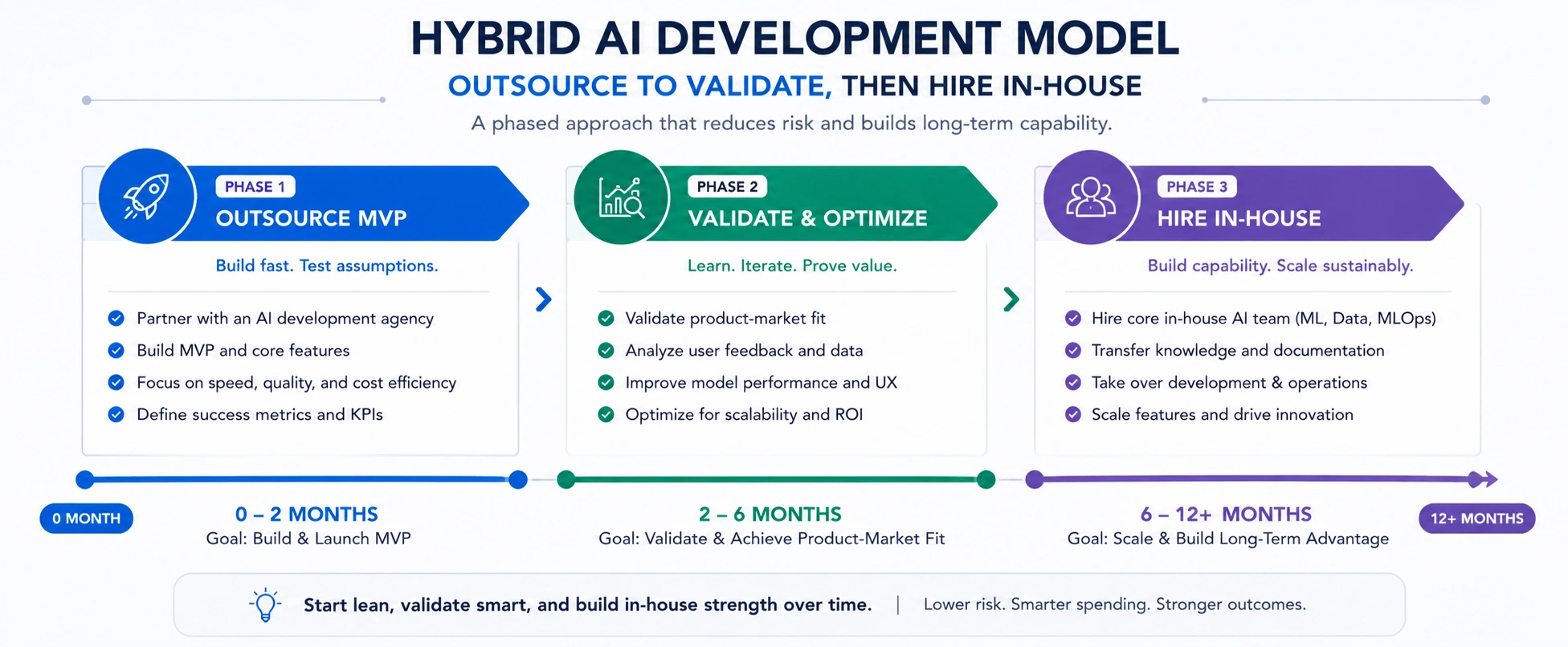
The Hybrid Model: The Best of Both Worlds
Most small businesses don't have to choose permanently. The hybrid path is actually the most common and most successful approach in 2026.
- Phase 1: Outsource your MVP to an offshore team (months 1–4)
- Phase 2: Validate it with real users, measure ROI (months 4–6)
- Phase 3: Hire 1–2 in-house AI engineers to own and iterate (month 6+)
Why this works better than going all-in either direction: you learn what you actually need before committing headcount. The outsourced team documents their work, hands off cleanly, and you hire someone who joins a working, documented system rather than starting from scratch. You can see how this phased approach looks in practice across our client projects — most of them started exactly this way. If your Phase 1 MVP involves chatbots, LLM integrations, or AI content automation, a focused generative AI development service can typically deliver a working prototype in 6–8 weeks.
Decision Framework: Outsourcing vs In-House Scorecard
Score your situation honestly on each of the six criteria below:
| Question | Points for Outsourcing | Points for In-House |
|---|---|---|
| Budget under $100K/year? | +3 | −2 |
| AI is your core product? | −2 | +3 |
| Need MVP in under 3 months? | +3 | −1 |
| Team under 20 employees? | +2 | −2 |
| Have a technical AI lead internally? | −1 | +2 |
| Sensitive proprietary data involved? | −2 | +3 |
- Score 9–12: Build in-house
- Score 4–8: Go hybrid — outsource the MVP, hire as you grow
- Score 0–3: Outsource, no debate needed
Most early-stage small businesses land between 2 and 5. The hybrid path is consistently underrated — and the most common outcome among businesses we work with at Shanti Infosoft.
AI Project Timelines: Outsourcing vs. In-House Hiring
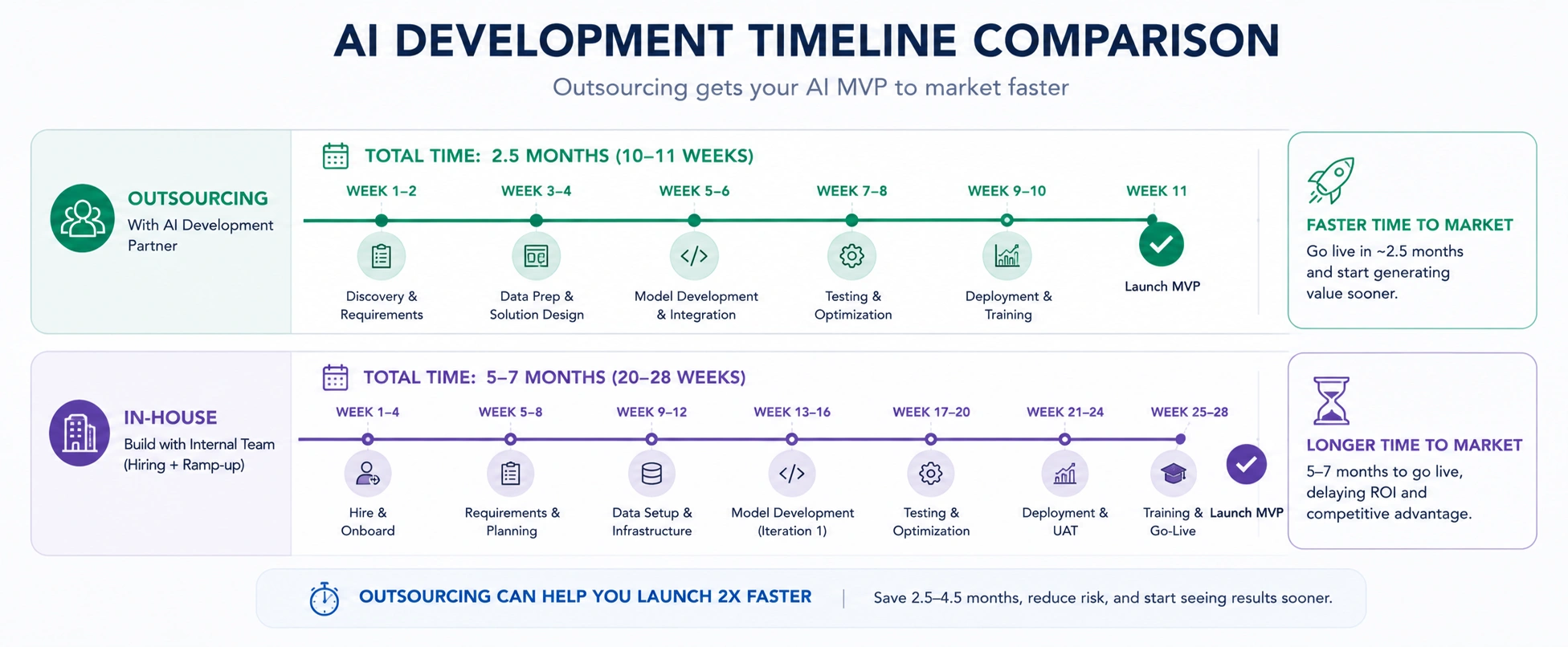
This is where most founders get surprised. In-house takes much longer than expected — and the gap is wider than most articles admit.
Outsourcing Timeline
- Vendor research and shortlisting: 1–2 weeks
- Discovery and scoping: 2 weeks
- MVP development: 6–10 weeks
- Total: 2.5 to 3.5 months
In-House Timeline
- Job posting, interviews, offers: 2–4 months
- Onboarding and ramp-up: 2–4 weeks
- MVP development: 8–12 weeks
- Total: 5 to 7 months minimum
If you're racing to show investors a working prototype or trying to ship ahead of a competitor, five months is not a timeline you can afford. Contact us and we can give you a scoped timeline estimate for your specific use case within 48 hours.
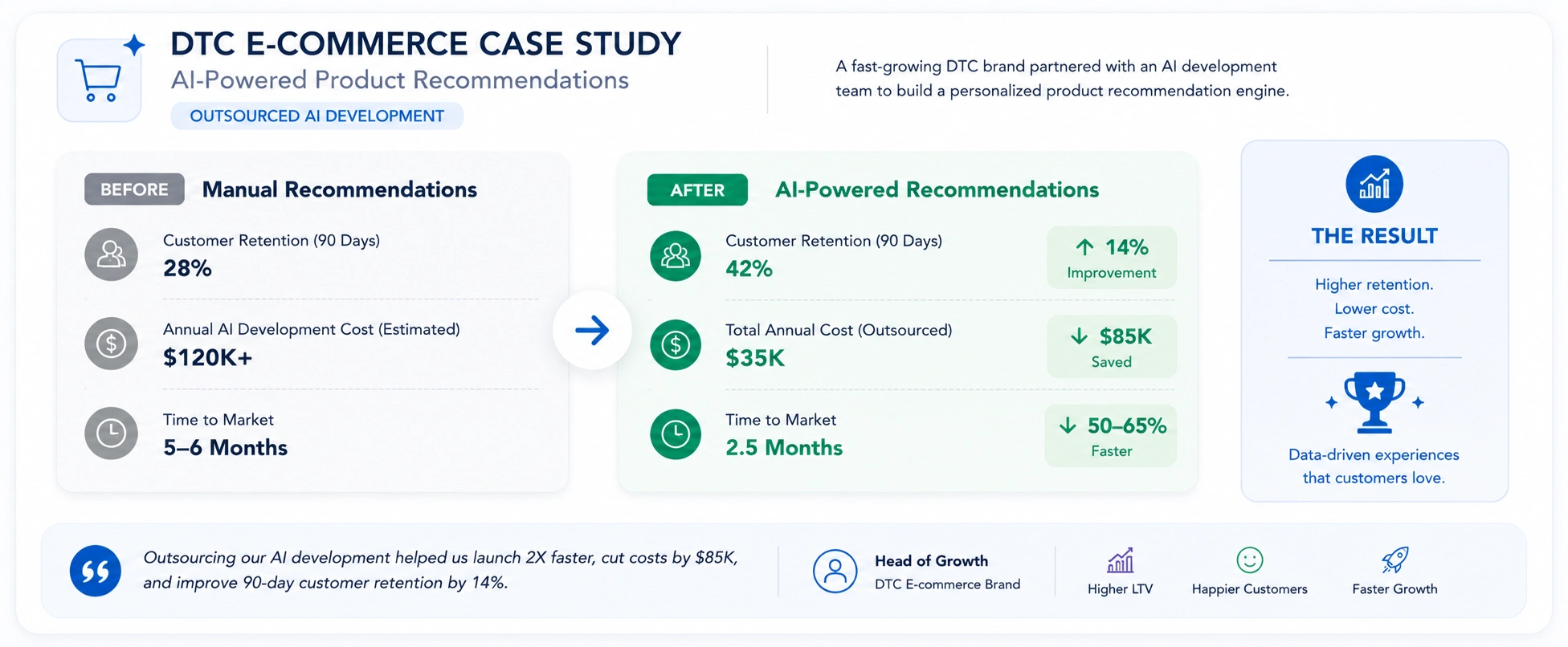
Case Study: How a DTC E-Commerce Brand Saved $85K by Outsourcing First
A 19-person direct-to-consumer e-commerce company selling customised home goods wanted to reduce customer churn by adding AI-powered product recommendations to their Shopify storefront. Their initial instinct was to hire a full-time ML engineer to build a custom recommendation model from scratch. Their CTO pushed back.
Instead, they outsourced a wrapper using pre-trained collaborative filtering models via API to our team in Indore. The brief looked clean on paper. Week two, it wasn't. Turns out their product catalogue had inconsistent tagging across SKUs — some items were categorised three different ways depending on which team member had uploaded them. The recommendation model was surfacing genuinely bizarre pairings as a result: outdoor furniture showing up next to kitchen accessories.
We spent most of week three rebuilding their taxonomy before touching the model again. Not what either side planned for. But it was the right call — and an in-house hire walking into that data mess with no prior context would have taken twice as long to diagnose the problem, let alone fix it.
By week nine we had a working integration live on a test segment. Retention improved 14% over three months of live data. Only after validating that did they hire one in-house AI engineer to own the feature long-term — someone who joined a working, documented system rather than starting from scratch.
3 Common Mistakes Small Businesses Make With AI Development
1. Hiring In-House Before Product-Market Fit
You don't know what you need yet. A $150K AI hire before your product direction is clear is one of the most expensive ways to learn a lesson. We've seen this pattern more times than we can count across early-stage engagements. The result is usually a talented engineer waiting months for a brief that keeps changing.
2. Outsourcing to the Cheapest Vendor
Rate-shopping for AI development is risky. The $12/hour team may deliver code that technically runs but breaks at scale or becomes impossible to maintain. Vet for experience and references, not price alone. Our AI development services are built on CMMI Level 5 process maturity — not the cheapest rate on the market.
3. Starting AI Development Without a Defined Use Case
"We need AI" is not a brief. What specific problem is it solving? What does success look like in 90 days? Without those answers, you'll waste your budget regardless of which model you choose — outsourced or in-house.
Frequently Asked Questions
Is AI outsourcing safe for small businesses?
Yes — with the right contracts. Look for vendors who provide NDAs, milestone-based payment structures (not full upfront), a clear IP assignment clause, and a Data Processing Agreement (DPA) if you're handling customer data. Ask for references from companies of a similar size. Most reputable offshore agencies in 2026 have worked with funded startups and can provide proof of prior engagements.
How much does AI development cost for a company under 50 employees?
Outsourcing offshore typically runs $3K–$8K per month. Building in-house costs $12K–$25K per month per engineer once you factor in salary, benefits, and infrastructure — and that's before LLM API usage, vector database hosting, and GPU compute multiply at production scale. Get a free cost estimate specific to your use case.
Should small businesses outsource AI in 2026?
For most under $2M in revenue, yes — at least as a first step. The majority validate their AI use case through outsourcing, then bring capabilities in-house once the product is proven and revenue supports the headcount. The hybrid model (outsource MVP → validate → hire) is the most common successful path we see.
How do I vet an AI outsourcing vendor properly?
Ask for three client references in your industry, a breakdown of their AI/ML team, sample documentation from a previous project, their data security and GDPR compliance policy, and how they handle IP transfer. Run a paid discovery sprint ($500–$2K) before committing to a full engagement. It's the fastest way to evaluate how they actually work versus how they pitch.
What contract terms should I expect when outsourcing AI development?
At minimum: an NDA, milestone-based payment schedule, IP assignment clause (all code and models become your property), source code escrow for long engagements, a Data Processing Agreement if customer data is involved, and clear termination terms. Avoid contracts that only grant you a license to the output — you want full ownership. Have a lawyer review before signing anything over $10K.
Get a Free AI Development Cost Estimate
We work specifically with small businesses under 50 employees. Realistic cost and timeline estimate within 48 hours — no pitch, no pressure, written summary included.